The Island Hopper Arrives November 30. It’s a Good Start.

Streets for People | Friends of Car-Free Key West & Duval Street/Historic Downtown | Chris Hamilton |November 12, 2026 | Substack | KONK Life | Short-version crossposted at The Keys Citizen
Key West Rides launched on November 30, 2022. Four years later, nearly to the day, it makes its last trip. It and the Workforce Express end Sunday, November 29, and on Monday, November 30 the new Island Hopper takes over. Better yet, the City Commission voted 7-0 on November 5 to make the first week free, through December 6.
I wasn’t shy about my concerns this summer. When the Hopper was first pitched at the July budget meeting, the bus would have come once an hour. By budget adoption in September, it was every 45 minutes. The schedule rolling out on the 30th? Every 40. That’s transit staff listening to riders, and they deserve credit for it.
Mayor Sam Kaufman, who sat in on the first public workshop on November 4, told me he’s excited about the more frequent service, calling it “an important first step toward the expanded, more reliable service we want for our community.”
That’s the point I want to drive home. The Island Hopper is a foundation, and a sturdier one than an on-demand service that could fill fewer than half the trips people asked for. You can’t build a transit system on a bus that might not come. Get the Hopper right, and more frequency, longer hours and wider coverage can be built on top of it. So let’s walk through how to ride it, what else is coming this year, and how it can become the backbone of a transit system that works for everybody.
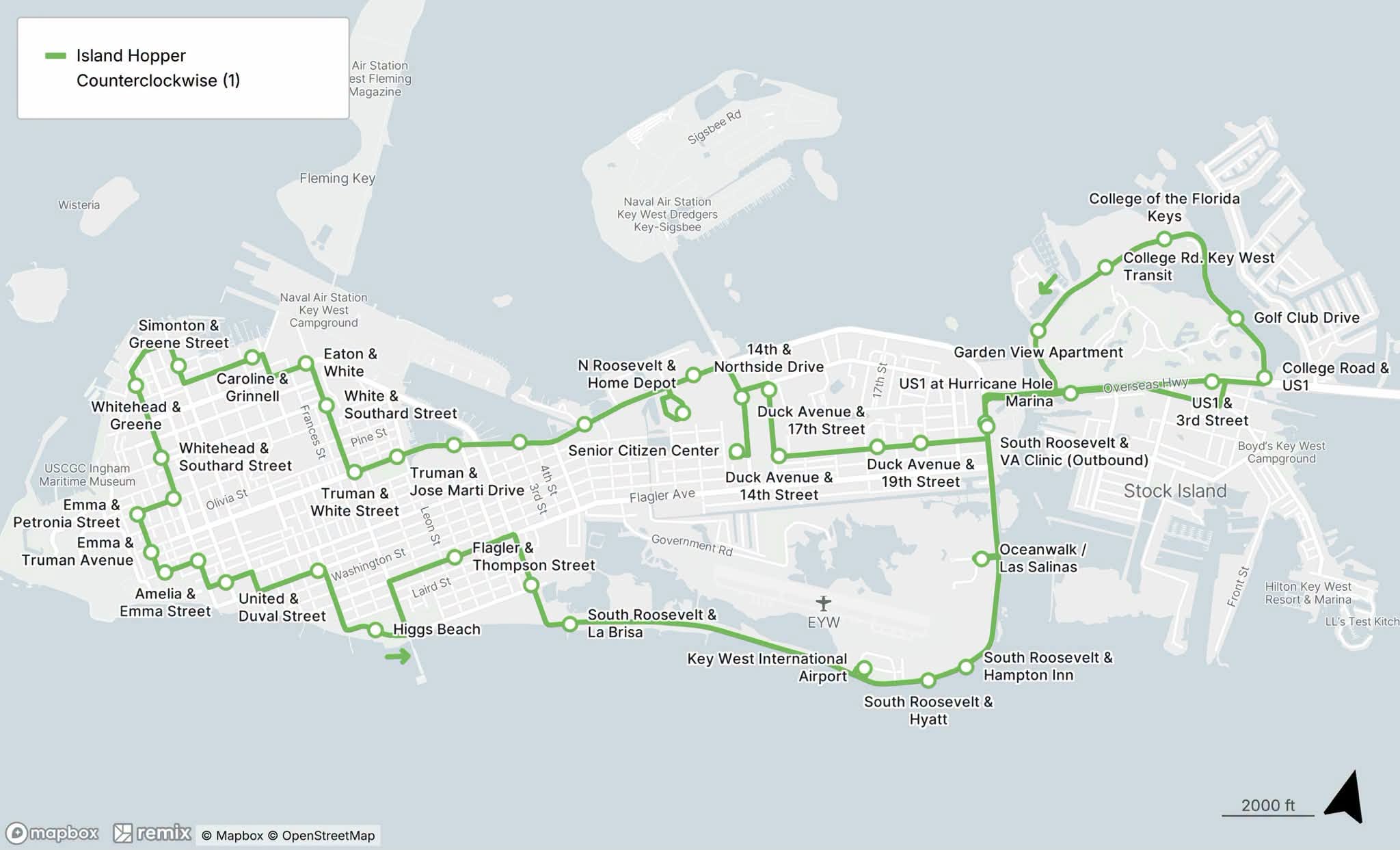
One Big Loop, Two Directions
The City says the Island Hopper will “provide reliable, consistent transportation throughout Key West and along the College Road corridor on Stock Island.” Here’s how it works.
Think of it as one big loop around the island, running in both directions. Every 40 minutes, seven days a week, two buses leave the Key West Transit facility on College Road together. One runs counterclockwise (Route 1), the other clockwise (Route 2). For the first 15 minutes or so they travel the same path. They stop at U.S. 1 and 3rd Street, circle past the hospital and college, then head through the Triangle to the Ocean Walk and Las Salinas apartments on South Roosevelt Boulevard.
That’s where they split. The counterclockwise bus doubles back up Duck Avenue, through one of New Town’s busiest worker neighborhoods, then follows North Roosevelt and White Street into the Historic Seaport and Old Town. From there it heads down to Higgs Beach and back past the airport. The clockwise bus does the reverse. It keeps going along South Roosevelt past the airport and the beaches into Old Town, then comes home via Truman, North Roosevelt and Duck.
Honestly, nobody in the room at the November 4 workshop, me included, caught the double-back at first. Staff agreed to add direction arrows to the final maps.
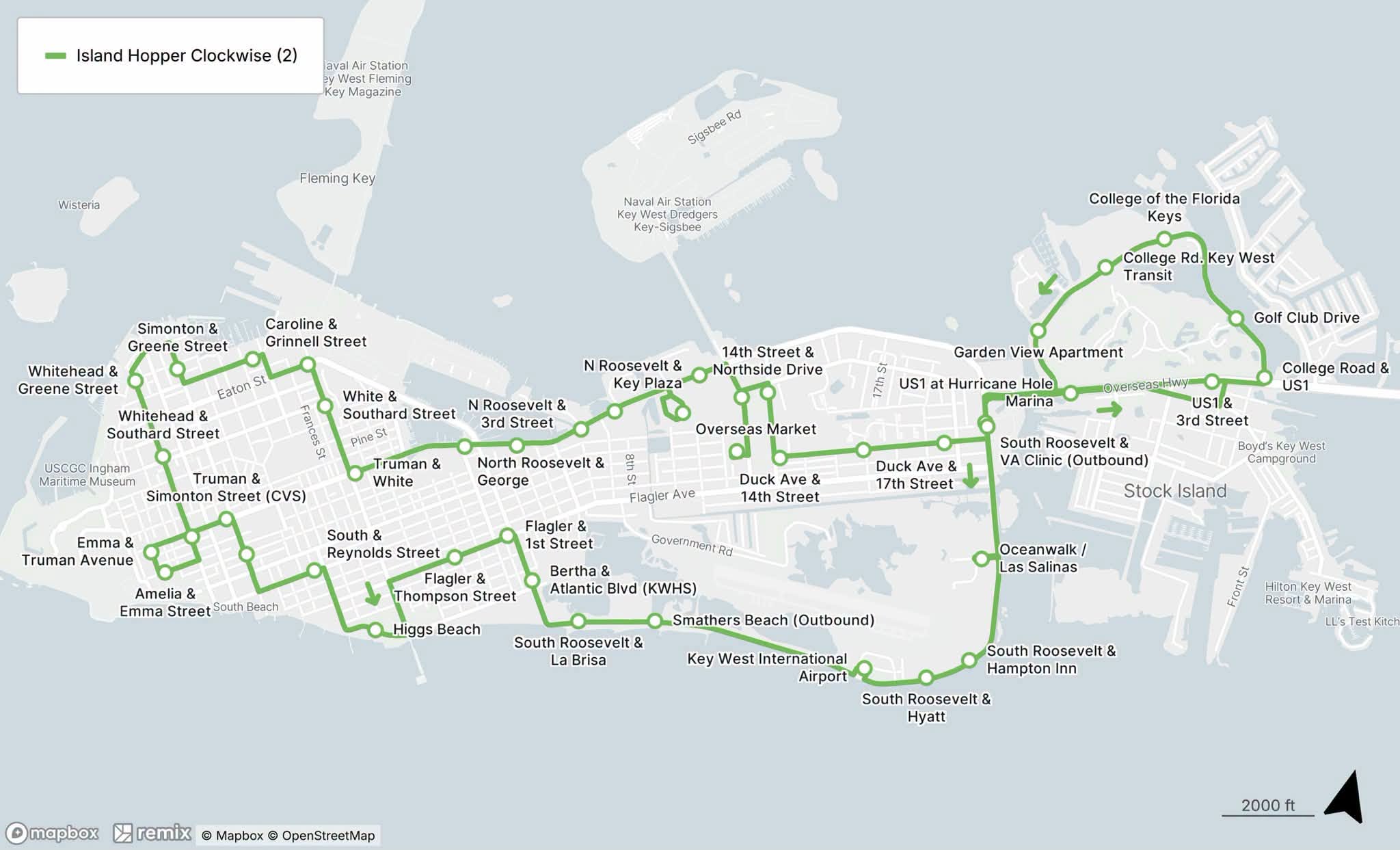
The trick is to pick the direction that gets you there faster. From the Senior Citizen Center, for example, the counterclockwise bus gets you to Truman and White in about 15 minutes. The clockwise bus would take you the long way around the island.
The first buses leave at 6 a.m., and the last trips wrap up at 7:38 p.m. If you’re downtown, the last buses come through around 7 p.m.: 6:58 at Eaton and White heading clockwise, 7:01 at United and Duval heading counterclockwise. Each full loop takes 98 minutes. The map shows 43 stops and the schedule lists 17 timepoints, with some additional unlabeled stops along the way.
Maps and schedules will be posted at every stop, each with a stop number and a QR code that pulls up real-time arrivals. You can also track your bus at kwtransit.com or on the Passio GO! app. Very handy. Google Transit should have the routes in time for launch, and you can always call 305-809-3910 for trip planning help.
Fares stay the same after the first week. Rides are $2 a trip, or $1 for students up to 21, military (active, retired and dependents) and riders with disabilities or disadvantages (proof of eligibility required). Seniors 60 and over who live in Key West ride free with ID; other seniors pay 50 cents. A one-day pass is $4, a 7-day pass is $8 ($5 reduced, $3.75 seniors), and a 31-day pass is $25 ($15 reduced and seniors). Pay with cash on board (drivers don’t make change) or through the Token Transit app. Tap-to-pay with a credit card or phone is expected this fiscal year, possibly as early as spring.
For riders whose disability keeps them from using the regular bus, Key West Transit has run ADA paratransit since June. It’s door-to-door, $4 a trip, and you book the day before.


Why the Change and What Else Is Coming
The short answer: Key West Rides couldn’t keep up. At the November 4 workshop, Director of Transportation Rogelio Hernandez said the on-demand service was getting about 10,000 trip requests a month and delivering about 4,500. That’s fewer than half, with most trips carrying just one to four passengers. He said they simply could never meet the demand.
Riders also told staff they wanted something simpler. Over the last two years, Mr. Hernandez said, they heard from plenty of people who found the app-based service hard to use. So staff dug into the on-demand data to see where riders were actually getting on and off, and drew the Island Hopper around it.
There are trade-offs. Some riders lose pickups near their front door, five to seven stops were dropped, and some will have a longer walk. Mr. Hernandez said he’d like to bring back some form of on-demand down the road, possibly with smaller vehicles that don’t require a commercial driver’s license. But for most riders, a bus that reliably shows up beats an app that too often says none is available.
One more thing worth applauding: every bus operator keeps their job, because the new schedule needs all of them. Several riders at the workshop went out of their way to praise the drivers, and Mayor Kaufman said he’s “pleased that we’re keeping our experienced bus drivers as we make this transition.”
Mr. Hernandez also ran through improvements in the works:
- Wrapped buses. Finally. South Florida Commuter Services, a free FDOT-sponsored program that helps communities promote transit, designed the Island Hopper logo and is now designing a wrap for the buses. I’ve been asking for branded buses for years, so this is good news. The Lower Keys Shuttle will get its own logo and wrap too.
- Next-stop screens. Displays on each bus show a “route ladder” of the next three stops, so you won’t miss yours. Audio announcements are coming.
- A bike-rack app that shows whether there’s room for your bike before the bus arrives, plus a new website. Both are expected this summer.
- A fare study. Key West Transit is working with USF’s Center for Urban Transportation Research on fares, which haven’t gone up in more than a decade, and options like an annual pass.
- Lower Keys Shuttle changes, which staff hope to roll out in January. (Here’s our take on what they should do.)

The Churn Should Stop Here
Longtime readers know I’ve been hard on the City for overhauling local bus service every few years. The Orange, Red, Blue and Green routes gave way to the North and South Lines in 2020. Those gave way to Key West Rides and the Workforce Express in 2022 and 2023. Now those give way to the Island Hopper.
Each change made some sense on its own. Key West Rides was a response to budget cuts and driver shortages coming out of the pandemic. On-demand looked like a way to cover more ground for the same dollar. Mr. Hernandez said last week that when it launched, staff thought it was the greatest thing since sliced bread, and plenty of riders came to love it.
But taken together, the churn has cost us. Riders can’t build their lives around a system that keeps disappearing. In FY19, the last full year before COVID, the old colored routes carried 186,937 trips. In the fiscal year that just ended, Key West Rides and the Workforce Express carried 89,047 trips, less than half.
Here’s the hopeful part. Look inside that number. The Workforce Express, the one fixed route in the mix, has grown every year since it launched, to 20,087 trips this past year. Meanwhile, Key West Rides couldn’t fill more than half the trips people asked for. The riders are out there. They just need a bus they can count on.
And the Island Hopper looks a lot like what the City’s own planning has called for. It closely resembles the North and South Connector routes in the March 2026 update to the 10-year transit plan. Back in July, Mr. Hernandez told the Commission, “What we don’t want to do is bring a service that we would then eliminate a year later.” He’s right. Let’s make the Island Hopper the one that sticks, and build on it.


A Foundation to Build On
Mr. Hernandez opened the November 4 workshop by calling 40-minute service “just the beginning.” Staff will study ridership over the first six months and hope to add trips and extend hours. He was candid: it isn’t everything staff want, but it’s what the current budget allows.
That six-month review lands around the end of May, just as the FY28 budget process gets going. The timing couldn’t be better. At September’s final budget hearing, Mayor Kaufman said he was tired of one-year fixes and told staff to solve dedicated transit funding for FY28. So the ridership data and the money conversation should arrive at the same table at the same time. I’d love to see interim updates from finance and transit staff along the way.

When that money comes, here’s how to build on the Hopper, drawn from the list we laid out in September:
- More frequency. Every 40 minutes beats every 60, but at 20 minutes you stop checking the schedule and just head to the stop. That’s what makes transit something you use without thinking, not something you plan your day around.
- A longer day. Key West is nearly a round-the-clock town. A rider at the workshop pointed out that plenty of people get off work at 9:30 or 10 p.m. A last bus out of downtown at 7 doesn’t get the line cook or the bartender home.
- Service to Stock Island’s south side. About 5,000 people live there, many of them the workers who keep our hotels and restaurants running. The City’s own announcement names a single stop at U.S. 1 and 3rd Street. That’s the edge of the neighborhood, not service to it. The good news is that everyone seems to agree something should happen. Mr. Hernandez said the City is looking at partnering with the County. In September, County Commissioner Craig Cates called transit there ‘our responsibility,’ and Commissioner Jim Scholl told me the County wasn’t done. City staff have said the County may revisit this in December. If you live on the south side, the November 19 workshop at Bernstein Park is in your backyard. Go.
- A better Lower Keys Shuttle. With half our workforce living beyond the bridge, buses every 90 to 120 minutes and a last trip around 7:50 p.m. aren’t enough. Hourly service and later trips should be the goal. Staff hope to make changes in January, which is a start, but the County, which passed on $180,000 for seven more peak-hour trips in September, needs to step up.
- A free, frequent Duval Loop. It keeps the golden goose of our downtown laying. Finance Director Christina Bervaldi has asked the County Attorney for a written opinion on whether tourist development tax dollars can fund it, and the City Manager floated cruise ship disembarkation fees during last year’s budget. If tourist dollars cover the Loop, every new local dollar can go to the Island Hopper.

Hop On
None of this happens unless the Island Hopper succeeds, and that’s on all of us. Ride it. The first week, November 30 through December 6, is free, so there’s no excuse not to try it. Download the Passio GO! app before then. Come to the November 19 workshop at Bernstein Park, 6751 5th Street on Stock Island, from 5 to 6:30 p.m. And over the next six months, tell Key West Transit what’s working and what isn’t by calling 305-809-3910.
Mayor Kaufman, for one, is ready. “I expect to be riding the bus myself starting November 30th!” he told me. “I look forward to hearing from riders as we continue working to make public transportation better for everyone in Key West.”
See you on the bus.
# # #

Chris Hamilton is the founder of Friends of Car-Free Key West & Duval Street/Historic Downtown, a local advocacy group championing sustainable mobility and vibrant public spaces. Subscribe to the blog and follow on Facebook, Twitter, and Substack for updates. All stories are cross posted at KONK Life News. Originally from Washington, D.C., Chris spent over two decades leading nationally acclaimed initiatives in transit, biking, walking, and smart growth for Arlington County, VA’s DOT. Since moving to Key West in 2015, he has embraced a car-free lifestyle downtown, dedicating his time to non-profits and community projects. Explore all Streets for People column.