Another Year, No New Transit Money. But the Captain Called for a Turn.

Both budgets passed with no new transit money — the predictable result of treating buses as charity for the few instead of infrastructure for everyone.
Streets for People | Friends of Car-Free Key West & Duval Street/Historic Downtown | Chris Hamilton |September 17, 2026 | Substack | Short-version crossposted at The Keys Citizen
No new transit money is coming to the Keys in Fiscal Year 2027. Last week both the City and County met to finalize their FY27 budgets, and neither could muster the resolve to improve the lives of thousands of workers, residents and tourists. It’s like déjà vu all over again as during last year’s budget proceedings the County discontinued the Conch Connect and dismantled its fledgling transit department while the City “suspended” the Duval Loop. And this coming year we’re in for further reductions.
Without new money, the City plans to replace the local Key West Rides on-demand and the Workforce Express with an every 45-minute fixed-route Island Hopper that does a giant loop around Key West and the City side of Stock Island. It means that the unincorporated south side of Stock Island won’t have any service whatsoever. And no return of the Loop either.
During the meetings we witnessed a contradiction over whether tourist taxes can help fund transit. County staff cited a legal opinion that tourist taxes can fund tourist-serving transit; City staff said no — that it couldn’t be done even for the Duval Loop. We’ll get into this further.
After last year’s budget fiasco, the City promised to look for dedicated local funding – TDC money, cruise fees, parking revenue – and the budget delivered none of it. Budget churn has been going on for the better part of a decade. Reporting this last year, we felt a spark of hope when City management floated those new funding ideas — like maybe, finally, we were turning that cruise ship around.
Given another year without new money, we’re not so sure that cruise ship is turning. But there’s a new captain of the ship, in the person of Mayor Sam Kaufman, and he’s ordered an end to this annual kabuki theater of staff saying they can’t find money, making cuts and promising to do better next year. He laid down a marker for staff to finally fix it in FY28.
Walk with me to see what this means for public transportation in FY27 — why our leaders keep treating real transit as an ‘extra’ when it’s basic infrastructure, whether tourist taxes could finally help pay for it, and whether that cruise ship is turning or stuck in the water.
No New Money for Transit In FY27 – What That Means
At the County budget hearing on the 9th, Commissioners were presented with an option to add seven peak period buses (4 inbound in the morning and 3 outbound in the evening) between Big Pine and downtown Key West on the Lower Keys Shuttle which has 10 trips a day in each direction between Marathon and Key West. The cost $180,000 additional dollars to the $331,000 contribution to the service the County already makes.

Commissioners also were presented with the news the City’s new Island Hopper wouldn’t serve unincorporated Stock Island but would route the bus through the south side neighborhoods for $300,000. County Administrator, Christine Hurley, presented a map showing two options. Without a county contribution the only bus stop serving the south side of the island would be at U.S. 1 and 3rd Street. “The green dot” on the map. If they funded participation in the Hopper, the route would loop through the south side via Cross Street, 5th Avenue, 4tth Avenue and Maloney Avenue to 3rd Street and back onto U.S.1. After sharing this Ms. Hurley said:
“I feel there may be a consensus that if Key West makes this change, we keep an eye on it and see what that does to the service, or if it overloads for example, only at one bus stop, but I don’t, I don’t know that any of us right now can predict what will happen with that change.”

Look at the map. Do you think people in the neighborhoods on the south side are going to “overload” the bus stop at U.S 1 and 3rd Street? Not likely. It’s too far away. But this “green dot” gave the commissioners an out to say they’ll monitor the situation and thus didn’t have to vote to cut something else to pay for it. And according to the Citizen, City staff at the following night’s City hearing said the County may revisit Stock Island funding in December.
So, over at the City, as reported in the Citizen, at the regular September 3 City Commission meeting the City Manager said regarding transportation: “Our team is also preparing information regarding service frequency, operating costs, evening service, and other options requested by the Commission.”

To their credit, staff did improve the Hopper since July. What was originally pitched as hourly service is now every 45 minutes, and the span runs to 8 p.m. rather than ending in the early evening. Bervaldi called it “an improvement,” and she’s right — it is, although we’d have liked to have seen service to midnight. But it came within the same budget, and it still leaves the two things that matter most unresolved: the residential south side of Stock Island, where riders would have to walk out to U.S. 1, and the Duval Loop, still parked.
Other than TDC monies, which we’ll get into in a second, staff didn’t mention cruise ship disembarkation fees, new parking fees or any other new potential sources of revenue.
If not for the Mayor asking questions, it seemed staff was ready to simply move on. And we’ll get back to some of the Mayor’s questions below. But the bottom line was no new money for transit was approved.
What that means is that for the second year running, public transit in Key West goes backward — fewer services and a whole neighborhood left with no bus at all.

The Use of TDC Money Contradiction
During her presentation about the Lower Keys Shuttle and potential participation in Key West’s local Stock Island service, County Administrator Christine Hurley noted in regard to funding:
“Further, there’s been discussions about whether or not TDC funds can pay for transit and fortunately, Christine Limbert (Sr. Assistant County Attorney) was very responsive, in Bob’s office (Bob Shillinger County Attorney), to provide us information that indicate, including an attorney general opinion, that you cannot use TDC fund for general transit. You can study whether that transit would provide services directly to tourists and in that instance, you may be able to use TDC funding, but for this route (Stock Island workforce transit), we do understand that the workforce lives on Stock Island and goes into Key West, but that is not the type of service we could use TDC funds for.”
This is something that we and others have been saying for some time now. That TDC funds can be used for tourist-serving transit – it just needs to be looked into. And the Monroe County Attorney’s Office seems to have finally opened that door for further exploring. In an article (Could Tourist Dollars Be the Answer to Our Transit Funding Problem, August 31, 2025) we looked into the Florida Statute and Florida Attorney General opinion in depth and here’s the key part from that Florida Attorney General’s opinion:
“Nothing in section 125.0104(5), Florida Statutes, suggests that the tourist development tax is a broad funding source. Rather, the tax revenues are a targeted funding source to directly and primarily promote tourism.”[5] Thus, such revenues cannot be used to fund a public transit system for the citizens of Walton County that would incidentally benefit tourists. Instead, to warrant use of tourist development tax revenues for transportation services under subsection (5)(a)3., there must be a clear and direct relationship between the promotion of tourism and the particular transportation service being offered.[6] Such transportation services should involve routes and schedules addressing the specific needs of tourists, and might include, for example, a shuttle connecting hotels and motels with county tourist attractions.”
So, while a worker route from Stock Island to Key West wouldn’t be eligible for TDC funds, wouldn’t it stand to reason that something like the Duval Loop could be eligible? And if you think about it, since the Lower Keys Shuttle simply follows our one road from Marathon to downtown and therefore every hotel, resort and destination is along that route too, might it also be considered “tourist serving”? Especially if you branded and marketed it as such like the Loop is?


At the City Commission’s first meeting of the year in January, Commissioner Monica Haskell asked the question “Do we support seeking tourist tax funds to fund tourist-serving transit like the Duval Loop?” Nearly all the Commissioners said some form of yes, and the City Manager said he was on the case. Kara Franker, President & CEO of the TDC said in a letter to the Commission at the time she “wasn’t opposed in principle,” that it needed to be “justified within this legal framework” and thought the idea deserved further study.
Fast forward to the City’s budget hearing last week. In response to a question from Mayor Sam Kaufman about the availability of TDC funds for the Duval Loop Christina Bervaldi, Senior Director of Finance answered:
“In regard to funding available from the TDC for the Duval Loop we’ve been given opinion that it would not be available to run the Loop unless there’s legislation change or request from them directly, I’m not really sure how that would be accomplished and it is not something they are willing to fund.”
The Mayor asked: “Do we have a written opinion about that or that came directly from?”
At this point City Manager Brian Barroso spoke up:
“This question continues to surface, and I’d imagine it’s because we’re getting a lot of traffic from outside individuals telling us how fix this problem. It’s been vetted and we’ve received information directly that we are unable to do TDC funding for the Loop. This is where this concept of one loop came from. So, to continue to ask these questions, perpetuates the narrative. We need to be able to pause that. There’s no additional funding from TDC regarding that.”
And then he began discussing the Island Hopper’s not serving the unincorporated side of Stock Island.
So, the County seems to indicate there’s a path for exploring the idea. The City seems to be saying they went down that path and hit a dead end. We’d like to see the math and we’re not sure why the Manager appears frustrated with people continuing to ask these questions, until he shows that math. We’d note there was no mention of cruise ship fees in connection with the Loop either.
The Mayor asked to see the math too when he asked to see directly where that answer came from and “see the written opinion.” We hope to chase that down and the County’s analysis too.
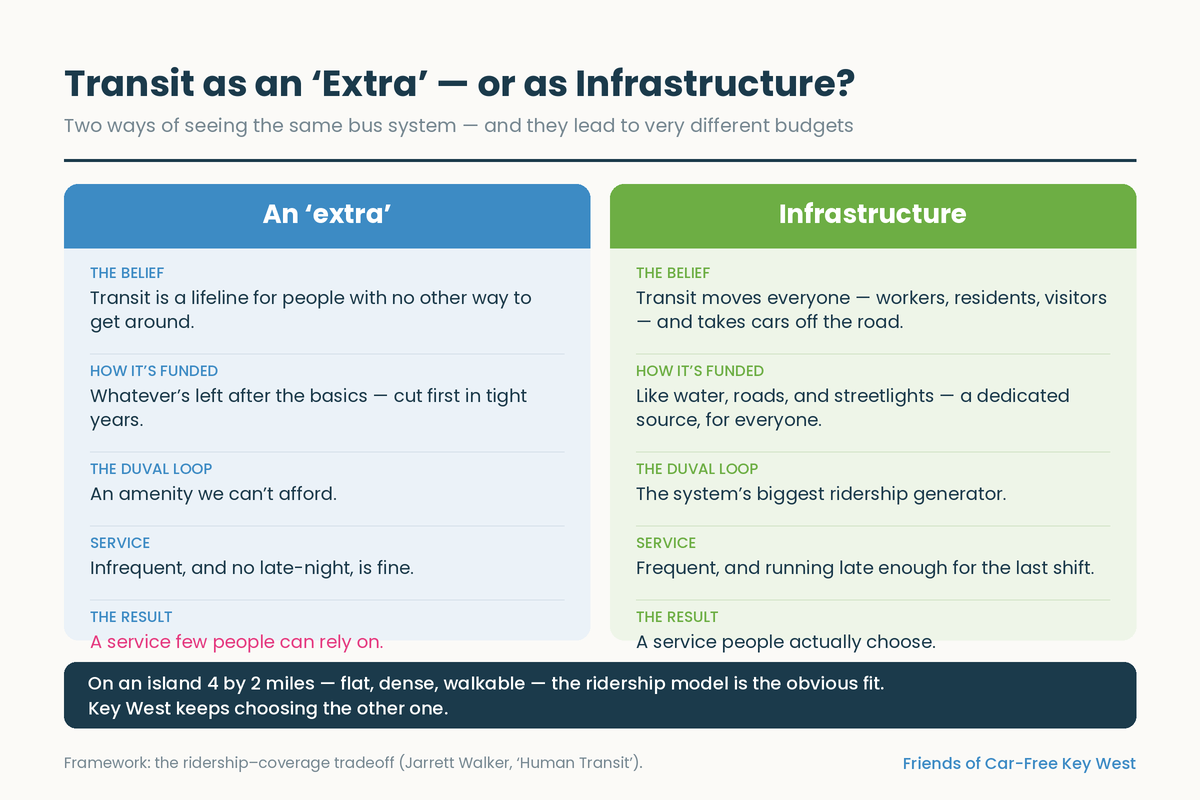
Direct, Fast and Frequent Transit Isn’t An “Extra” – The Ridership – Coverage Tradeoff
At the end of their discussion on transit funding Mayor Kaufman said we need to begin thinking about dedicated sources and increases to the transit budget because otherwise it seems like every year, we have the same problem.
In response Ms. Bervaldi noted that: “We do have 50% funding (we think referencing state and federal funds). We’ve identified that and that’s something we’re going to have every year. It’s just for all of the…Duval Loop or extra services or the services that are outside of what are the core services, those are the ones that we do not necessarily have dedicated funding for.”
And that there’s the crux of the problem – the thought that anything beyond the little bit of service provided now is “extra.” There’s a name for this way of thinking about transit, and planners call it the coverage model – the idea that the bus system exists to be a lifeline for people with no other way to get around, and that anything beyond that basic safety net is an “extra.”
The other is the ridership model. The idea being that service isn’t a charity, it’s infrastructure. And as such you serve the densest and most compact attractors where the largest number of people can easily walk to and from the bus with a direct, fast and frequent route.
We should be able to do both. I mean, Key West and Stock Island, from Wreckers Cay to 0 Duval Street is just over 5 miles long. It’s flat, compact and dense. It isn’t wide either.
Treating the Duval Loop as an extra, when it initially served 300,000+ riders annually is wrong.
Treating frequent 30-minute or better service instead of the Island Hopper’s every 45-minutes as an extra is wrong.
Treating service that runs past the dinner rush — in a town where bars close at 4 a.m. — as an extra is wrong.
Treating service to unincorporated Stock Island, when half the City’s workers live beyond the bridge, as an extra is wrong too.
It gets the whole thing exactly backwards. Transit isn’t a nice to have, it’s basic infrastructure.
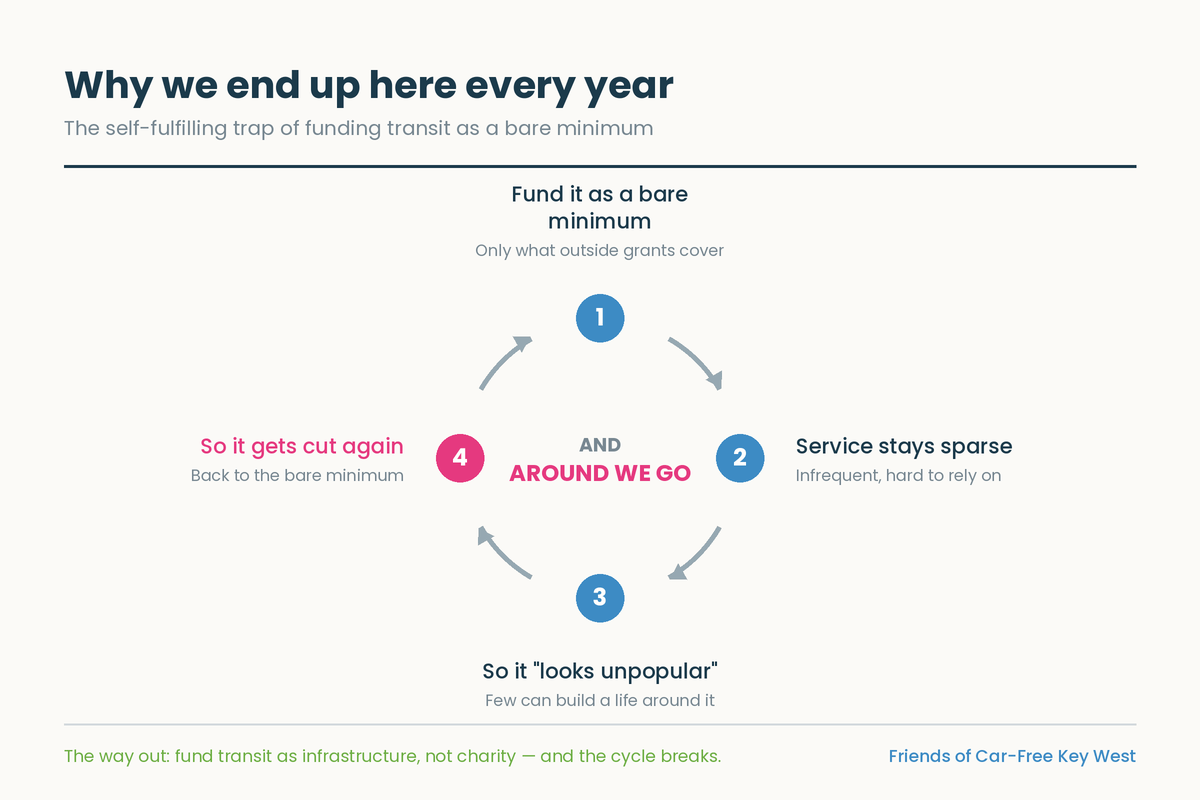
And this thinking is a self-fulfilling trap. The reason we’re back here year after year is that when you fund transit as a bare-minimum safety net, it stays bare-minimum — infrequent, inconvenient, easy to write off as something few people use. So, it looks unpopular. So, it gets cut to the minimum again. And around we go.
No finance director stands up at a budget hearing and says we only have money to run water to the people who truly depend on it, or to keep the streetlights on in the neighborhoods that can’t do without them. We treat water, roads, and power as things everyone benefits from — so we fund them for everyone. On an island this small and this dense, transit is the same kind of thing. It moves workers to jobs, tourists to Duval, cars off our streets, and money into local businesses.
Treat it as charity and you’ll always be back here next year, making cuts. Treat it as infrastructure and you find a way to fund it. That’s the choice in front of the City and County — and it’s why we need a new, dedicated local source of money.

Is That Cruise Ship Stuck in the Water Or Turning?
At the County budget hearing, here’s what Commissioner Craig Cates, who represents Stock Island, said:
“I think we should definitely monitor this closely and be prepared to maybe help in the future because those are constituents, a lot of them work in Key West, and Key West should, I believe help, but it’s also I believe our responsibility to have public transportation in that area for our residents. So that’s the way I would like to see us move forward. Not close the door but monitor it and see possibly get more involved.”
In talking to Commissioner Jim Scholl after the hearing, he told me not to be disappointed. He reminded me the Commission didn’t say no and that we weren’t done. He promised to keep working on this.
So, despite no new money, that’s some kind of movement, right?
At the City, our new Mayor Sam Kaufman said he was tired of one-year fixes and the churn of seeing the same problem every year for three or four years. He also said we need to start thinking about raising parking rates and “…dedicating increases to transit in order to have consistency for our system because we don’t have a dedicated fund for transit.” He was adamant that staff solve this for Fiscal Year 2028.
Given these leaders’ stances and that the County thinks there’s a path forward for using TDC funds for tourist-serving transit, is the cruise ship turning? Certainly, the captain, in the form of Mayor Kaufman, has called for the turn. The ship’s helmsmen, in the form of City staff, haven’t yet turned the wheel. And in FY28 we’ll all be able to see if they heeded that call.
# # #
Chris Hamilton is the founder of Friends of Car-Free Key West & Duval Street/Historic Downtown, a local advocacy group championing sustainable mobility and vibrant public spaces. Subscribe to the blog and follow on Facebook, Twitter, and Substack for updates. All stories are cross posted at KONK Life News. Originally from Washington, D.C., Chris spent over two decades leading nationally acclaimed initiatives in transit, biking, walking, and smart growth for Arlington County, VA’s DOT. Since moving to Key West in 2015, he has embraced a car-free lifestyle downtown, dedicating his time to non-profits and community projects. Explore all Streets for People column.