Even If You’ll Never Ride the Bus, You’ll Feel It When It’s Gone

Why Transit Cuts Hurt Everyone in the Keys—And Why We Need to Speak Up Before the September Budget Hearings
🚗 It’s Not About Buses. It’s About Our Daily Lives.
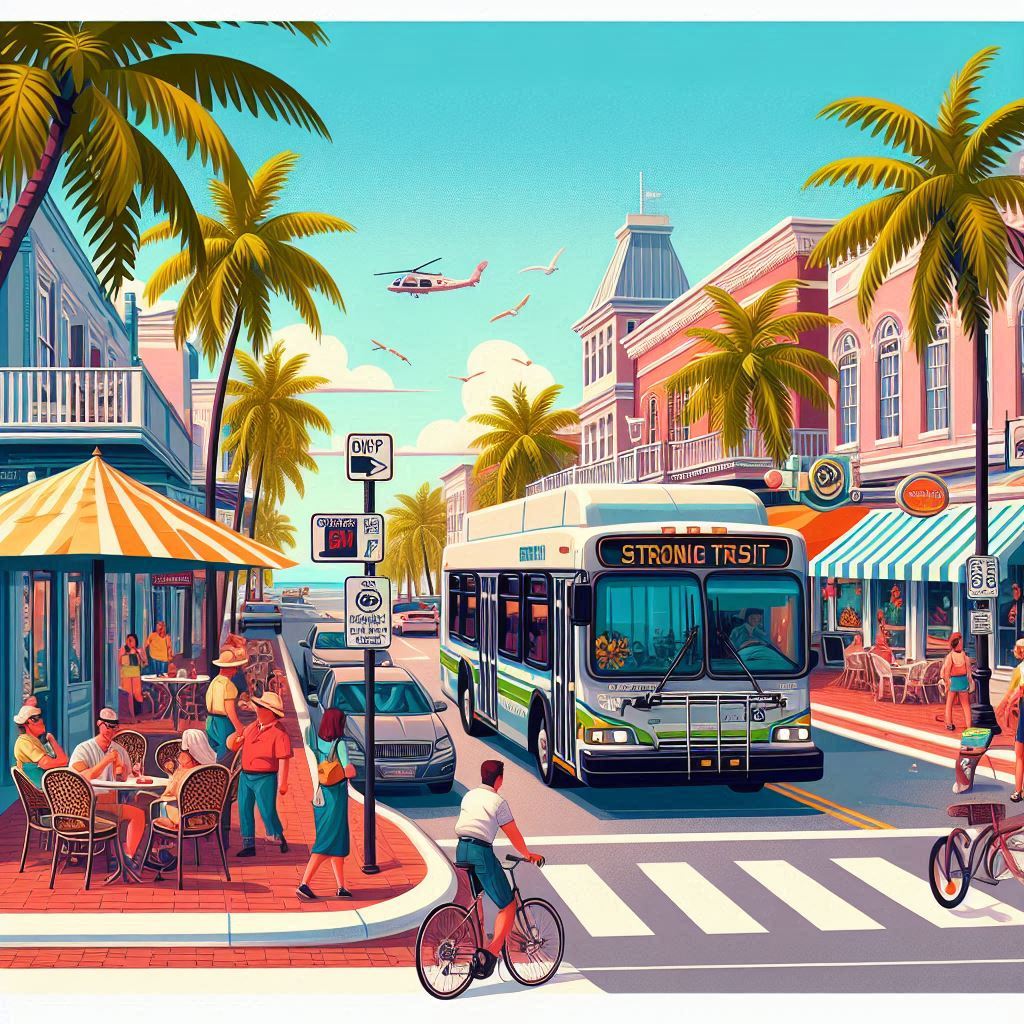
August 24, 2025. The photo above shows what’s at stake. You may never have ridden the Conch Connect. Now already gone. You might never hop on the Duval Loop, Workforce Express, Key West Rides or Lower Keys Shuttle. But if some of these too disappear, as is proposed in next year’s as yet to be finalized budgets, we’ll all feel it:
- More congestion. Every rider forced into a car adds to the gridlock.
- Fewer parking spots. Transit riders free up space—cut the service, and good luck downtown or in villages up and down the Keys.
- Slower service. From restaurants to retail, workers can’t get to jobs reliably.
- Tourist overload. Without transit, visitors drive everywhere—and clog everything.
Public transit isn’t a handout—it’s a public service. Just like roads, schools, and clean water. Our story below discusses how we all benefit when it works—even if we don’t ride. How it’s about equity: making island life accessible to all. How it’s about freedom: having real choices in how we get around. And how it’s about infrastructure—and when it works, we all move better. Even drivers feel the difference.
🏳️🌈 This Is About Equity, Too

We showed up for rainbow crosswalks. We protested ICE raids. We spoke up about water quality. Now let’s show up for the roads that lead to those crosswalks—and the transit systems that make our islands accessible to all.
Transit is a justice issue. When it fails, the most vulnerable suffer first. And equity isn’t just about race or income—it’s about access.
In the Keys, where car ownership is expensive and housing is scarce, transit is what allows people to move freely, reach jobs, and participate in community life. That’s equity, too.
And while equity is sometimes viewed with suspicion in today’s political climate, the ability to move freely—regardless of car ownership—is a core equity issue. Transit ensures that everyone, regardless of income or circumstance, can take part fully in island life.
🧭 Freedom Means Having Options

A car shouldn’t be a requirement for participation in life.
Transit gives people freedom of choice:
- Freedom to live farther out and still reach jobs.
- Freedom to move freely without a car. Teens, seniors, and low-income residents gain independence.
- Financial freedom by going car-lite. Families can save money if every adult doesn’t need to own a car to get around. The high cost of owning and operating a car ($12,292 a year) on top of our sky high rents makes this imperative.
- Freedom to choose how to participate. Transit lets people engage in island life on their own terms. And that includes visitors, who research tells us, if they drive a car here, they tend to use it if there aren’t options. Do we really want everyone arriving by plane renting a car? That’s not freedom.
When we cut or don’t provide adequate transit, we cut off opportunity.
Freedom means having options—not just for those who can afford a car, but for everyone.
🌎 Why Transit Infrastructure Helps Even Car Owners
Even if we rarely use public transit, it benefits us every day. And the benefits start personal:
- Faster commutes. If more people—whether fellow workers, residents, or visitors—use transit, we spend less time in traffic.
- Easier parking. Fewer cars on the road means more open spaces in our downtowns and in neighborhoods.
- Backup transportation: Everyone may need public transit occasionally, whether their car is in the shop, during severe weather conditions, or to reach specific events like concerts or sporting events where parking is limited or expensive.
- Less stress. Less congestion and more predictability make driving less frustrating.

Then come the broader benefits:
- More efficient road use. Buses move more people using less space, reducing the strain on infrastructure. This would be especially true on our overburdened Overseas Highway.
- Economic development. Transit connects workers to jobs, expands customer bases, and boosts local economies. Research shows customers who use the Duval Loop go to shops, restaurants and attractions they might otherwise have ignored. Villages up the Keys could enjoy the same.
- Environmental benefits. Fewer cars mean fewer emissions, cleaner air, and less fuel consumption.
- Improved safety and health. Public transit is statistically safer than driving and encourages walking and biking, which promote healthier lifestyles. Transit-rich communities tend to support healthier lifestyles simply by making walking, biking, and social interaction easier.
- Higher property values. Homes in areas with strong transit access tend to be valued more—not just for price, but for livability. High Walk/Bike/Transit scores attract residents who prioritize convenience, sustainability, and community.
- Smarter land use. Transit doesn’t just move people—it reshapes places. It allows us to build new multi-family workforce housing in the Keys without exacerbating traffic problems, making driving easier for those that need to.
But all of these benefits vanish when service disappears. And right now, that’s exactly what’s on the table.

🚌 Proposed Cuts Threaten Transit Across the Keys
The County has already axed the Conch Connect and is proposing to get rid of its transit department and transit director Richard Clark. And likely any of the excellent vision Mr. Clark had for better transit up and down the Keys.
The City is proposing to eliminate the Duval Loop and Key West Rides. It is also proposing to cut back on the non-City Stock Island portion of the Workforce Express. And plans for improvements as embodied in their recently adopted 10-Year Plan would be shelved too.
The threat is real. The cuts are coming. But most of this is not a done deal, yet.
📣 What We Can Do
If we believe in equity, freedom, and smarter infrastructure—then we need to act. Because right now, those values are under threat. Budget hearings are coming:
- Monroe County: Sept 3 (Key West) & Sept 10 (Key Largo) at 5:05 PM
- City of Key West: Sept 11 and Sept 25 at 5:01 PM, 1300 White Street
If we stay silent, the cuts go through. If we speak up perhaps, we can save some or all of the existing service and set the stage for future improvements.
Here’s how to speak up:
- Email your commissioners:
- Craig Cates (District 1): boccdis1@monroecounty-fl.gov
- Michelle Lincoln (District 2): boccdis2@monroecounty-fl.gov
- Jim Scholl (District 3): boccdis3@monroecounty-fl.gov
- David Rice (District 4): boccdis4@monroecounty-fl.gov
- Holly Merrill Raschein (District 5): boccdis5@monroecounty-fl.gov
- Full Monroe County Commissioner Directory
- Key West Commissioner Directory
- Mayor Danise “DeeDee” Henriquez: mayor@cityofkeywest-fl.gov
- Monica Haskell (District 1): DistrictI@cityofkeywest-fl.gov
- Samuel Kaufman (District II): DistrictII@cityofkeywest-fl.gov
- Donald “Donnie” Lee (District III): DistrictIII@cityofkeywest-fl.gov
- Lissette Carey (District IV): DistrictIV@cityofkeywest-fl.gov
- Mary Lou Hoover (District V): DistrictV@cityofkeywest-fl.gov
- Aaron Castillo (District VI): DistrictVI@cityofkeywest-fl.gov
- City of Key West only. Submit an eComment: Visit the City legislative website here, look for the date of the meeting and at the far right you’ll see a button for eComment.
- Show up and testify: Bring your voice, your story, your stake in this community.
- Review the budget proposals and attend the meetings:
- Monroe County Budget information here. September 3 Budget Hearing here. September 10 Final Budget Hearing here.
- City of Key West Budget information here (note FY26 proposed budget info not found here yet) September 11 Budget Hearing here and final September 25 Budget hearing here.
It takes just a few minutes to contact our leaders. You’ll feel better for doing so.
We’ve lost enough already. More is on the chopping block—and with it, the freedom to move without a car. Let’s not lose the ability to move freely, to choose how we live, and to ensure everyone has a place in this community. This is our moment to speak up, to stand together, and to protect the future of transit in the Keys, even if you’ll never use it.
# # #

Chris Hamilton is the founder of Friends of Car-Free Key West & Duval Street/Historic Downtown, a local advocacy group championing sustainable mobility and vibrant public spaces. Subscribe to the blog and follow on Facebook, Twitter, and Substack for updates. All stories are cross posted at KONK Life News. Originally from Washington, D.C., Chris spent over two decades leading nationally acclaimed initiatives in transit, biking, walking, and smart growth for Arlington County, VA’s DOT. Since moving to Key West in 2015, he has embraced a car-free lifestyle downtown, dedicating his time to non-profits and community projects. Explore all Streets for People column articles here.