Streets for People / What’s Old is New Again – Two New Bike Trails Take Us Back in Time to a Simpler Key West
Posted on April 30, 2021 Leave a Comment

By Chris Hamilton. (Featured picture by Britt Myers, Keys Weekly); This story was written for and published by KONK Life on April 30, 2021 and is reprinted here with permission.
Do you know where the Cubana Plane, once used by Cuban defectors in an attempt to reach the U.S., is? It’s parked along Government Road behind the airport and next to Little Hamaca Park and the Salt Ponds. Still confused? That’s because few people use Government Road these days. But that could change if the road gets incorporated into two new proposed bike trails, that it turns out, aren’t really that new of a concept.
New Trails Start with Planning
Here’s something novel for Key West. Someone on City staff is actually trying to follow and implement an adopted plan. Maybe we’re being unfair to City Hall. Letting community driven plans, written by big-name consultants, sit on shelves and grow old and musty, happens in a lot of places. So, color us impressed that the City’s wonky multi-modal transportation coordinator is trying to both get some quick wins on the ground so people see progress AND begin planning today for some longer-term projects that will take more time to bear fruit.
We’re speaking of course about the Engineering Department’s Multi-Modal Transportation Coordinator Timothy Staub’s charging ahead with implementing the City’s, Key West Bicycle and Pedestrian Master Plan, adopted in February, 2019. A couple months ago, we brought you the feel-good story of Mr. Staub and a band of volunteers constructing the first phase of the Crosstown Greenway (Volunteers and a Little Green Paint Show How We Can Make it Safer to Bike, January 29, 2021). The Greenway, an element of the Bike Plan, was a nice little victory to show people some quick, easy and inexpensive ways to put paint on the street and make it safer for cars and bikes.
Tim recently released to the Sustainability Advisory Board and City Commission a straightforward, easy-to-read Transportation Report 2021 that outlines what he and others on City staff are prioritizing to do regarding transportation in the next 12 months. There’s a dozen plus planning, construction and service projects mentioned covering bike, walk and transit from the respective Bike/Ped and Transit Plans. Over the next couple months, we’ll revisit this subject and hope to highlight some of the exciting projects. Two projects in particular caught our attention for their novelty and daring and because for some people they recall a forgotten era before tourism took over our town.
Salt Ponds and Smathers Beach Trails
Connectivity in the Bike Plan is a big deal. Nothing is worse than a bike trail that ends without a safe way to continue on to your destination. Or a bike lane that is one block long. It also means connecting people from where they live to where they work, shop and play. If people don’t perceive a convenient (think: easy, short, direct) AND safe way to bike somewhere, they’ll find another way. They’ll drive. They’ll call an Uber. They might take the bus – in other cities, but not here in Key West because our transit is so abysmal – but that’s a whole other story). Or they won’t take some trips at all – and that’s bad for our Mom-and-Pop shops. The Salt Ponds and Smathers Beach Trails aim to both provide convenient and safe connections that entice more people to use a bike to get from A to B.


Salt Ponds Trail
The better named Salt Ponds Trail, called the Airport Connector Trail on page 65 of the Bike Plan, would connect the communities of Ocean Walk, Las Salinas and Seaside, where a lot of the city’s workforce lives, with downtown via a time-saving and safer bike trail. This new facility would cut behind the backside of the Key West International Airport, with the ideal design being a wide boardwalk or something with limited disturbances of nature, to Government Road where it would cross Flagler Avenue at 7th Street and then connect up with the Crosstown Greenway. This short-cut between downtown and these uptown communities, would take riders through the middle of town and the salt ponds, rather than out and around S. Roosevelt Boulevard. It could save bikers 10+ minutes. Don’t underestimate the difference between a 20-minute and 30-minute commute, especially when the 30-minute commute is often windswept in at least one direction along the beach.
But it seems this new trail isn’t such a new idea after all. In fact, more than 20 years ago, those “in the know Conchs” knew of and used the trail.
Tom “the Bike Man” Theisen, owner of BikeMan Bike Rental Key West, tells us that he worked with Key West Bicycle Coordinator Jim Malcolm, who held the job from January 1999 until his death in November 2008, on the Salt Ponds idea including holding meetings and mapping a path. There already was a defacto path people used. “You could walk back there, and kids would ride bikes and play paintball.” In the early 2000’s Mr. Malcom wanted to formalize it.
He tells us “the path from behind the salt ponds was complicated because the Sunrise Suites people didn’t want anyone going past their property.” He went on to explain that there is apparently an agreement that the city can have access through an easement to the Salt Ponds but because the Sunrise Suites objected, the project stalled. Even though nothing happened with the planning effort, “The area was accessible for a long time after that.”
The Bike Man goes on to say that over the years, fences and some channels were dug to prevent access. He ends with: “A connecting path is of course very logical and could be used for recreational purposes as well (as a good commute short-cut), cheap to implement too.”

Smathers Beach Trail
The long-term goal for the Smathers Beach Trail (page 69 of the Bike/Ped Plan) is to allow the High School to connect as well allowing students to have another path that doesn’t involve Flagler. It can better connect New Town residents to Smathers without having to travel along Bertha or go all the way around past the Cow Key Channel and airport. The proposed trail also lines up with FDOT’s proposed HAWK light pedestrian crossing.
Says Bike Man Tom Theisen: “The whole area where the Cuban plane currently sits was open to the public, people drove out there and had their lunch etc. It was a nice space, and it was the start of a trail to Smathers Beach. The trail ran along the runway fence and ended at the bridal path close to the big concrete block (known as the Key West by the Sea condominium). It was easy to bike, though not paved. One day the city came in and put up a fence claiming people where dumping and that was the end of it. Years later they cut a channel where the path was so now a bridge would be needed to restore it.”

Will the Future Mimic the Past?
During the community meetings and public surveys in preparing the Bicycle and Pedestrian Master Plan people remembered these old paths and got them put into the document. Good for them!
Mr. Staub points out that: “The trails are going to be a long-term project that will probably take a few years to accomplish, which is why we want to start planning them now. It’s going to require a ton of environmental work, and partnering with FAA, School Board, County, and State land is involved too.”
Former City Manager Greg Veliz was said to be a champion of these trails because it revives routes that many Conchs used to use to wander through the Salt Ponds. Maybe they were on to something with these paths in the old days. Times were simpler and people expected common sense and practicality to prevail over other considerations.
We applaud the Multi-Modal Transportation Coordinator for pulling these off of the Bike/Ped Plan and starting the planning for the two trails in the next 12 months. As Tom Theisen says: “If the city wants to reduce automobile traffic the paths should be at the top of the list.”
Amen. Let’s get these done!
# # #
You can find all the KONK Life Streets for People column articles here and recent stories below:
- Do Key West Commercial Areas Need Business Improvement Districts (BIDS)? – Part 2: What BIDS in Key West Might Look Like, April 23, 2021
- Do Key West Commercial Areas Need Business Improvement Districts (BIDS)? – Part 1: What’s a BID?; April 16, 2021
- The Good, the Bad and the Ugly – A Dozen Marketing Things KW Transit Can Do to Increase Ridership; April 9, 2021
- The Sorry State of Key West Bus Stops – We Just Don’t Care; April 2, 2021
- It’s Time to Reconsider a Road Diet on S. Roosevelt and Make the Promenade and Road Safer; March 26, 2021
- Getting the Parking Right Leads to Streets for People – Part 2: Battling Our Inner George Costanza – Ten Things We Can Do in Downtown Key West to Get the Parking Right; March 19, 2021
- Getting the Parking Right Leads to Streets for People – Part 1: Nobody Goes there Anymore. It’s Too Crowded – Six Reasons for Right Pricing Parking; March 12, 2021
- Eight Things We Can Do to Pedestrianize Duval and Still Allow Cars, March 5, 2021
- How We Get Wider Sidewalks Downtown Without Ripping Up the Streets – Parklets; February 26, 2021
- The Wee Donkey, Whataboutism, Bathwater and Duval Street’s Future; February 19, 2021
- Averting E-Bike Mayhem and Making Key West Sidewalks Safer; February 12, 2021
- Sustainability Board Wants to Make Free, Frequent and Simple Key West Transit a Reality, February 5, 2021
- Volunteers and a Little Green Paint Show How We Can Make it Safer to Bike; January 29, 2021

Streets for People / Do Key West Commercial Areas Need Business Improvement Districts (BIDS)? – Part 2: What BIDS in Key West Might Look Like
Posted on April 23, 2021 Leave a Comment

By Chris Hamilton. (Featured photo by Karrie Bond) This story was written for and published by KONK Life on April 23, 2021 and is reprinted here with permission.
In Key West we’ve seen budding support for putting in parklets to widen the sidewalks, for restaurants and retailers to “take the streets” and even for some semblance of the return of Mall-on-Duval-like activities. Advocates have been calling for commercial streets that are more pedestrian oriented. The City’s COVID Recovery Plan recommends free transit, moving businesses outdoors and creating marketing and related support for local retailers. The City, in fits and starts, is trying to embark on a Duval Street Revitalization Study, envisioning a better looking and functioning N. Roosevelt business corridor, and conducting workshops aimed at projects to enhance the Mallory Sq./Sunset Celebration experience. And during the last year, the wonderful Mom&Pop Business Key West group was formed, to give local business operations a voice to improve things. It seems a missing element in all this is someone to organize and help businesses accomplish activities that will help them, and their immediate neighborhoods prosper. The businesses are too busy running their businesses and the City, well, they could probably use some help too. Might the answer be one or more Business Improvement Districts or BIDS in our commercial areas?
This is a big subject, so, we broke it into two stories. Last week, in Part 1 – What’s a BID? we tried to answer that question. This week in Part 2 – What BIDS in Key West Might Look Like, we’ll explore where BIDS might be able to help, how they might function and what they may be able to accomplish that isn’t happening now.
Part 1 – What’s a BID? Summary Recap
The International Downtown Association (IDA) says: “A Business Improvement District (BID) is a public/private partnership in which property and business owners elect to make a collective contribution to the maintenance, development and promotion of a commercial district.” Since the 1970’s nearly 1,000 BIDS in big cities (New York City has 76) and small towns across North America have popped up. As a Department of Transportation employee of Arlington County, Virginia government, I worked closely with six Arlington, Virginia business improvement districts over the years – each one being indispensable to helping its neighborhood thrive.

I witnessed local BIDS do small things like provide ambassadors on the street to welcome people and provide them with directions. They helped small shops with permits and applications. The local BIDS did extra sweepings of the streets and emptying of the trash cans. They sponsored branded benches, bus stops and recycle bins. They provided maps and wayfinding signage. ALL of the BIDS I worked with promoted walking, biking and transit and they directed workers and visitors to long-term parking and shoppers to short-term parking. They fostered farmer’s markets, block parties, movie nights, lectures, gallery walks, first Friday events to promote businesses and full blown one and two-day festivals of all sorts. And when it was a holiday or special occasion, they made sure the street light poles were festooned with flags sharing the moment as a neighborhood. They helped foster a stronger sense of place and belonging.
BIDs are financed primarily through a dedicated, add-on BID tax, assessed over and above normal real estate taxes. BIDS begin when a group of local businesspeople petitions a City to legally create one. In Florida a locality must authorize the creation of these districts. We found 16 BIDS in nine cities throughout Florida.
Part 2 – What BIDS in Key West Might Look Like
We intend this article to hopefully be the beginning of a discussion. I don’t pretend to know all the answers. I’m not a BID consultant. But as a local DOT employee up north, I worked closely with BIDS for a couple decades and my observation here in Key West is that our commercial areas could use some similar help. So…
The Key West Historic Seaport Acts Like a BID
Key West already has one BID-like organization. The Key West Historic Seaport. Back in the day, City Commissioner Jimmy Weekley and some other thoughtful folks, saved the Bight from certain overdevelopment into big hotels and timeshares, by using a similar State authority to BIDS, and created an entity to buy the property. While they are a city-agency, the Historic Seaport have their own income and budget, overseen by their own Key West Bight Management District Board of Directors. The Port and Marina Services Director and his team are City employees reporting to both their Board and the City Manager.

As they have their own budget, they have their own staff and contractors. The Bight Board and its staff:
- invest in infrastructure improvements to the site,
- operate the site, meaning they clean the area, trim the trees and landscaping, provide routine maintenance for all the common areas,
- assist the businesses with liaising, lobbying and troubleshooting with City and County agencies as individual businesses and as a powerful and unified group, AND
- they promote the businesses on the site and program the Key West Historic Seaport with unified, branding, marketing and events with the help of a marketing contractor that has over $344,000 annually to work with.
As we discussed in the first article, most BIDS across the country do for themselves numbers two, three and four and then they work with their locality to do number one.
Check out the Seaport’s web site. So, while their marketing firm is asking people to shop, dine and play at the Seaport, who’s doing that for businesses on our Main Street and other commercial areas?
Who’s Doing for Our Commercial Districts, What the Bight Board Does for the Historic Seaport
The short answer is that the City is responsible for 1. infrastructure and 2. operations, and no one is doing the 3. assistance/liaising with the government or 4. marketing. For example, the City’s Community Services Department is responsible for street cleaning every morning on Duval. It is also responsible for putting up barricades for events and for installing the Christmas wreathes on the street poles at the Holidays. The Bight Board does this for themselves. They also put in and maintain their own bike racks and more.
The City is stretched pretty thin as it is. With N. Roosevelt Boulevard and Mallory Sq. studies underway, what if those commercial neighborhoods wanted some of the extra services Duval Street receives? What if White Street asked for help installing holiday lights and wreathes? What if Duval Street wanted more? Certainly, the City has the resources and scale to do a lot of things, but what happens if we want to do more? Wouldn’t it be helpful to have BIDS or Historic Seaport-like operations in other parts of the City?
We should note that based upon community input, as part of the City’s COVID Recovery Plan, the City did recognize the need for numbers three and four and hired the wonderful Nadene Grossman Orr’s Team at Key West Events – We’ve Got the Keys to assist businesses with permits and compliance and to do some marketing. But the contract was only for three months and has already ended. If the City recognized this kind of help was needed for 3 months, why not longer?

What about the Chamber and Other Organizations?
We have a lot of organizations in Key West that may seem kind of related. The Key West Chamber of Commerce, the Key West Business Guild, the Lodging Association of the Florida Keys and Key West, the Key West Attractions Association, and just this year Shop Mom & Pop Key West was established. There’s also the Monroe County Tourist Development Council or TDC. They all do a fantastic job at what they do. I attend many of their functions. There’s indeed a little overlap, but do any of them specifically look out for and provide the kind of typical BID services at a neighborhood level like we’ve discussed here? The answer is no.
Key West Historic Seaport businesses belong to all these organizations and yet they also get the added help of their BID-like organization. That’s not to say one of these organizations couldn’t, if tasked with running a BID, do it. But none of them are providing those typical services to Duval Street or White Street or N. Roosevelt Boulevard at the moment. The creation of any BIDS would need to cede to these other organizations what they do best and concentrate on filling in the gaps, not duplicate services. Same goes with what the City does.
Could We Use One Or More BIDS in Key West?
We’ve noticed many local business owners say they have problems getting permits for sidewalk seating and others don’t know where they’d even begin at the City if they wanted to put in a parklet in front of their business. Others have shared stories of receiving little support when they tried to participate in Mall on Duval. That and there seems to be a different City department for everything. Wouldn’t it be easier to have an advocate for neighborhood businesses? Someone who could help organize things. Our business districts are our city’s life blood. If we’re going to invest in infrastructure, shouldn’t we likewise invest in its smooth operations? Shouldn’t we likewise invest in helping those businesses be all they can be? Shouldn’t we also invest in marketing and creating a sense of place around these businesses that attract residents and visitors to use them, especially downtown? Yes.
Where Could We Use BIDS?
Duval Street. When I first started thinking about this subject, I was primarily thinking about Duval and adjacent 400 and 500 blocks on Front, Greene, Caroline, Eaton, Fleming, Southard, Angela, and Petronia because it is our Main Street corridor, and is also a focus of our Facebook page – Friends of Car-Free Key West & Duval Street/Historic Downtown. Following up on the demise of the Mall on Duval, the City has embarked on a path to do a “Duval Street Revitalization Study” that will enlist an engineering and planning consultant to help plan the revitalization of the infrastructure or streetscape of Duval. The Mayor said she envisions improvements including widening sidewalks and adding planters, benches and water fountains.
But once we renovate Duval Street, is that enough? Or do we need someone to help the businesses and community take advantage of and operate this improved asset? Yes, yes, we do.
The businesses themselves are too busy just trying to run their own operations. These days that’s harder than ever to do. Mom and Pop shops shouldn’t also be expected to figure out how to make all this happen, coordinate with each other and actually do it. While the City should certainly set the table and provide services and capital improvements for one of its most important assets, Duval Street, and they do, should they be expected to do all the work or even more work, especially the activities part? Or should there be some sort of empowered third-party organization that can take responsibility for helping small businesses thrive while liaising with and enhancing what the local government does do?

I talked to Paul J. Menta, the founder of Shop Mom & Pop Key West, and he enthusiastically liked the idea of a downtown BID, saying “Can I tell you; I love this! I want a downtown business district that connects all the areas and side streets.” He suggested perhaps a district with a historic theme shaped like the Duval Loop route that encourages visitors to hop on the Loop or other provided transit and try out each of the different areas. He went on to further advocate for better Loop-like (think frequent) service from Sugar Loaf to enable workers to get downtown.
While we prefer Paul’s idea of one downtown BID, focused mainly along Duval, it may make sense to break it up into multiple BIDS (yet still be connected up by frequent, free transit). In Arlington, Virginia the 2.3-mile-long R-B or Rosslyn-Ballston Corridor had 3 different BIDS covering it. Duval certainly has Lower, Middle and Upper sections, each with their own distinctive vibe. Or maybe each section is just marketed differently by one BID? Just food for thought.
Where Else Could We Use BIDS?
White Street. What about White Street from Petronia to United? This, sometimes called White Street Gallery District, has its own small-town flair and needs that may be worthy of some help.
Petronia Street. The Bahama Village portion of Petronia Street is its own little paradise and has a rich history. Imagine if these businesses acted with one focus. And if this section was car-free.
Truman Avenue. Truman Avenue between White Street and Duval Street is a nice mixture of shops, hotels and a few restaurants and bars. Are they their own district or could they be folded into something nearby?
N. Roosevelt Boulevard. Perhaps our largest commercial district hugs N. Roosevelt Boulevard from the Triangle down to Truman Avenue. This diverse, car-centric area has needs that are very different than the places downtown. What are the possibilities of more unified planning, operations and marketing of this stretch of U.S. Route 1? Especially since the City is doing a survey of needs at the moment.
“Downtown” Stock Island. The I Love Stock Island Group already has a marketing presence, some great events and touts the local businesses. What if this was more formalized with a staff and budget to do more?
Funding
As we discussed last week, most BIDS are financed via an added tax on properties within the district. Section 511 of Florida Statues pertains to Special Neighborhood Improvements Districts, like BIDS. It authorizes these districts the ability, through the local government, to levy an ad valorem tax on real and personal property of up to 2 mills annually or up to $2 for every $1,000 of property value, which at max translates to $2,000 annually for every $1 million dollars in property value. Would Key West commercial property owners, like their counterparts in places across the country be willing to pay a little extra for these additional services? That’s a crucial question.
Perhaps in Key West there are opportunities for some innovative funding to keep any additional tax on commercial property owners even lower. The County’s Tourist Development Council (TDC) takes in an awful lot of money annually. Perhaps some of that money could be put to use enhancing our commercial districts’ operations rather than some of the money it spends on advertising Key West in general. Making the product they are advertising a stronger place might be a better way of attracting tourists, rather than clever marketing slogans. Just a thought. Other ideas?
Imagine What Key West BIDS Might Accomplish
The easiest way to imagine what BIDS in Key West might accomplish, is to simply go back to the Key West Historic Seaport example and imagine having the cash and staff to do similar infrastructure, operations, business development and marketing in other areas.
I’d imagine, for example on Duval Street, where there’s seemingly a festival every weekend, it would be easier for event organizers to work with a BID and the City rather than dozens of individual businesses and the City. We heard the Mall on Duval failed because it was badly organized and didn’t help the businesses participate. Failure would be less likely if there was a BID organizing the activities. Likewise, it is time-consuming and difficult to get dozens of businesses owners together for meetings. However, if BID staff can represent their neighborhood, operations and events, whether run by the City or private entities, can be made to run smoother.

Imagine a unified website for the district with information for residents and visitors and property owners. Instead of just Christmas wreathes during December, banners and flags could be programmed throughout the year, providing a unified look.
Imagine that wayfinding signage was installed directing people to each of the micro-neighborhoods in and around Duval. Imagine that visitors were further provided information on where to rent bikes and to catch transit. Even better that there is unified promotion of long-term parking lots so that short-term metered parking can be used for shopping and dining.
While the City does a nice job cleaning the streets each morning on Duval, imagine if there was a little team that could trouble-shoot and supplement this service throughout the day and evening. The same people could act as easily identifiable ambassadors to answer questions and they could also act as the eyes and ears on the ground and alert the police or public works when something goes awry like a broken streetlight, abandoned bikes, malfunctioning traffic signal or illegal trash dumping.
Further imagine that the BID could raise money and plan for small improvements such as street furniture, bike racks, benches, parklets, water fountains and additional trees and landscaping. Perhaps they could even help Key West Transit install map and signage information at every bus stop in their district.
Imagine a new business needs assistance with getting an outdoor seating permit or permission to set up a parklet or needs help navigating other City, County and State rules. The BID could step in and help. They could even work with the Chamber and other organizations to foster lectures and seminars to help the businesses.
What’s Next?
Typically, BIDS begin when a group of local businesspeople or a local business organization petitions a City to legally create one. Often BIDS are fostered by local governments that realize they can’t do everything themselves and could use some help. But the City won’t act unless there’s a groundswell from the businesspeople in these places to rally for something like this. A BID is a mechanism to provide help to businesses and their neighborhood. But they need to ask the City for help to make it so.
Could the Duval Street Revitalization Study Look into Creating a BID?
Perhaps the best avenue to approach this subject, at least for Duval Street, is via the Duval Street Revitalization Study process. The City still hasn’t contracted with a firm to do the work. While the Study is focusing on infrastructure, it seems appropriate that the selected consultant, in consultation with the business community and public, could come up with recommendations and action items relating to a Duval Street or Downtown BID overseeing this enhanced asset too.
Likewise, perhaps the N. Roosevelt study could look into the same. Potential districts on White Street and Stock Island may need to grab the bull by the horn themselves.
Final Takeaway – A Rising Tide Lifts All Ships
Instead of dozens or hundreds of businesses in a local neighborhood competing with each other to be seen and heard, with unified neighborhood operations under a BID umbrella, a rising tide lifts each individual business. Now’s the time to learn more, think it through and hopefully have a good discussion about creating BIDS during these upcoming planning processes. Our commercial districts are too important to just leave their success to chance. Let’s help make that discussion happen.
# # #
You can find all the KONK Life Streets for People column articles here and recent stories below:
- Do Key West Commercial Areas Need Business Improvement Districts (BIDS)? – Part 1: What’s a BID?; April 16, 2021
- The Good, the Bad and the Ugly – A Dozen Marketing Things KW Transit Can Do to Increase Ridership; April 9, 2021
- The Sorry State of Key West Bus Stops – We Just Don’t Care; April 2, 2021
- It’s Time to Reconsider a Road Diet on S. Roosevelt and Make the Promenade and Road Safer; March 26, 2021
- Getting the Parking Right Leads to Streets for People – Part 2: Battling Our Inner George Costanza – Ten Things We Can Do in Downtown Key West to Get the Parking Right; March 19, 2021
- Getting the Parking Right Leads to Streets for People – Part 1: Nobody Goes there Anymore. It’s Too Crowded – Six Reasons for Right Pricing Parking; March 12, 2021
- Eight Things We Can Do to Pedestrianize Duval and Still Allow Cars, March 5, 2021
- How We Get Wider Sidewalks Downtown Without Ripping Up the Streets – Parklets; February 26, 2021
- The Wee Donkey, Whataboutism, Bathwater and Duval Street’s Future; February 19, 2021
- Averting E-Bike Mayhem and Making Key West Sidewalks Safer; February 12, 2021
- Sustainability Board Wants to Make Free, Frequent and Simple Key West Transit a Reality, February 5, 2021
- Volunteers and a Little Green Paint Show How We Can Make it Safer to Bike; January 29, 2021
Streets for People / Do Key West Commercial Areas Need Business Improvement Districts (BIDS)? – Part 1: What’s A BID?
Posted on April 16, 2021 Leave a Comment

By Chris Hamilton. This story was written for and published by KONK Life on April 16, 2021 and is reprinted here with permission.
In Key West we’ve seen budding support for putting in parklets to widen the sidewalks, for restaurants and retailers to “take the streets” and even for some semblance of the return of Mall-on-Duval-like activities. Advocates have been calling for commercial streets that are more pedestrian oriented. The City’s COVID Recovery Plan recommends free transit, moving businesses outdoors and creating marketing and related support for local retailers. The City, in fits and starts, is trying to embark on a Duval Street Revitalization Study, envisioning a better looking and functioning N. Roosevelt business corridor, and conducting workshops aimed at projects to enhance the Mallory Sq./Sunset Celebration experience. And during the last year, the wonderful Mom&Pop Business Key West group was formed, to give local business operations a voice to improve things. It seems a missing element in all this is someone to organize and help businesses accomplish activities that will help them, and their immediate neighborhoods prosper. The businesses are too busy running their businesses and the City, well, they could probably use some help too. Might the answer be one or more Business Improvement Districts or BIDS in our commercial areas?
This is a big subject, so, we’re going to break this into two stories. This week, in Part 1 – What’s a BID? we’ll aim to answer that question. Next week in Part 2 – What BIDS in Key West Might Look Like, we’ll explore where BIDS might be able to help, how they might function and what they may be able to accomplish that isn’t happening now.
Part 1 – What’s a BID?
According to Wikipedia, BIDS are special commercial districts within a city overseen by a non-profit entity, typically funded by some sort of taxing authority with the money going towards improvements and services within the area. BIDs often rely on other sources of revenue, in addition to the tax assessment, to fund their operations. Services financed by a BID are intended to enhance existing city services, not replace them and/or provide services the city doesn’t do. BIDS work towards both a physical and commercial transformation of clean and safe streets, active public spaces and vital retail that creates a sense of place.
The International Downtown Association (IDA) says: “A Business Improvement District (BID) is a public/private partnership in which property and business owners elect to make a collective contribution to the maintenance, development and promotion of a commercial district.” Since the 1970’s nearly 1,000 BIDS in big cities (New York City has 76) and small towns across North America have popped up. Wikipedia says “Often, BIDs are formed as a result of property owners in a defined district who seek funding for a variety of services, including governmental services such as cleaning and maintenance, non-governmental services such as marketing and promotion or beautification, and the implementation of capital investments.” As a Department of Transportation employee of Arlington County, Virginia government, I worked closely with six Arlington, Virginia business improvement districts over the years – each one being indispensable to helping its neighborhood thrive. Each one was very different, reflecting the attitude of a specific neighborhood but at their core, they were all about making their commercial neighborhood a place where people wanted to be.

I got to work with the DC Downtown BID on birthing and branding a brand new downtown circulator bus and with the Crystal City BID on starting bikeshare in Arlington. Both were huge undertakings that needed a push, planning and even funding to get the two local governments on-board. In both cases had the BIDs not taken the lead, the local governments would not have implemented the projects. And in both cases their neighborhoods were better for the having the project.
I witnessed local BIDS do small things like provide ambassadors on the street to welcome people and provide them with directions. They helped small shops with permits and applications. The local BIDS did extra sweepings of the streets and emptying of the trash cans. They sponsored branded benches, bus stops and recycle bins. They provided maps and wayfinding signage. ALL of the BIDS I worked with promoted walking, biking and transit because they knew that was better economically for their small business owners. They directed workers and visitors to long-term parking and shoppers to short-term parking. They fostered farmer’s markets, block parties, movie nights, lectures, gallery walks, first Friday events to promote businesses and full blown one and two-day festivals of all sorts. And when the home teams went to the playoffs or when it was a holiday or special occasion, they made sure the street light poles were festooned with flags sharing the moment as a neighborhood. They helped foster a stronger sense of place and belonging.
Typical BID Services

Every business improvement district is different and what they do, and offer may change over time. But my experience and the literature on the subject suggests the following are typical business improvement district type services:
- Supplement maintenance, sanitation and cleaning
- Supplement security
- Supplement or provide landscaping and landscaping maintenance
- Provide welcoming services including “Ambassadors” on the street
- Conduct research and analyze economic, demographic and psychographic data
- Provide parking and alternative transportation information and promotion so visitors don’t clog downtown looking for parking
- Provide unified marketing services and promote businesses
- Help brand or rebrand a district to impart a new, more positive or unified identity
- Connect property owners with the right tenants
- Promote and expand district business activity, thereby creating more jobs and furthering economic vitality or revitalization. A BID, in effect, acts as a localized chamber of commerce
- Initiate event planning and production – think what Nadene Grossman Orr’s wonderful Key West Event’s does for Fantasy Fest and this is what BIDS do for their members
- Advocate and promote civic art installations in public spaces or on publicly visible private properties in the district
- Advocate and lobby on behalf of businesses to City Hall
- Provide unified wayfinding signage
- Report potholes, broken streetlights, malfunctioning traffic signals, illegal dumping and other urban shortcomings
- Foster best use of precious curb space
- Foster or generate starts for eventual City programs like circulator buses, carsharing and bikeshare programs
- Initiate small capital improvements by funding or installing:
- trees and landscaping
- bike racks
- benches
- street furniture
- parklets
- water fountains
- public amenities such as bathrooms
If there’s a function a city doesn’t provide, many BIDS step in to do it if that’s what their members want.
Financing
Architecture professor and Washington Post columnist Roger K. Lewis in an article about How a BID Helps explains “BIDs are financed primarily through a dedicated, add-on BID tax, assessed over and above normal real estate taxes. Only businesses within the improvement district pay the extra tax. Typically, the jurisdiction collects the additional BID tax, which is then available to the BID for its budgeted operating costs. However, BIDs are not official government agencies but, rather, function as independent, nonprofit organizations.” The Center for Innovative Finance Support adds “BIDs often rely on other sources of revenue, in addition to the tax assessment, to fund their operations.” I’ve also seen BIDS where the local government, in addition to the services it already provides in the BID Area, gives annual cash matches and allows the BIDS to access the City’s capital budget. There are likely as many ways to finance a BID as there are BIDS.

Typical BIDS operate on budgets that are a couple to a few million dollars annually. In New York City the 75 bids average an annual budget of $2 million with a couple of them topping $5 million and a few that have budgets much less. The brand new Flagler District BID in Miami is targeting a $1 million first year budget. In Arlington, VA the Crystal City BID, mentioned above, had a $2.8 million annual budget and a tax rate of $0.043. The Ballston BID had a $1.6 annual budget and a $0.053 tax rate. The Columbia Pike Revitalization Organization had a budget of about $550,000. So, you can see there’s quite a range.
Formation
Typically, BIDS begin when a group of local businesspeople or a local business organization petitions a City to legally create one. Using Google, we found 16 BIDS within the State of Florida. There may be more. Our cursory look showed these BIDS vary from seemingly very independent entities to little more than an arm of the local City government – in so much as the BIDS website resided on the locality’s website. Florida State statue permits communities who wish to join forces to increase beautification project along with marketing, public relations and promotional efforts to hold a ballot election of property owners to form a Special Neighborhood Improvement District. The local government must first adopt an ordinance authorizing the creation of these districts and then must approve the creation of each district within the rules adopted by the State of Florida.
Florida Business Improvement Districts
To help ground us for next week’s article where we discuss Key West, here are some nearby Florida BIDS: South Miami BID, Winwood BID, (Miami), The Beach BID (Fort Lauderdale), Flagler District BID (Miami), City of Palm Bay BID, Coconut Grove BID (Miami), Lincoln Road BID, Fifth Avenue South BID (Naples), St. Armonds Special Business Neighborhood Improvement District (Sarasota), International Drive BID/TMA (Orlando), Downtown South BID (Orlando), Downtown Orlando Central District BID, Downtown Jacksonville, Downtown Coral Gables BID, Tampa Downtown Partnership, Westshore District Tampa Bay.
Sources for Additional Research on BIDS
To further ground the discussion, here are links to the research done for this article:
- Business Improvement Districts in the United States – Wikipedia
- City of Key West Annual Budget 2019-2020, Key West Bight Fund 405
- Key West Historic Seaport – website
- International Downtown Association (IDA) – website
- Partnerships and BIDS, Arlington Economic Development website
- National Landing BID (former Crystal City BID), Arlington, VA
- DC Downtown BID, Washington, D.C.
- A to Z of Business Improvement Districts, Project for Public Spaces
- How a Business Improvement District Helps, Roger K. Lewis, Washington Post
- Betting On Bids, Larry Houston’s Urban Public Places and Business Improvement Districts blog
- Business Improvement Districts – Self-Help Downtown, Compilation of Articles, International Economic Development Council
- Business Improvement District Fact Sheet, Center for Innovative Finance Report, U.S. DOT FHWA
- BIDS Bring Financial and Community Benefits to Miami-Dade’s Neighborhoods, by Many Gonzalez, Miami Herald
- City Plans Duval Revitalization – Long Term Plan Rolls Out, Sarah Thomas, September 2019, Keys Weekly
Could BIDS Be Helpful in Key West?
We hope we’ve given some basic information about BIDS that will make for a useful discussion next week about Key West. If you have some ideas either drop me a line or go to our Friends of Car-Free Key West & Duval Street/Historic Downtown web page and leave some comments or questions.
Does Duval Street need a BID? What about the greater downtown historic district? Or perhaps a micro-BID on White Street? Or one or more BIDS to organize the commercial areas along N. Roosevelt Boulevard? Or even in the bourgeoning “downtown” Stock Island? Did you know our Historic Seaport already acts like a BID? We’ll explore all of this next week in Do Key West Commercial Areas Need Business Improvement Districts? – Part 2: What BIDS in Key West Might Look Like.
# # #
You can find all the KONK Life Streets for People column articles here and recent stories below:
- The Good, the Bad and the Ugly – A Dozen Marketing Things KW Transit Can Do to Increase Ridership; April 9, 2021
- The Sorry State of Key West Bus Stops – We Just Don’t Care; April 2, 2021
- It’s Time to Reconsider a Road Diet on S. Roosevelt and Make the Promenade and Road Safer; March 26, 2021
- Getting the Parking Right Leads to Streets for People – Part 2: Battling Our Inner George Costanza – Ten Things We Can Do in Downtown Key West to Get the Parking Right; March 19, 2021
- Getting the Parking Right Leads to Streets for People – Part 1: Nobody Goes there Anymore. It’s Too Crowded – Six Reasons for Right Pricing Parking; March 12, 2021
- Eight Things We Can Do to Pedestrianize Duval and Still Allow Cars, March 5, 2021
- How We Get Wider Sidewalks Downtown Without Ripping Up the Streets – Parklets; February 26, 2021
- The Wee Donkey, Whataboutism, Bathwater and Duval Street’s Future; February 19, 2021
- Averting E-Bike Mayhem and Making Key West Sidewalks Safer; February 12, 2021
- Sustainability Board Wants to Make Free, Frequent and Simple Key West Transit a Reality, February 5, 2021
- Volunteers and a Little Green Paint Show How We Can Make it Safer to Bike; January 29, 2021
Streets for People / The Good, the Bad and the Ugly – A Dozen Marketing Things KW Transit Can Do to Increase Ridership
Posted on April 9, 2021 Leave a Comment

By Chris Hamilton. This story was written for and published by KONK Life on April 9, 2021 and is reprinted here with permission.
There’s no substitute for frequent and simple service, but studies show that you can get a 10 to 30 percent increase in the investment of putting bus service on the street by doing some simple and relatively inexpensive things. Things like reaching out to people and educating them about the service and how to use it, (you’d be surprised at the number of people who are intimidated about using a bus), and explaining where it goes and how often. Likewise branding and marketing can enhance existing riders experience and attract new riders to try the system.
Market research also indicates that once someone tries a product, they are more likely to come back. But you’ve got to get them to try it first. With this in mind, we’d like to suggest to our friends at Key West Transit that they take this marketing thing way more seriously. And so, begins our story of the good, the bad and the ugly of Key West Transit marketing and our dozen suggestions for improvement.
The Good
Take out your smart phone and type in www.kwtransit.com in your browser. Up pops up an easy-to-use app-like interface that shows you the nearby bus stops with real-time arrival information for each of them. Choose a bus route, like Duval Loop and then press the nearest bus stop and up will pop the arrival time of the next bus. I live on the Duval Loop route, so this works well. Test it out. We’re sure you’ll be impressed.

The Bad
A couple years ago Key West Transit was approached by the wonderful folks at Key West Finest to be included in their popular On Duval Guide and Off Duval Guide. The guides, which always sported a map, now included the Duval Loop route and stops and an ad explaining the service. In addition, Key West Finest included Key West Transit’s Duval Loop and other bus routes in their racks all across the island. Key West Finest even offered the services of their 230,000 strong Facebook family. But alas, we are told KW Transit ended the partnership. Key West Finest didn’t know why, and we didn’t get a response from KW Transit. This is bad because it is precisely the kind of partnership the transit agency needs to do to stretch its marketing to the fullest. We’ll come back to this, but suffice it to say, Key West Transit needs more partners like the On Duval and Off Duval guides, not less.
The Ugly
Type in www.kwtransit.com on your regular desktop computer, in any browser. Go ahead. We’ll wait. Ugly, right? If they had websites in the 1980’s, this is what they’d look like. No branding. Very little information. Click on schedules and you get sent to the City’s web site. Once at the City site you’ll then find additional information about fares, rules, etc. but you won’t find that information unless you are lucky enough to stumble onto the City’s site. It is badly organized, hard to use and downright ugly.

One Dozen Things Key West Transit Can Do to Better Market Themselves
Branding, marketing, outreach and education isn’t done as a means unto themselves but rather to get butts in seats. That means less cars on the road and that’s the the goal, right? Good communications leverage the investment in the service itself and gets you more riders per dollar of investment. The Small Business Administration says that companies should spent between seven and 12 percent of an annual budget on marketing. Our cursory look at Key West Transit’s budget shows that promotions barely register and most of that is in the hardware and software needed to run the real-time bus information. Suffice it to say, a lot more resources need to be allocated here. But we’ll reiterate that this isn’t a big expense. These are all relatively inexpensive and cost-effective solutions:
1 – Brand the Enterprise
Bring in some professionals and brand the entire enterprise. The North and South City Lines, the Lower Keys Shuttle and the Duval Loop. Are they all distinct services of the same Key West Transit family? What brings them all together? FDOT paid South Florida Commuter Services and an ad agency (the wonderful Diaz Cooper) to come in and brand the Duval Loop from the website, to the buses, to the bus stops. It was a job well done. (Here’s the story.) Time to do it for the whole agency.

2 – Develop a Marketing Plan
Now do the same for the whole shebang. Once the professionals have gotten the branding straightened out, develop a marketing plan that is tied to the fiscal year and budget.
3 – Create a Communications or Public Relations Center
The agency is too big and important to not have its own communications point person. This is a different skill and practice than marketing, but these days, especially with social media, they go hand in hand. Think of this as the system’s own, part-time Alyson Crean, who does such an amazing job for the Key West Police. We won’t belabor the point, but Key West Transit has had a problem with a lack of transparency. Part of communications means putting out reports on ridership, budgets, what’s been done well, and what can be done better. Importantly, having a communications arm allows Key West Transit to share how it wants the system to grow in the future and what is needed to get there. It creates advocates! Lack of transparency sow’s mistrust.
4 – Ask Existing Customers to Spread the Good Word
To its credit, the Duval Loop has a 4.5 out of 5 rating and is ranked #2 of 11 services in the Key West Transportation (mostly private rental services) category off of 123 reviews on TripAdvisor. This is good news. Make a big deal of this. Ask customers through in-bus advertising to share their experience on TripAdvisor and other rating services and on their own social media. And these positive comments should be shared on kwtransit.com and its social media channels. (Of course, that means redoing the website and starting some social media…)
5 – Rebuild the Key West Transit Web Site
Yes, the mobile version of the website is quick and easy to use, but for the other 50% of people who often use a traditional desktop instead of a mobile device, the current Key West Transit website doesn’t build confidence in the system. There’s a number of good firms on the island, like Wonderdog Studios KW or Duval Street Media, who could rebuild the site in a jiffy. Let’s do it!
6 – Do Social Media
Hard to believe but Key West Transit doesn’t have its own social media presence. It isn’t like they need to be everywhere, all the time, but come on now, at least get a Facebook page. This is low-hanging fruit these days. We don’t even need to elaborate.
7 – Reach Key West Workers Through Their Employers
Employers can influence how their employees get to work – use the connection to get more people riding the bus. In transportation demand management (TDM) research, the number one strategy for influencing commute behavior is working with employers. Key West Transit should develop an easy-to-use portal on their new website for employers to become partners with the agency. KW Transit can provide each employer with a big map of the transit system/info to display in a break room with bus schedules. They can provide discounted passes for the City Lines and Lower Keys Shuttle.
8 – Reach Key West Visitors Through Hotels, Inns, B&Bs and Vacation Rental Companies
Without fail one of the first questions front-desk and concierge people get asked is how do I get around? Rather than have these folks send these customers looking for rental cars and rental scooters wouldn’t it be nice if their first instinct was to share information about the Duval Loop and other buses? But in order for this to occur KW Transit needs to make it easy to do so by providing lots of map and schedule information. Perhaps a framed route map on the wall or something that can be laid out on the desk. Simple take-one boxes that are constantly restocked and reminders of the website address so people can type it into their smartphone. Hotel staff have a million other things to do, so make it easy on them. Join the Lodging Association and attend their events.
9 – Develop a Strong Ground Game

Look around town for some great examples of a strong ground game. Start with each of the major water sports companies or the aforementioned Key West Finest. They all have excellent maps and brochures. Their people make sure these are stocked at all the lodging across the island. Their people regularly visit lodging staff to make sure they have information and are up to date on the latest offering and specials. Copy this approach and do it in-house or hire it out as there are a number of companies that specialize in this. That way KW Transit can reach the employers, lodging and retail people to carry the system’s information to the potential end users.
10 – Partner with Others
At the top of this story, we talked about “the Bad” of KW Transit dropping the seemingly one partnership they’d actually developed, with Key West Finest ‘On Duval Guide’ and ‘Off Duval Guide.’ KW Transit should have their routes, especially the Loop, on as many of the maps and guides around town as possible. Don’t expect companies to simply do this as a public service. KW Transit must barter, trade, and pay to get there. A partnership is a two-way street and that way everyone wins. Make sure KW Transit are members of and active participants in the Lodging Association, the Business Guild, the Chamber, Mom n Pop Key West and others.

11 – Put Information at the Bus Stops
You thought we’d forget about this one? The point of purchase – or the bus stop – is one of the best places to sell the product. But you actually have to put map and schedule information at every stop. You have to brand the stop as part of the system, so it looks like the bus, the website and marketing materials. As well as a sign that tells you what route this is. This isn’t being done at even a rudimentary level. It needs to. Read the whole story here: The Sorry State of Key West Bus Stops for the full story.
12 – Promote ALL Alternatives to the Car, Not Just the Bus
Studies show that transportation choice and options are what people want. Those who use one form of alternative transportation, like a bike, are more likely to want to use another mode, like the bus, or a scooter or Uber, Lyft and taxis or a even a vanpool. So Key West Transit should promote and provide information for all alternative modes and become an Alternative Transportation Agency. Perhaps KW Transit can take over the forgotten Car-Free Key West web site and Facebook page. People today often like to make one-way trip decisions, perhaps taking the bus in to work and catching a taxi home. Being a one-stop shop for all the alternatives to driving is a way to lift ridership on the bus.
A Small Investment Leverages Big Rewards
As we said out the outset, nothing would move the needle on increasing ridership more than Key West Transit finally instituting free, frequent and simple service. But research also tells us that you get more use out of whatever service you put on the street if you market it well. This is something Key West Transit doesn’t do at all. It needs to start now. And if their management says they don’t have the money, then the City leaders need to allocate it. Doing otherwise is pennywise and pound foolish.
# # #
You can find all the KONK Life Streets for People column articles here and and here (non-paywall) recent stories below:
- The Sorry State of Key West Bus Stops – We Just Don’t Care; April 2, 2021
- It’s Time to Reconsider a Road Diet on S. Roosevelt and Make the Promenade and Road Safer; March 26, 2021
- Getting the Parking Right Leads to Streets for People – Part 2: Battling Our Inner George Costanza – Ten Things We Can Do in Downtown Key West to Get the Parking Right; March 19, 2021
- Getting the Parking Right Leads to Streets for People – Part 1: Nobody Goes there Anymore. It’s Too Crowded – Six Reasons for Right Pricing Parking; March 12, 2021
- Eight Things We Can Do to Pedestrianize Duval and Still Allow Cars, March 5, 2021
- How We Get Wider Sidewalks Downtown Without Ripping Up the Streets – Parklets; February 26, 2021
- The Wee Donkey, Whataboutism, Bathwater and Duval Street’s Future; February 19, 2021
- Averting E-Bike Mayhem and Making Key West Sidewalks Safer; February 12, 2021
- Sustainability Board Wants to Make Free, Frequent and Simple Key West Transit a Reality, February 5, 2021
- Volunteers and a Little Green Paint Show How We Can Make it Safer to Bike; January 29, 2021
Streets for People / The Sorry State of Key West Bus Stops – We Just Don’t Care
Posted on April 2, 2021 Leave a Comment

By Chris Hamilton. This story was written for and published by KONK Life on April 2, 2021 and is reprinted here with permission.
Experts say, the bus stop is one of the biggest signals, to everyone in the city, about a community’s attitude toward buses and their customers. What do Key West Transit’s bus stops say to residents, workers and visitors? Judging by their quality and lack of information one would have to answer: “We just don’t care!”

If you are unfortunate enough to have to take the bus, the City seems to be saying to customers and potential customers you can fend for yourself. On the City’s North and South Lines, the bus stops consist of a pole with a sign that has a generic graphic of a bus on it. That’s it.
Where does this bus go? When does the next bus come by here? There’s no route designation, so am I standing at the North, South, Lower Keys Shuttle or Duval Loop bus stop? Or is it a private shuttle? No map with an identifying “You are here,” so one can ascertain if the bus even goes where I need to go. No schedule so one can figure out when something might come by, let alone a real-time information sign. No shade. No bench. No branding. No marketing. Not even a website address to let you know where you might get some information.

The Duval Loop stops, aimed at hundreds of thousands of tourists, are barely any better. If one is lucky, you’ll find a sign with a bus stop number on it. So, IF you happen to already have a map (their lack of marketing and outreach will be fodder for a future story), you may figure this means something. Otherwise, what exactly does a number 8 on a bus stop sign tell you? If you are really lucky the sign might actually say Duval Loop. Yay! Okay, well at least you know what route it is. But like with the City Lines, where does it go a and how often? You don’t get a clue.


Successful bus companies convey their bus system matters through thoughtful branding and amenities at the point of purchase – or the bus stop. What better place to tell the world that your customers matter or that if you aren’t a customer, we’d love for you to be one.

There’s no excuse for this sad state of our bus stops. The City rebuilt most of Duval Street during the shutdown, so why couldn’t they install some information signs at all the poles? I mean if the lovely Dee Dee Green at Key West Recycles can install cigarette butt dispensers at most of the Loop stops, how hard would it be to install the bright pink signs atop the pole and map and information guides at each stop. Come on man, this was in the original plan (below) in 2017. Why hasn’t it been implemented in the four years since? Well, because “We don’t care!”

Good Bus Stops Can Be Inexpensive and Yield High Dividends
According to the good folks at the research think tank TransitCenter: “The good news is that upgrading bus stops is relatively cheap and yields high dividends. The cost of one bus shelter ranges considerably depending on factors such as design, size, and place, but typically amounts to between $2,000 and $15,000. Smaller upgrades — such as benches, trash cans, or signage cost much less. Transit agencies should view bus stop improvements as low-hanging fruit for improving transit service – and growing ridership. Research show that stops and their surrounds factor heavily on the rider’s experience of taking transit, and that great bus stops can drive ridership. Better stops entice new riders to try the bus.”
Even placing real-time arrival info at bus stops can be done relatively inexpensively these days. Shouldn’t at least some of our highest use stops like near the Park n Ride Garage have these?
In TransitCenter’s Why Bus Stops Matter report they surveyed 3,000 people and did numerous focus groups and said the two most important factors driving satisfaction with transit service are frequency and travel time. Something we’ve covered extensively as Key West Transit’s City Lines have 90–120-minute waits between buses and the Duval Loop’s original “frequent” 15–20-minute service has been creeping upwards of 30 minutes lately. (see Sustainability Board Wants to Make Free, Frequent and Simple Key West Transit a Reality; February 4, 2021. However, the report goes on to say that riders also value stop conditions and real-time information. The point being, taking care of the bus stops is taking care of business and needs to be done.

Says the National Association for City Transportation Officials (NACTO) in the Transit Street Design guidebook: “Design stops as introductions to the transit system, paying special attention to how transit space interacts with the sidewalk and adjoining buildings. Comfortable stops with shade trees, shelter, places to sit or lean, and nearby business activity can anchor an improved local pedestrian realm and improve rider perceptions of transit service. Branding and distinctive stations serve to advertise frequent service, while clear information saves people time—and bolsters ridership.”
Research has shown when bus riders have amenities like benches, shelters and trash cans, and map and schedule information they perceive waits to be shorter. When one provides real-time information, customers actually don’t mind longer waits. And bus stop amenities may even help improve ridership. Something Key West Transit sorely needs.
Key West Transit Needs to Do Better
People around here get mad when the Welcome to Key West sign and the landscaping around it looks bad. They rightfully get mad when the grass isn’t mowed in the medians. Or when the streets aren’t cleaned. Or the beaches aren’t raked. Or the sidewalks have gum and other debris on them. We don’t like when bikes are locked to trees and fences and we don’t like cigarette butts in the gutter. So why in the world do we put up with bus stops that look like they belong in some third world country. Why on earth do we tell the hundreds of thousands of visitors to our little island and our residents and workers that we just don’t care when it comes to our transit system. This is especially egregious when we feign to want people to leave their car and get around by alternative transportation.
There’s no excuse. This isn’t rocket science. And it doesn’t cost a lot of money. Let’s get this done Key West! We deserve better.
# # #
Recent stories from the KONK Life Streets for People column:
- Getting the Parking Right Leads to Streets for People – Part 2: Battling Our Inner George Costanza – Ten Things We Can Do in Downtown Key West to Get the Parking Right; March 19, 2021
- Getting the Parking Right Leads to Streets for People – Part 1: Nobody Goes there Anymore. It’s Too Crowded – Six Reasons for Right Pricing Parking; March 12, 2021
- Eight Things We Can Do to Pedestrianize Duval and Still Allow Cars; March 5, 2021
- How We Get Wider Sidewalks Downtown Without Ripping Up the Streets; February 26, 2021
- The Wee Donkey, Whataboutism, Bathwater and Duval Street’s Future; February 19, 2021
- Averting E-Bike Mayhem and Making Key West Sidewalks Safer; February 12, 2021
- Sustainability Board Wants to Make Free, Frequent and Simple Key West Transit a Reality; February 4, 2021
- Volunteers and a Little Green Paint Show How We Can Make It Safer to Bike; January 29, 2021
Streets for People / It’s Time to Reconsider a Road Diet on S. Roosevelt and Make the Promenade and Road Safer
Posted on March 26, 2021 1 Comment

By Chris Hamilton. This story was written for and published by KONK Life on March 26, 2021 and is reprinted here with permission.
APRIL 29, 2021 UPDATE: At the May 4, 2021 City Commission Meeting, Commissioner Mary Lou Hoover is sponsoring a resolution that would rescind the Commission’s February 7, 2017 decision to keep the road at 4 through travel lanes and instead recommends 3 lanes, including a middle turn lane and bike lanes in each direction. Please support this resolution by providing an eComment on Item 10 here. Email or call your City Commissioner here or the Mayor here. Read the full Resolution here:
Original Story, March 26, 2021
At its meeting on March 31, the City Commission is poised to enact a new e-bikes ordinance that will ban e-bikes and e-scooters from city sidewalks and limit their speed to 15 mph on multi-use paths, like the North and South Roosevelt Boulevard Promenades. That’s a good thing! – (See: Averting E-Bike Mayhem and Making Key West Sidewalks Safer; February 12, 2021.) But it begs the question, if e-vehicles and bicycles shouldn’t be on sidewalks, don’t we need to make our streets safer? Can we start by separating bikes and scooters from pedestrians? And all of those, from vehicles on S. Roosevelt Boulevard?
To borrow a phase, Yes, We Can!
FDOT’S Rebuilding of S. Roosevelt from Bertha to the End of the Smathers Beach is an Opportunity for a Road Diet
Although it has been delayed by a few years, FDOT is reconstructing a one mile stretch of S. Roosevelt, from Bertha Street to the end of Smathers Beach, with improvements to the seawall and drainage work as they had done previously from the end of Smathers Beach around to Flagler Avenue. Work should finally begin in a couple years. In 2016 they started discussions with the City and citizens on potential restriping options for this segment as part of the roadway rebuild.

FDOT’s engineers and planning consultants presented options to redesign the street surface up to the existing curbs that they said would be safer and would maintain traffic flow and volume on the segment. They recommended a road diet.
What’s a Road Diet?
Typically, it is the reduction of lanes on a roadway and is done to improve safety and/or provide space for other modes of travel. In this case, FDOT in responding to calls for: increased vehicle, pedestrian and bicycle safety; increased walkability; adding bicycle facilities; maintaining the parking; and reducing speeding; recommended going from two through lanes of traffic in each direction to one lane of traffic in each direction with a middle turn lane for people entering the hotels and condos. This would also provide extra room for bicycle facilities in one configuration or another. So, it would make the road both safer and provide separated space for other modes. Win. Win.
Key West Citizens Say, Yes Please, Let’s Do a Road Diet
The citizens who participated in workshops and surveys loved this idea. They preferred Options 1 or 2 (below), which included one through lane in each direction, a center turn lane for cars, and bikes lanes on each side of the road or the same three car lanes with a Two-Way Bicycle Facility (pictured at the top of the article and in a photo example from Rio de Jeneiro). So did City staff. Said then Engineering Director Jim Bouquet in a memo at the time to the Commissioners: “Choosing the two-lane option for South Roosevelt will better support a transportation system which is aesthetically attractive, functional, efficient, safe and environmentally sensitive.”

Change Is Hard and Commission Says No
But as has happened more often than not with our beloved Key West leaders when met with something new and different, they balked. Ignoring FDOT, city staff and the citizens, the City Commission voted 5-2 that FDOT should keep the configuration just the way it was, because well, we don’t want to inconvenience cars (even though FDOT said traffic flow and volume would remain the same).
Commissioners Kaufman and Weekley were the only two who embraced change. Commissioners Wardlow, Lopez, Romero, Payne and Mayor Cates voted for the status quo. And by keeping it the same, it means that bicycles, e-bikes, e-scooters, pedestrians and beach goers will continue to share the promenade sidewalk along the beach.
But Wait, There’s Still Time to Reconsider and Make the Road Safer
If you watch this short video clip of the February 7, 2017 meeting at which the Commission made the decision, you might miss that in answer to a question from Commissioner Lopez, then City Manager Jim Scholl says that yes, this decision can easily be revisited because it’s mostly just surface or paint changes to the asphalt that would be needed. And since the project’s been pushed back to 2023, they haven’t even done the final design engineering for the top of the roadbed. So yes, if the City really wanted to, they have time to reconsider this change.

Commissioners Kaufman and Weekley are already on board. Commissioner Lopez seemed open to the idea. And Mayor Johnston and Commissioners Davila and Hoover seem more open to bike, walk, transit and streets for people safety measures than previous members of the dais. Maybe even Commissioner Warldow will change his mind, as we know he has railed against e-bikes and e-scooters on sidewalks. So maybe, just maybe we can get this done. Especially now that we’ve got the addition of e-bikes and e-scooters to the mix that weren’t discussed in 2017. Let’s hope our leaders have the will to make change for the better this time around.
# # #
Recent stories from the KONK Life Streets for People column:
- Getting the Parking Right Leads to Streets for People – Part 2: Battling Our Inner George Costanza – Ten Things We Can Do in Downtown Key West to Get the Parking Right; March 19, 2021
- Getting the Parking Right Leads to Streets for People – Part 1: Nobody Goes there Anymore. It’s Too Crowded – Six Reasons for Right Pricing Parking; March 12, 2021
- Eight Things We Can Do to Pedestrianize Duval and Still Allow Cars; March 5, 2021
- How We Get Wider Sidewalks Downtown Without Ripping Up the Streets – Parklets; February 26, 2021
- The Wee Donkey, Whataboutism, Bathwater and Duval Street’s Future; February 19, 2021
- Averting E-Bike Mayhem and Making Key West Sidewalks Safer; February 12, 2021
- Sustainability Board Wants to Make Free, Frequent and Simple Key West Transit a Reality; February 4, 2021
- Volunteers and a Little Green Paint Show How We Can Make It Safer to Bike; January 29, 2021
Streets for People / Getting the Parking Right Leads to Streets for People – Part 2: Battling Our Inner George Costanza – Ten Things We Can Do in Downtown Key West to Get the Parking Right
Posted on March 19, 2021 3 Comments

By Chris Hamilton. This story was written for and published by KONK Life on March 19, 2021 and is reprinted here with permission.
Parking is a big topic, so we broke this piece into two stories. Last week we set up the problem and discussed why the topic should be addressed in “Part 1: Nobody Goes there Anymore. It’s Too Crowded.” This week we discuss specific solutions in Part 2: Battling Our Inner George Costanza – Ten Things We Can Do in Downtown Key West to Get the Parking Right.
Summary Recap of “Part 1: Nobody Goes there Anymore. It’s Too Crowded – Six Reasons for Right Pricing Parking”
There are approximately 3,000 on-street parking spaces in Old Town below White Street. About 1/3 of these spaces are metered, 1/3 are marked Residential and 1/3 are unmarked. Residential Permits can be had for $20 annually or $0.05 cents per day. The unmarked spaces are FREE. That means two thirds of downtown’s public, on-street parking spaces are virtually FREE. Traffic and parking congestion is the result. Islanders often don’t want to go out to eat or a movie or shopping downtown because they perceive the streets are too crowded.
If we want to make a dent in traffic and parking congestion, we need to apply the right parking strategies and manage our community’s parking to its maximum. We can’t give it away or subsidize it (underprice it), as this exacerbates congestion AND works against people using alternatives to driving.
Six Reasons for Right-Pricing Parking:
- Discourage Cruising for Free On-Street Parking
- Encourage Turnover for Retail
- Encourage Visitors to Park in Long-Term Lots and Keep Them There
- Fairness and Equity
- It’s a Wasteful use of Valuable Land
- Additional Revenue for Transportation Alternatives
In a January, 2021 community survey of Key West residents, done in conjunction with the new Key West Strategic Plan, just released by the City, parking and traffic flow were in the bottom three of the worst rated services of the City, coming in at 16 and 17 of eighteen rated items. This underscores that, yes, people perceive there is a problem.
The George Costanza Parking Conundrum

When a city undervalues parking by providing free, nearly free and underpriced metered parking, many people think like George Costanza and always believe if they just try hard enough, they’ll find a spot. In one of the most popular Seinfeld episodes of all time – the 39thepisode called “The Parking Space,” – Elaine tells George to just put the car in a garage because he’s never going to find a parking space. But George, like most Americans, is loath to pay for parking. And that’s the dilemma. If people, whether they are visiting for a few days, parking for a work shift, or coming downtown for dinner, know there are free or nearly free parking spaces out there, no matter how rare they are, they are going to circle the block and go round and round until they find one rather than put it in a longer-term lot. And as we learned in last week’s story, that just leads to more congestion on our streets. It’s the same here in Key West.
We can tell visitors to downtown to park in the garages and long-term lots, but if they believe they can find a free or nearly free spot, well damnit, they are going to spend 10 or 15 minutes to find that FREE spot. And that’s what makes downtown so congested and that’s what gets people so frustrated when they “can’t find parking.” Here’s some solutions.
Ten Things We Should Do in Key West
As evidenced by the recent Community Survey, seemingly everybody thinks there is a parking and traffic problem. The thing is everyone comes at this a little bit differently. Some people “can’t ever find parking” when what they really mean is, they can’t find free on-street parking within a block of their destination. Others can’t find parking in front of their home on Thomas or Fleming or Olivia Streets. Businesses get frustrated when their customers can’t find nearby parking. The parking and traffic problem is really as varied as there are individuals, because what’s a problem for one person on one block isn’t exactly the same on another block.
With that being said, the following proposals are meant as a starting point for discussion. Thoughtful people can fine tune the details and numbers. But we stand by the general thrust of the basic points. We should do these things because they will improve our quality of life, business prosperity for Mom n Pop Shops, and our environment. The fact that taken as a whole they may raise some additional revenue is a bonus. Oh, and that additional revenue, should be designated to transportation alternatives and infrastructure improvements downtown. We should also stress that you need to do most of these things in a coordinated fashion. They work together. They support and build upon each other.
1 – Raise the Price on Metered Parking
In most places downtown, $4 an hour is too cheap to price this valuable real estate asset. Especially when surveys show the minimum to park in most garages, or lots is $5 or more per hour. Raise the rates to $5 or more immediately. Vary the prices so that it is more expensive during peak periods of the day and peak times of the year. For the very most convenient spaces, consider using a progressive price structure to favor short-term users. For example, charge $5.00 for the first hour, $6.00 for the second hour, and $7.00 for the next and so on.
Meters Must Be Priced Higher Than Garages/Lots. If the City is considering raising garage and parking lot rates at its facilities, we must remember the on-street metered rates always need to be more than surrounding garages and lots, and that needs to be common knowledge. Otherwise, people will want to try and park on the less expensive street spots first and that leads to the Constanza cruising congestion problem.
2 – Reform Residential Parking Permits – Raise the Price to Reflect the Value
The purpose of these permits is to regulate parking by giving residents priority over available designated spaces. Enabling them to park close to their residence.
As the number of spaces allocated to this program downtown (approximately 1,000) is scare, the price should take this into account. $20 for an annual permit comes out to $0.05 cents a day. $0.05 CENTS A DAY! To ease into this how about next year charging $60 annually for the first vehicle. At $5 a month, this is still a bargain as garages charge upwards of $200 monthly. Charge $120 for a household’s second vehicle and progressively on up. Then raise these rates automatically with inflation so this doesn’t become a political hot potato every year.
3 – Reform Residential Parking Permits – Institute a Zone System
Residential Permit Parking is intended for residents to be able to park within a few blocks of their home. Zones should be small and only available to people who reside or have a business within that zone. This is common practice throughout North America. Wikipediasays “residential zoned parking is a local government practice of designating certain on-street automobile parking spaces for the exclusive use of nearby residents. It is a tool for addressing overspill parking from neighboring population centers such as a business or tourist district. “
In Key West there’s only one Zone. It covers the entire City, including Stock Island. Anyone can purchase this pass for $20 or $0.05 cents a day. The permit allows folks on Stock Island to drive into downtown and use one of those 1,000 on-street Residential Permit Parking spaces for virtually FREE. As long as they like. For people living north of White Street, the only reason to get a pass is to be able to park for 5 cents a day downtown.
The people who live in the core in Bahama Village, the Seaport or around the Cemetery are the ones that need a permit to ensure parking near their home. But with 10,000 to 12,000 annual permits out there and only 1,000 Residential Permit Parking spaces, those spaces are hard to come by, especially in season. Let’s say that again, there’s at least 10 permits for every one parking space.
It isn’t fair to the people who live downtown. Perhaps we should just call these passes what they are, Residents Please Drive and Park Anywhere You Like for Free Passes and not pretend to call them what they aren’t. Most people aren’t using them to park near their own home, but they might be using them to park near your home. We often hear the tired argument that “I pay city taxes, so I should be able to park for free anywhere in the City I want.” But if these people lived on Elizabeth, Emma or William Streets, would they really say the same thing? Doubtful.

How many zones are needed? That’s a good question. We have 3 Commission Member Districts and 6 Voting Precincts downtown, perhaps those boundaries could be used for three to six zones downtown and one big zone for the rest of the City? How many different micro-neighborhoods do we have? Or perhaps you just use one zone for downtown and one for the rest of the City? However, you slice it, having multiples zones is better than having none.
The Residential Parking Permits would still get you 4-hours free at the beaches and select lots and garages all over downtown, but people who don’t live nearby would no longer compete with people who actually live on a block. All the zones could be $60 or perhaps just the downtown zones are $60, and the other zones are $30?
4 – Put Hourly Limits on the 1,000 Unmarked Spaces Downtown
There are at about 1,000 unmarked, free spaces in Old Town below White Street. One can park in these spaces for three days or 72 hours before having to move a vehicle. THESE are the parking spots that the George Costantza’s among us, whether they be overnight or day visitors or uptowners and non-islanders without Residential Permit Parking passes, look for. Limit the parking in these spaces to a certain number of hours, say 4 to 6 hours between the hours of 8 am and midnight. This encourages people who are visiting to use the long-term lots. We might also consider turning more of these spaces over to Residential Parking Permit and more to metered parking spaces.

5 – Allow Use of Hourly-Limited Unmarked Spaces for People with Residential Permit Parking Permits
For persons that live in the City and currently have a Residential Parking Permit but don’t live downtown, they might say that the Zoned system (#3) doesn’t allow them to park close-in for nearly free anymore. For persons that live in a downtown zone, they might say well now that you’ve instituted 6-hour parking on the unmarked spaces, if I find one of those, I can’t use it. However, this proposal (#5) would allow ANY Residential Permit Parking holder, from any zone, the right to use these spaces, as they were previously, for up to 72 hours at a time. The signage for the unmarked spaces would say:
“6-Hour Parking, 8 am to Midnight,
Except Vehicles with Any Zoned Residential Parking Permit.”
You’ve likely seen these kinds of restrictions, all over the country. They work to push visitors to long-term parking lots or garages.
6 – Reform the City’s Employee Parking Program and Get Employers Involved
We need better data, but anecdotally we find people who work downtown complain about the lack of parking as they hunt for those elusive 1,000 free unmarked spaces or if they live in the City and have a Residential Parking Permit also try to find one of those spaces, which then frustrates people who live on the block.
There are two City programs to help employees out.
- There’s an Employee Parking Lot Permit, for $25 a month, that allows employees to park in the Truman Waterfront Park or the Park n Ride Garage at Grinnell and James Streets at the Seaport. Employees can also park behind the County building on Whitehead after hours and on weekends. The Duval Loop also serves all three points to take people for free anywhere in downtown.
- Employee Assistance Parking Permit. This premium permit allows the user to park in ANY metered space, without feeding the meter for 12 hours a day. It costs $175 a month + 7.5% sales tax. It is valid for one specific vehicle.
Keep #1, Reform #2, the Employee Assistance Parking Permit. It may seem like a lot of money, but consider that for downtown parking, surveys show that a monthly permit in a private garage costs between $200 and $225. In fact, the City’s Public Park n Ride Garage at the Seaport charges $200 per month + 7.5% tax for a monthly permit. So, buying one of these permits is less expensive than using a private lot or the public garage. There are about 350 of these permits in circulation. So that means 350 of the choicest metered parking isn’t being used by customers of nearby shops but by people who should be parking in long-term lots. Also consider that because these are the choicest metered spots, although that $175 in revenue per month may seem like a big haul, it is likely less than would be brought in if hourly users were getting those spots. DO AWAY WITH THIS ELITIST PROGRAM and turn the spots back over to people who are shopping and dining.
Get Key West Employers More Involved. Unlike many other cities where we find employers provide their employees parking or a tax-free parking or transit stipend, we find that Key West employers tend to leave how their employees get to work, up to the employees. The City and/or Chamber should work with downtown employers to help them provide information and stipends to use the Employee Parking Lot Permit, stipends to use Key West Transit and the Lower Keys Shuttle and even stipends to use for bicycling to work.
7 – Make It Easy to Find Long-Term Parking with Better Wayfinding
Direct people to long-term garages and parking lots with better wayfinding signage and marketing before they get downtown and through downtown, all the way to the destination. This way visitors aren’t hunting all over the place for on-street parking. Even better, coordinate all the lots and garages and direct people to those less full by providing coordinated dynamic signage.

Don’t forget to develop a truck/delivery plan for downtown so it is less congested with delivery and trash and recycle vehicles at all times of the day. Coordinate the merchants and plan the hours.
8 – Build a Park-n-Ride Lot on Stock Island and Bus People In
This idea has been talked about for decades. The recent 10-Year Key West Transit Development Plan calls for expanding the current Key West Transit facility on Stock Island to establish an Intermodal Center with bus transfer facilities and a park-and-ride for personal vehicles and tour buses. The plan calls for busing visitors to downtown every 15 minutes, seven days a week on a free Key West Intermodal Connector bus “allowing the reduction of ever-increasing congestion and parking demand.” Let’s finally get this done.
9 – Make it Easier to Get to Key West Without a Car
When asked “How they got to Key West”? in a 2019 TDC Visitor Profile Survey, overnight visitors said: 36% by personal vehicle, 29% rental vehicle, 8% fly into Miami and rent a car for a total of 73% by car. Twenty-three percent (23%) flew directly into Key West Airport, 3% into Marathon Airport and 1% came by tour bus. I’m surprised the ferry numbers didn’t even register, but the numbers beg the question about why we don’t have better ground and water transportation alternatives to get to the island from the mainland.
According to a 2019 Study published in the Journal of Transportation Demand Management at the University of South Florida entitled “Toward Car-Free Key West” by Mary Bishop the author cites a dramatic drop off for people renting cars on subsequent trips to Key West because they realize that once here they don’t need a car to get around. Perhaps the TDC’s marketing efforts could reiterate how compact, flat and easy Key West is to get around without a car and encourage people to get here by plane, ferry and coach buses.
The County and the State should be encouraged to invest in more ferry and long-haul bus service and dare we even say some sort of rail all the way to the island.
10 – Make it Easier and Safer to Bike, Walk and Take the Bus
Coupled with all of this parking management activity is the knowledge that if we expect more people to switch from driving alone everywhere, we need to radically remake Key West Transit so that all routes resemble the Duval Loop – free, frequent and simple. We need to make it safe to bike everywhere in town by slowing cars down and providing protected bicycle lanes, greenways, trails and lots more bike parking. We also need to make it safer to walk. We need to slow the cars and give preference to pedestrians on our crowded downtown streets – not cars.
Result – Streets for People, Not Just Cars
When we right price our valued downtown on-street parking via these parking management techniques and coordinate them with robust bike, walk and transit alternatives, it makes our streets more efficient and less crowded.
By vanquishing our inner George Costanza, we’ll have less cars on our streets and we just might get to turn over more of this valuable community asset to encourage more space on our main commercial streets downtown for wider sidewalks for people to sit, chat, eat and people gaze. It doesn’t have to be entire streets. It can be parts of streets or even just parklets. We might be able to turn over more of that asset for protected bicycle lanes and bicycle parking too. Or use it for trees, art and pop-up vendors.
Doing all this will be more friendly to our environment and help combat climate change. It makes us healthier. And happier too. Very importantly it helps local Mom n Pop businesses prosper. It will help us build a thriving, vibrant downtown that visitors AND residents will be happy to go to because it won’t be perceived as so crowded – with cars – anymore.
# # #
Streets for People / Getting the Parking Right Leads to Streets for People – Part 1: Nobody Goes there Anymore. It’s Too Crowded – Six Reasons for Right Pricing Parking
Posted on March 12, 2021 1 Comment

By Chris Hamilton; This story was written for and published by KONK Life on March 12, 2021 and is reprinted here with permission.
Parking is a big subject, so we’re going to break this story into two. This week we’ll set up the problem and discuss why the topic should be addressed. Next week we’ll discuss specific solutions in: “Part 2: Battling Our Inner George Costanza – Ten Things We Can Do in Downtown Key West to Get the Parking Right”
Part 1: Nobody Goes there Anymore. It’s Too Crowded – Six Reasons for Right Pricing Parking
There are approximately 3,000 on-street parking spaces in Old Town below White Street. About 1/3 of these spaces are metered, 1/3 are marked Residential and 1/3 are unmarked. Residential Permits can be had for $20 annually or $0.05 cents per day. The unmarked spaces are FREE. That means two thirds of downtown’s public, on-street parking spaces are virtually FREE. And the metered spaces are fairly low priced.
In addition, City and County employees are provided free parking downtown and people with those’ $0.05 Cents a Day’ Residential Permit Parking passes can park FREE for four-hours in many close-in City and County lots and the beaches. What’s the result of all this underpriced parking?
“Nobody Goes There Anymore. It’s Too Crowded.”

Traffic and parking congestion is the result. It ruins everything. In a City-sponsored survey in 2015, traffic was ranked the number three “biggest issue” on the island, behind affordable housing and cost of living. We often hear residents lament something along the lines of the old Yogi Berra saying in referring to downtown Key West. “Nobody goes there anymore. It’s too crowded.” Islanders often don’t want to go out to eat or a movie/entertainment or shopping downtown because they perceive it’s too crowded. The streets are too congested. It’s too hard to find parking. There are too many cars. Many people don’t consider alternatives because they perceive all that traffic and parking congestion makes it less safe and easy to bike downtown. And our City bus system is in need of a radical overhaul if we expect people to actually use it.
You Can’t Eat Your Cake and Then Still Have It Too
So why do we have so much free and nearly free parking if it only exacerbates the problem? Why are we making it so easy to drive when it just makes downtown too crowded to want to go to? Perhaps because our leaders want to have their cake and eat it too. Meaning, although research, data and common sense tell us providing a scarce commodity like parking for virtually nothing causes problems, our politicians are loathed to do anything about it because they want the majority of their car-driving constituents to be happy or at least experience no pain. But is anybody really happy when half of us won’t go downtown because it’s too crowded and the other half is unhappy because there is never any parking available in their neighborhood.

In a January, 2021 community survey of Key West residents, done in conjunction with the new Key West Strategic Plan, just released by the City on Wednesday, March 11, parking and traffic flow were in the bottom three of the worst rated services of the City, coming in at 16 and 17 of 18 rated items. So, if the City leaders think that by sticking their heads in the sand and not addressing the parking issue by right pricing parking, they are making the voters happy, they are sadly mistaken.
If we want to make a dent in traffic and parking congestion, we need to apply the right parking strategies. We must manage our community’s parking to its maximum. We can’t give it away or subsidize it (underprice it), as this makes congestion worse AND works against people using alternatives to driving. Somebody has to have the guts to say enough.
Six Reasons for Right-Pricing Parking
When you have a scarce resource like parking spaces and you have a lot of demand for that resource, the best way to manage that is to price it properly. It’s a simple economic principal. But to get there, perhaps we need some additional reasons to undergird the decision to right-price parking. These six reasons help further explain, why we need to do so:
1 – Right Pricing Parking Discourages Cruising for On-Street Parking
When a city undervalues parking by providing free, nearly free, and underpriced metered parking, many people think if they just try hard enough, they’ll find a spot. When you undervalue street parking it encourages driving and causes congestion. Research indicates that in some congested downtowns up to 1/3 of cars are cruising for underpriced curb parking. This cruising causes congestion and pollution.
“A surprising amount of traffic isn’t caused by people who are on their way somewhere. Rather it is caused by people who have already arrived. Our streets are congested, in part, by people who have gotten where they want to be but are cruising around looking for a place to park.” says Parking Guru and UCLA Professor Donald Shoup in this article: Cruising for Parking.

2 – Right Pricing Parking Encourages Turnover for Retail
Metered parking should be tailored to encourage turnover in retail areas to help small Mom and Pop shops. People who want to park for longer periods should be directed to long-term parking lots. Also metered parking should reflect location and time of day/week/season. For example, metered parking one block from Duval or retail shouldn’t be the same price as metered parking three blocks away. Likewise, parking rates, Christmas through Easter, should be higher than in the off-season. Right-pricing metered parking is a science according to Donald Shoup. So, what’s the right price for curbside parking? According to the professor and author of The High Cost of Free Parking, “the right price is the lowest price you can charge and still have one or two spaces available on each block.” He says the sweet spot for pricing meters is where 85% of parking spaces in a given area, at a given time, are occupied or one or two open spaces per block. If the spaces are always full or empty than you’ve missed the mark.

In our case, people visiting downtown look for either an unmarked free space or if they have a Residential Parking Permit, they can look for those too. The problem is, close-in residential streets are where everyone wants to find this free parking, making it very difficult for those who live in the core to park in their own neighborhood, let alone their own block or in front of their home. Likewise, when we underprice metered parking, it encourages people who should be using long-term lots or even could be using the bus or biking, to drive and park for work. This doesn’t help retail, restaurants and attractions.
3 – Right Pricing Parking Encourages Visitors to Park in Long-Term Lots and Stay There
According to a 2019 Study published in the Journal of Transportation Demand Management at the University of South Florida entitled “Toward Car-Free Key West” by Mary Bishop, 82% of visitors to Key West arrive by vehicle, either their own or a rental. The same study referenced the Key West Chamber saying there were 2.7 million visitors to Key West in 2015. In answering the question “How did you get to the Keys for this trip?” in a 2019 TDC Visitor Profile Survey overnight visitors said: 36% by personal vehicle, 29% rental vehicle, 8% fly into Miami and rent a car for a total of 73% by car. Twenty-three percent (23%) flew directly into Key West Airport, 3% into Marathon Airport and 1% came by tour bus.
However you slice and dice the data, THAT’S a lot of cars on our little island. Overnight and day visitors, prefer to find free parking. Many of our downtown hotels, inns and B&Bs don’t provide adequate parking. So, faced with a choice of hunting for those elusive 1,000 unmarked free spots downtown or paying upwards of $20 a day or night for parking, it isn’t surprising that many overnight and day visitors choose to try and park in the neighborhood.
4 – Right Pricing Parking is Fair and Equitable for All
Former New York City Transportation Commissioner Janette Sadik-Kahn said: “Streets are some of the most valuable resources that a city has, and yet it’s an asset that’s largely hidden in plain sight.” Streets and sidewalks take up 25 to 50 percent of a typical U.S. city’s land. New York City, for example, is on the lower end of that scale at 28 percent and Chicago (42 percent), Washington D.C. (43) and Portland, Oregon (47) are at the higher end. I wish I could figure out Key West’s percentage, but it is likely in this range. Is it fair that so much of our community’s valuable asset is provided so cheaply for the sole purpose of providing car storage for people who can afford to own and maintain cars? Simply put, the answer is no.
Providing parking isn’t free. And no, the gas tax you pay doesn’t cover the cost of maintaining our roads. General taxes on everyone pay as much or more. The cost of land, pavement, street cleaning, and other services related to free parking spots come directly out of tax dollars (usually municipal or state funding sources). Each on-street parking space is estimated to cost around $1,750 to build and $400 to maintain annually. In a place like Key West, the cost is likely higher because this doesn’t include the cost of the real estate underneath the asphalt. “That parking doesn’t just come out of thin air,” Shoup says. “So, this means people who don’t own cars pay for other peoples’ parking. Every time you walk somewhere, or ride a bike, or take a bus, you’re getting shafted.”
5 – Right Pricing Parking Limits a Wasteful Use of Valuable Land
According to Zillow the average value of real estate in Key West is $692 per square foot. We realize that real estate downtown around Duval Street is worth even more, but we’ll be conservative here. Say that typically on Duval, half of that value is for the land or $346 per square foot. A typical parking space is 160 square feet (20″ x 8″). Do the math. That parking space is worth $55,360. Would you give this away free or underprice it? How would you price the value of something we say we want less of?
Put this another way. 3,000 on street parking spaces is equivalent to 110 acres of land (3,000 parking spaces x 160 sq. ft. = 480,000 sq. ft = 110.2 acres).
Notes on #4 and #5
(Note this section was added a day later in response to people’s reaction to #4 and #5 above.) No it doesn’t exactly correlate that this valuable land, that is a community asset, could be easily turned into something new. That’s fair. But before the invention of cars, streets were used very differently in cities, they weren’t just used for movement. They were bazaars, gathering places, and playgrounds. They were places of communal life and everyone had access to them and was allowed to mix there. It was only with the advent of the car that engineers displaced everything else.
When there’s an affordable housing crisis and bikes and pedestrians are squeezed on our streets, is using all this land for car storage really the best and most fair use of this valuable land? Could some of that car parking be turned into parklets or pocket parks? Be used for popup venders and artists? Be provided to restaurants and retailers for cafe seating and showing of wares? How about instead of car parking we widen the sidewalks or add protected bikeway networks? That would be more fair and show we value other things besides private car storage.


6 – Right Pricing Parking Provides Additional Revenue for Transportation Alternatives
While not the main goal of right pricing parking, it will bring in additional revenue. A good portion of that additional revenue should go into the City’s Transportation Alternatives Fund or TAF that provides things like the Duval Loop and City bus service, the Transportation Coordinator’s salary, bicycle racks, bus stop signage, protected bicycle lanes, wayfinding signage and more.
As you can see, there are many reasons why we’d want to right price and properly manage our parking supply. Next week, on March 19, we’ll bring you specific solutions in: Part 2: Battling Our Inner George Costanza – Ten Things We Can Do in Downtown Key West to Get the Parking Right.
# # #
Streets for People / Eight Things We Can Do to Pedestrianize Duval and Still Allow Cars
Posted on March 6, 2021 Leave a Comment

By Chris Hamilton; This story was written for and published by KONK Life on March 5, 2021 and is reprinted here with permission.
The idea of closing Duval Street off to vehicles after a certain time of day has been talked about for decades. People love the idea for obvious reasons, but we often get stuck on the details. Conversations usually devolve into “close the block entirely to cars” or “you can’t do that because…” and so nothing gets done, as there’s seemingly no in-between or compromise way to do this.
“When asked what they like most about a city they have visited, almost no one answers: The cars whizzing by on the streets. Cultural attractions, the people we meet, walking through the city and gazing at plazas, buildings, and places—these are the things that make a city unique.”
Brooks Rainwater, National League of Cities
We give credit to Mayor Johnston and Commissioners Weekley and Kaufman for trying with the Mall on Duval, but even that little 3-block experiment, eventually got smothered by whining and opposition and withered away in a 4-3 Commission vote against extending it any longer. It did beget a Duval Street Revitalization Study, so something good did come out of that pilot project.
Whether part of the long-term strategy being considered by the Duval Street Revitalization Study or as a short-term temporary strategy leading up to more permanent infrastructure solutions, in thinking about closing off a block to cars we have to think about things like these:
- What about access for delivery vehicles?
- What about seniors, people with mobility or ADA issues that need to be dropped off at the front door?
- What about taxis, Ubers and Lyfts?
- What about the hotels and inns with access off of Duval?
Good questions, but certainly something we can overcome, if not accommodate these considerations, right?
Provincetown, Massachusetts Shows the Way
If we don’t ban cars outright, perhaps we institute a 5 MPH speed limit and simply allow people to walk in the street. The example of Commercial Street in Provincetown, Massachusetts comes to mind, as they do something similar in their season, during the summer. They have small sidewalks and a narrow street and so they allow people to walk in the street. Notice in these pictures of PTown there are indeed cars on the street. But in this case, the sheer number of people forces a vehicle to slow down. There are people riding bikes too. But if you look at the pictures closely, you’ll notice that sometimes the number of pedestrians makes bike riding uncomfortable and so people are walking their bike. Even though Commercial Street is their main retail and activity street, unless people in cars really need to use it, they try to avoid it, especially in the afternoons, evenings and weekends during the season. It works. No extra police. No infrastructure. People know the nature of the street and everyone adjusts.

Some people will say, Key West is different and unique. Yes, we know. Duval Street is wider. True. Commercial Street is a one-way street and Duval is two-way. Also, true. Provincetown’s a special case. Okay, that’s a given, but so is Key West And this is where our conversations usually get derailed because well, the powers that be are loathed to try anything from someplace else. We know. We know. We are unique and do things our own way. But there is growing evidence from around the world that people adjust to these types of situations and that it can be done. So why can’t we figure this out in our own Key West way?
“Shared Streets” or “Woonerfs”
This isn’t a new concept. A Woonerf is a Dutch term for a street shared by cars, bicycles and people as equals. Woonerfs are alternately called “Shared Streets.” Although cars are allowed in most — but not all — of the zones or blocks of a Woonerf, they are generally restricted to “walking speed” with the onus of responsibility for safety entirely on the driver. Bikes cede the right of way to pedestrians. Instead of dividing a street with barriers like curbs, sidewalks and bike lanes, everyone uses the street simultaneously and cars are forced to drive slowly. There are things called Slow Streets, but usually those are associated with residential neighborhoods. And these aren’t Complete Streets, which accommodate all users but do so with separate infrastructure or lanes for pedestrians, bikes and vehicles.
“Woonerfs are designed to allow cars, but they aren’t designed for cars. Cars have to behave themselves in a different way.”
Stan Eckstut, the lead architect in a huge Washington, D.C. project called The Wharf DC, in an article about its growing use in North America.


8 Things We Can Do to Pedestrianize Duval and Still Allow Cars
Here’s some things we can do right now, or incorporate into future, more permanent infrastructure plans for Duval Streets and some of the surrounding downtown commercial blocks:
- Set the speed limit at 5 MPH.
- Get rid of on-street parking so people aren’t coming down the street looking for it (up to one third of traffic are people looking for a parking space).
- Ban cars outright on a few blocks at certain times of day, thus alleviating people trying to traverse the entirety of Duval for a sight-seeing adventure and giving a few blocks that want it, more of the “Mall on Duval” experience.
- Not allow cars on one side of the street or one-way some blocks to allow retailers, restauranteurs, artists and pop-up vendors to use the space and have vehicles go around these.
- Discourage through traffic. If you come down the block it is because you are making a delivery, dropping off or picking up passengers or you are going to a specific destination that has off-street parking or needs access on that block (like a hotel).
- Encourage private and public parklets in former parking spaces.
- Install barriers, barricades and signs that make it clear you are entering a Pedestrian Zone and to protect seating and displays.
- Educate visitors, residents and workers that this area works this way.
Is this a perfect solution? No. Is it a compromise? Yes. But in the face of the seemingly all or nothing conversations we’ve been having for decades on closing Duval Street to cars, perhaps this can be a start for discussion. We wouldn’t need to do much planning nor infrastructure improvements to implement this on some blocks as a pilot project. Perhaps the consultants doing the Duval Street Revitalization Study could use tactical urbanism, as we did on the Crosstown Greenway, to test some ideas out?
Doing these things wouldn’t have to be permanent, so if we want to reconfigure the street in the future, we can change things. Duval Street is something that should bring us all together. The idea is to do it quickly, get a win and feel good about doing something that will be healthier and more prosperous for our Mom n Pop shops in response to this Coronavirus mess. Repaving Duval Street was a nice start. Now let’s make it for everyone, not just cars.
# # #
Streets for People / How We Get Wider Sidewalks Downtown Without Ripping Up the Streets – Parklets
Posted on February 26, 2021 Leave a Comment

By Chris Hamilton; This story was written for and published by KONK Life on February 26, 2021 and is reprinted here with permission.
Wouldn’t it be nice to see Duval Street with more room for people? Benches and places to sit? Seating for outdoor cafés and room for retailers to show off their wares? More greenery? Art? Pop-up retail, food space or musician space that doesn’t take over the sidewalk and force people to walk single file? Many people envision all or parts of Duval Street and our historic downtown as pedestrian-only zones, except for delivery vehicles, so that we could accommodate these ideas. While the Duval Revitalization project is supposed to address these issues, it hasn’t started yet. Let’s face it, even if the community agrees on an approach, it could be years before something is actually built. One way to “widen our sidewalks” and add more people activity to our Main Street quickly would be to allow businesses, organizations or even the City to install parklets in space that is currently used for car parking.
What’s a Parklet?
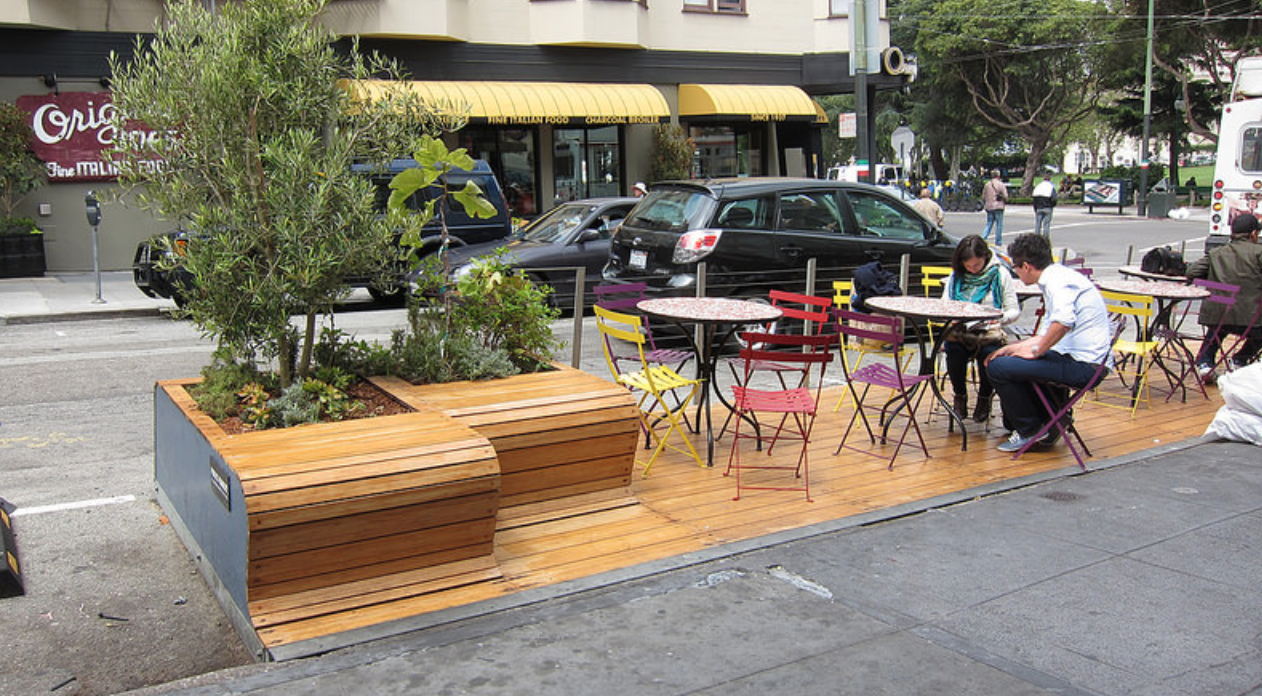
Parklets are spots for people. Not cars. Parklets are an extension of the sidewalk out into the street, usually in what was formerly a parking space – thus the name. They are intended to be used by people, usually to sit, either as an open park or as part of a retail establishment nearby. They are often temporary and can be built quickly and relatively inexpensively. So, putting these in now wouldn’t preclude more permanent infrastructure changes in the future. In fact, this little bit of tactical urbanism would be a nice way to test out wider sidewalks before going to the expense of rebuilding the street. It might be a way for restaurants to add capacity at a time when they have decreased the number of tables inside to meet physical distancing guidelines.
According to the National Association of City Transportation Officials (NACTO) Street Design Guideline manual: “Parklets are typically applied where narrow or congested sidewalks prevent the installation of traditional sidewalk cafes, or where local property owners or residents see a need to expand the seating capacity and public space on a given street. To obtain a parklet, property owners enter into an agreement with the city, in some cases through a citywide application process, procuring curbside seating in place of one or more parking spaces.”

Downtown Has Plenty of Places to Install Parklets
There are places along Duval where there is currently parking (300, 800, 900 blocks) or where the sidewalk narrows for temporary parking (200, 500, 600, 700 blocks) where parklets could be installed. On Upper Duval, beyond Truman Avenue, there’s parking on both sides of the streets, providing additional spots for parklets.
Parklets shouldn’t just be for Duval Street. Anywhere near Duval or how about anywhere downtown where there are groups of retail shops, should be able to participate. Southard (Frita’s Cuban Burgers, Mr. Z’s, Key’s Coffee, The Café and Miso Happy), Fleming (The Roost and Clemente’s) and Eaton Streets (Flaming Bouy and Glazed Donuts) between Simonton and Whitehead are perfect places to add street vitality. Why not on White Street? Where else?
Parklets Can Be Public or Private Third Spaces
Installing retail sponsored parklets provide opportunities for restaurants to provide dining for customers. Installing public parklets provide anyone with a place to stop, rest, have a drink from another establishment and people watch. Studies show that older folks especially consider sidewalk furniture important. Another benefit of public parklets is the community of Third Places. A public space to sit draws people to slow down and chat and share and recognize their neighbors. Saying “meet me in front of that little park in front of the shop” now means I can sit down. Coffee shops are a great example of Third Places but you have to buy something to use it. A public parklet become a Third Place and that creates community. We need both privately sponsored and publicly sponsored parklets. And publicly sponsored doesn’t necessarily mean City-sponsored. It could be a nearby retail shop, a civic or non-profit group or a general benefactor.

Imagine some rainbow benches with visitor information installed in front of the Business Guild shop at 808 Duval. Or some wine themed furniture next door in front of Vino’s on Duval? Perhaps some greenery and public benches in front of the Oldest House Museum in the 300 block instead of cars? Or maybe some the art vendors that usually use the same side of the block and force people to walk single file, have a little space of their own in the parking space instead of the sidewalk, thereby making the sidewalk wider?
Public and Private Organizations/Foundations Can Fund and/or Build Them
Parklets would help further enliven the street and their extension into the right of way would slow down cars. Perhaps grants can be given to groups to build these? Restaurants and retail shops could build their own or team with others to help them. The TDC could provide money. Or CFFK. Team with Key West Hight School and/or arts organizations to help design, build and decorate them like was done with the trash and recycling on the street.

We need to make the permits for these free during this build back period and restaurants should NOT incur additional charges for the new outdoor seating. This is something we should encourage as making it onerous for businesses or groups to participate will kill any effort to enliven the street.
We Can Widen Our Sidewalks and Build Streets for People Sooner Than Later
The dream of revitalizing Duval Street and making it more pedestrian friendly doesn’t have to wait for a study and an infrastructure rebuild to happen. If we could simply widen our existing sidewalks by taking over some of the space being used for car parking, we could get closer to that dream right now.
# # #