🌈 This Is Just the Beginning: Rainbows Return to Duval
Posted on October 7, 2025 Leave a Comment

Streets for People | Friends of Car-Free Key West & Duval Street/Historic Downtown | Chris Hamilton | October 7, 2025
When the State of Florida removed Key West’s rainbow crosswalks in the dead of night on September 9, many feared it marked a retreat from visibility, history, and pride. But the response from our community has been anything but quiet.
In the weeks since, two powerful developments have emerged—proof that resilience, creativity, and collaboration are alive and well in Key West.

🏳️🌈 A Welcoming Arch, Approved
The City of Key West and the Key West Business Guild have announced that FDOT has officially approved the construction of an “All Are Welcome Here” arch honoring the LGBTQ+ community and our allies. This vibrant symbol will stand at the entrance to the newly designated LGBTQ+ Historic District, celebrating our past, present, and future.
“We want to thank Key West Mayor Danise ‘Dee Dee’ Henriquez, City Manager Brian Barroso, and so many others in city government, for working so closely with this group to help make sure this happens,” said the Key West Business Guild.
The arch will span Petronia Street at Duval, mirroring the Bahama Village arch on the opposite side of Petronia. The current design features translucent tubes to allow light to pass through, and the committee is exploring a plaque on one of the posts to explain the arch’s origin. The project is now in the hands of City Director of Engineering Doug Bradshaw, who is working with artists and architects to refine the design. It still needs to go before HARC, Planning, and the City Commission before final approval.
Rob Dougherty, Executive Director of the Business Guild, emphasized that this is just the beginning. The committee is also exploring signage and other ways to mark the LGBTQ+ Historic District (Simonton Street to Duval Street, Olivia Street to Angela Street), ensuring visitors know when they’ve entered this vibrant neighborhood. Dougherty expressed hope that the City will establish a standing LGBTQ+ advisory committee, modeled after similar efforts in other cities.
He praised the City’s genuine collaboration: “At no point was it lip service. People were very honest and easy to work with.” And he echoed the Mayor’s sentiment that “things have to be Tallahassee-proof” — a nod to the importance of creating lasting, resilient symbols of inclusion.


🚲 Rainbow Bike Racks Hit the Street
Meanwhile, the first phase of the City’s new Rainbow Racks initiative is underway. Brightly painted bike racks now line the 700 and 800 blocks of Duval Street, offering a joyful burst of color and a visible reminder of our LGBTQ+ legacy.
The idea came from Ryan Stachurski, the City’s Multi-Modal Coordinator, who wanted a quick, visible way to show support while the arch project moved through approvals. Ryan brought the idea to Dorian Patton, the City’s Mayor and Commission Liaison, who then enthusiastically took it to Mayor Danise “Dee Dee” Henriquez. The Mayor loved it and brought it to City Manager Brian Barroso, who responded, “This is wonderful.” Dorian tells us the City Manager also took the initiative to contact FDOT and secure approval.
The City asked the Key West Business Guild to select the correct rainbow colors, and then City crews painted and installed the racks. So far, three groups of six rainbow racks (red, orange, yellow, green, blue, and violet), have been installed. In two locations, existing black racks were relocated elsewhere on Duval Street and replaced with six rainbow racks—adding four new racks in each spot. In the third location, six rainbow racks were installed where none existed before. That’s a net gain of 14 new racks across those blocks, and a total of 18 rainbow racks now brightening Duval Street.
Commissioner Sam Kaufman shared this reflection:
“While it’s disappointing that FDOT chose to remove the crosswalks, I’m proud to see our City staff and the Key West Business Guild working together to keep that message alive through the new rainbow-colored bicycle racks. These beautiful displays continue to reflect our City’s official philosophy of ‘One Human Family.’ I’ll always support seeing more rainbows across our community as a reminder that everyone belongs here.”

✊ A Community That Refuses to Be Erased
These projects are more than decoration. They’re declarations. They show what happens when a community refuses to be erased—and instead responds with creativity, unity, and pride.
As Rob Dougherty put it: “This is just the beginning.”
We couldn’t agree more.
# # #
Read our September 10, 2025 story: From Rainbow Crosswalks to Rainbow Museums.
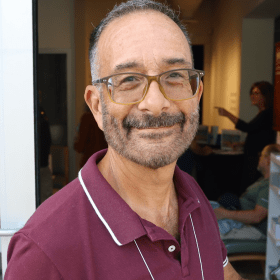
Feature Photo: Key West Business Guild Executive Director Rob Dougherty, Community Services’ Ralph Major, 801 business owner Jim Gilleran, and Community Services’ Richard Sarver.

Chris Hamilton is the founder of Friends of Car-Free Key West & Duval Street/Historic Downtown, a local advocacy group championing sustainable mobility and vibrant public spaces. Subscribe to the blog and follow on Facebook, Twitter, and Substack for updates. All stories are cross posted at KONK Life News. Originally from Washington, D.C., Chris spent over two decades leading nationally acclaimed initiatives in transit, biking, walking, and smart growth for Arlington County, VA’s DOT. Since moving to Key West in 2015, he has embraced a car-free lifestyle downtown, dedicating his time to non-profits and community projects. Explore all Streets for People column articles here.
No Director, No Department, No Direction: Monroe County’s Transit Collapse
Posted on September 21, 2025 2 Comments

Transit Decapitated in the New Budget
September 21, 2025. Monroe County’s new budget year begins October 1, and with it comes a stunning decision: the complete elimination of the county’s transit department and the departure of its director, Richard Clark. This isn’t just a bureaucratic reshuffle—it’s a declaration that transit is no longer a priority in the Keys. Clark’s exit, along with the decision to end Conch Connect—the County’s short-lived micro-transit pilot—in August, marks the end of a brief but ambitious era of trying to build real mobility options for residents, workers, and visitors alike.
Clark was hired in September 2022 to help Monroe County “solve one of our largest challenges with transportation,” according to then–County Administrator Roman Gastesi. At the time Commissioner Cates called the new transit director position an “investment” in public transportation and Commissioner Lincoln said the county needs a person whose “sole job is transportation.” With a background in economic development and public transit leadership, Clark was brought in to develop cost-effective, high-quality, innovative public transportation options. The County recognized the problem and invested in leadership. Now, they’ve abandoned the effort—even though the underlying problems haven’t improved.

County Administrator Christine Hurley confirmed the cuts in a recent email: “We did not fund the Transit Director position, nor Conch Connect.”
This decision doesn’t just eliminate a department—it erases a vision. It signals a retreat from solving the very problems Monroe County once committed to tackling: congestion, worker mobility, tourism, affordability, and environmental sustainability.
The City of Key West recently eliminated its Duval Loop service—a painful cut, but one that sparked public outcry and perhaps a willingness to finally address funding, leaving room for future reconsideration. Monroe County’s decision is different. It doesn’t just reduce service—it erases the department, the director, and the vision. There’s no flicker of hope here. Not yet. Only a void where leadership should be.
The sections that follow will show how transit in Monroe County was beginning to show signs of promise on an ambitious plan, why transit and that plan remains essential, and what’s at stake when leadership fails to act. From the collapse of Conch Connect to the worsening conditions on U.S. 1, the story is one of regression, not reform.

Conch Connect and the Vision It Served
Conch Connect, the county’s micro-transit service, was launched last summer to help workers—especially those on Stock Island—access jobs and services more reliably. It was just a start, an early piece of a broader plan: a quick-launch pilot using outside contractors, designed to address unmet demand where Key West Transit was struggling (and still is). While the County later claimed it wasn’t meeting expectations, the service had gained a small but loyal ridership (65,000 annual rides—far more than the City’s Workforce Express at 12,000) and was showing signs of promise. Feedback was positive, and demand was beginning to outpace supply.
Our May 2024 article laid out Richard Clark’s vision in detail—a layered, scalable system tailored to the Keys. It called for frequent 30-minute coach bus service from Key Largo to Key West along the Overseas Highway, supported by fixed-route circulators in 14-passenger vans and on-demand micro-transit to fill gaps in the many villages up and down the island chain. With up to 30 coaches serving long haul travel on U.S. 1 and the vans and micro-transit serving as first/last mile connectors to that service AND helping people in the Lower Keys, Marathon, Islamorada, Key Colony and Key Largo to get around those villages without a car. The goal: connect workers to jobs, reduce congestion, and give visitors seamless access to destinations. As Clark put it, the plan was for “a system that’s frequent, easy-to-use, and connects the entire island chain—from Homestead to Key West.”
The vision was articulated in part because there is currently no viable regional transit service, and less than half of one percent of Monroe County workers use the bus to get to work. Even the City’s Lower Keys Shuttle between Marathon and downtown Key West offers just 10 trips in and 10 trips out per day—not much help. Growing that number through a layered, responsive system would directly address congestion and worker mobility.
This vision was repeated in County communications and featured in a promotional video produced by the County:
The “Looking Ahead to the Future” section of our January article on the success of Conch Connect painted a hopeful picture—one now rendered moot. Monroe County is dismantling a system before it could even get off the ground.
Why Transit Is Still Essential
The need for transit in the Keys hasn’t gone away—if anything, it’s grown more urgent. As outlined in the County’s own vision, transit is the only scalable solution to a host of interlocking challenges:
- No Room to Widen: Monroe County recently rejected FDOT’s request to reserve the ability to widen the Overseas Highway in the future. That decision effectively locks in the current footprint, making transit the only scalable alternative – because you can’t add more cars.
- Congestion on U.S. 1: The Overseas Highway is over capacity. Level of Service studies show the road is failing. Daily backups, long travel times, and resident frustration are now routine. In surveys over the years, congestion ranks just behind housing as the top concern for Keys residents.
- Worker Mobility: Thousands of workers commute from the Lower Keys to Key West daily. Others travel from Marathon, Islamorada, and even Homestead. Without transit, they face long, costly, and unreliable commutes.
- Visitor Experience: Tourism is the lifeblood of the Keys, but gridlock and parking scarcity degrade the experience—especially in the evening when workers are heading home and visitors are trying to get from resorts to dinner.
- Affordability and Fairness: Many families are forced to own a car for every adult just to survive here. Transit reduces the high cost of car ownership and expands access to jobs, services, and opportunity.
- Environmental Impact: More cars mean more emissions, more noise, and more wear on fragile infrastructure. Transit is a cleaner, smarter alternative.

With the Highway Failing, Transit Is the Only Fix
U.S. Route 1, operates at or exceeds its capacity. The most recent Level of Service study (LOS), the 2023 U.S. 1 Arterial Travel Time and Delay study downgraded the overall LOS for the highway from C to D – a failing grade by Monroe County standards. The study concluded there is “no reserve capacity for additional trips.”
FDOT’s proposal to widen the highway was recently rejected by the county, leaving transit as the only scalable solution. Without it, families are forced into car dependency, workers face impossible commutes, and the visitor experience continues to degrade.
Richard Clark’s vision, as laid out in the County’s own communications, was to build a system that addressed these issues head-on. The May 2024 article described a future with “frequent, easy-to-use transit up and down US1 and within each of the villages”—a future that’s now been shelved, even though the problems remain.
If the highway is failing and transit is the only fix, how did it come to this? If the County was serious about solving the problem—even if they didn’t yet have the money to launch service—why did they let go of the only person working on the plan?

Leadership Without a Plan
There is no replacement plan. No continuity. No vision. This isn’t just a budget cut—it’s a retreat from responsibility. County Administrator Christine Hurley stated that the County is “monitoring ridership with the City of Key West to determine whether need exceeds available seats”—a reactive posture that waits for failure rather than planning for success.
Hurley’s full email response to our request for information reveals a deeper problem: the County seems to have given up. She wrote, “I know you were focused on possible funding solutions; but most of the funding ideas were not something we can easily utilize.” She cited the failed charter county referendum and the State’s resistance to transit authorities, concluding, “Without the tax in place we could not venture into a new transit system.”
She added, “The thing about these funding ideas, is many of them have state or federal laws that don’t allow us to use them for transit.” Parking fees, TDC funds, and tolls were all dismissed as legally or politically unworkable. But as we explored in our August 31 article Could Tourist Dollars Be the Answer to Our Transit Funding Problem?, there are alternative legal interpretations and untapped possibilities. The County’s posture feels prematurely defeatist.
Hurley also wrote, “We believe having two separate government agencies providing transit doesn’t make sense—as you end up paying for two directors and support staff.” What, NOW this is a concern? If that’s the case, why did the County pursue a new transit system before resolving this question? And now that Clark is gone, who from the County will work with the City to figure it out?
If the County truly believed in the need for transit—regardless of which agency runs it—they would have kept someone in place to pursue alternatives, build partnerships, and fight for funding. Instead, they let go of the one person with the knowledge to do it.
Commissioner Michelle Lincoln has expressed openness to further discussion and acknowledged the need for more reliable transit routes. Her willingness to meet and explore ideas offers a glimmer of hope—but no clear commitments have been made. And where are her colleagues? Missing in action.
Two years ago, the County saw the need and invested in leadership. Now, they’ve retreated, offering reasons why things can’t be done instead of a vision for what should be.

The Road Ahead Seems Empty
Monroe County has walked away from transit—not just from a department, but from a responsibility. The Overseas Highway is our only road, and it’s failing. The County knew this. They hired a director, built a plan, and acknowledged the urgency. Then they retreated.
There is no interim strategy, no transition, no leadership. The County’s own statements show a pattern of excuse-making and legal deflection, not problem-solving. They shelved a solution that was already underway, leaving workers, visitors, and residents to fend for themselves.
This isn’t just a missed opportunity—it’s a dereliction of duty. The need for transit remains. The problems are worsening. And the only entity with the power to act has chosen not to.
Unlike the City’s recent transit cuts, there is no flicker of hope here. Not yet. Only a void where leadership should be.
# # #
Chris Hamilton is the founder of Friends of Car-Free Key West & Duval Street/Historic Downtown, a local advocacy group championing sustainable mobility and vibrant public spaces. Subscribe to the blog and follow on Facebook, Twitter, and Substack for updates. All stories are cross posted at KONK Life News. Originally from Washington, D.C., Chris spent over two decades leading nationally acclaimed initiatives in transit, biking, walking, and smart growth for Arlington County, VA’s DOT. Since moving to Key West in 2015, he has embraced a car-free lifestyle downtown, dedicating his time to non-profits and community projects. Explore all Streets for People column articles here.
Duval Loop Eliminated: A Tragedy — and a Turning Point
Posted on September 14, 2025 1 Comment

The Loop is gone. But the conversation has shifted — and that may be the first step toward a smarter future.
Streets for People | Friends of Car-Free Key West & Duval Street/Historic Downtown | Chris Hamilton | September 14, 2025
Key West is about to make a decision that defies logic, economic sense, and basic urban planning. The elimination of the Duval Loop — the city’s best-performing transit route — is a textbook example of short-term thinking with long-term consequences.
But something changed at Thursday’s budget hearing, even as they decreased this year’s transit budget by $1.3M versus last year’s. For the first time, city staff and commissioners seemed to begin talking seriously about long-term funding solutions — cruise ship disembarkation fees, Tourist Development Tax allocations, expanded Park-n-Ride revenue. These ideas should have been explored months ago, even years ago. Their absence is what led us here.
Still, the shift matters. It’s like turning a cruise ship — slow, deliberate, and overdue. But it’s movement. And that movement deserves recognition.
We mourn the loss of the Duval Loop. It didn’t have to be this way. But if the city follows through on the ideas now being discussed, this moment could mark the beginning of a smarter, more resilient transit future.
In the sections that follow, we’ll break down why this decision is so damaging, how the Loop became Key West’s most vital transit service, and what — if anything — can still be done to reverse course.
The Duval Loop: A Route That Works
| Transit Service | % of Total Rides (FY2024–2025) |
| Duval Loop | 43% |
| Lower Keys Shuttle | 29% |
| Key West Rides | 23% |
| Workforce Express | 6% |
Since its launch in August 2017, the Duval Loop has quietly become the backbone of Key West’s transit system. Designed to serve visitors and locals alike, it offered a simple promise: a reliable, free way to explore downtown without the stress of parking or traffic. And it delivered.
Ridership has rebounded dramatically since the pandemic, climbing from 63,055 in FY2020–2021 to over 152,000 projected in FY2024–2025. That’s a 141% increase — and yet, this is the route they’re cutting. The Loop now accounts for 43% of all Key West Transit rides, outperforming every other service. It’s not just popular — it’s essential.
| Fiscal Year | Duval Loop Ridership |
| FY2018–2019 | 331,603 |
| FY2019–2020 | 201,077 |
| FY2020–2021 | 63,055 |
| FY2021–2022 | 71,981 |
| FY2022–2023 | 109,044 |
| FY2023–2024 | 125,655 |
| FY2024–2025* | 152,000+ |
Cutting the Loop doesn’t just hurt riders — it risks future funding. Federal and state transit formulas rely heavily on ridership data to determine allocations. Every ride counts. By eliminating 43% of the system’s total rides, Key West could jeopardize its eligibility for future funding, compounding the damage for years to come.

Research Tells Us Downtown Depends on the Loop
City management and transit leaders presented short-term fixes to preserve Key West Rides and Workforce Express. That’s encouraging. Someone is finally thinking about new sources of funding. But no money for the Loop, that since its launch has quietly become the backbone of the island’s transit system — serving visitors, workers, and locals alike with a reliable, free way to explore downtown.
In our March Madness and the Duval Loop, March 29, 2024 article, we showed how the Loop absorbs seasonal surges, keeping downtown accessible even during peak tourism. It’s not just a convenience — it’s a pressure valve. Without it, traffic clogs, parking overflows, and the visitor experience deteriorates.
During a recent conversation with USRadio 1’s Nick Wright, we talked about how the Loop fuels downtown vitality. “It’s the one thing that makes downtown feel like it works,”we said. “You take it away, and suddenly everything feels harder — for visitors, for workers, for businesses.”
Research tells us that 77% of overnight visitors drive to Key West. And if they have a car and don’t have an easy-to-use alternative, they’ll default to the car — because it’s there. Even those who do walk, often come from car-dependent places where walking isn’t second nature. Add in the heat, and many visitors won’t explore beyond a few blocks. The Loop opens up areas of downtown that might not otherwise get visited — and that’s good for our retailers, restaurants, and destinations.
Business owners have echoed this sentiment for years. From Duval Street retailers to waterfront restaurants, the Loop brings foot traffic that translates directly into revenue. It’s not just transit — it’s infrastructure for prosperity.
Cutting the Loop sends a troubling message: that downtown mobility is expendable. And if that’s the message, then Key West risks undermining the very infrastructure that makes its economy thrive.


The Loop: Not Just for Tourists
The Duval Loop isn’t just for visitors — it’s a lifeline for locals too. That fact is about to become even more obvious as 126 units of workforce housing begin opening at The Lofts, located right on the Loop’s route. The city was rightly praised for placing affordable housing downtown, with direct access to transit. Now, it’s preparing to cut that very connection.
Officials claim the Loop is “only for tourists,” estimating that 95% of its riders were visitors last year. But that figure is disputed — and it overlooks the lived experience of downtown workers who rely on the Loop to move between jobs, errands, and lunch breaks.
The Park and Ride Garage on Grinnell Street will also lose its downtown shuttle connection. Workers are encouraged to park there — so are tourists — but without the Loop, there’s no easy way to get from the garage to the heart of downtown. This isn’t just inconvenient. It’s a step backward for mobility, equity, and common sense.
Residents use the Loop. Workers use the Loop. And the city’s own planning decisions — like placing affordable housing downtown — were built around its presence. Eliminating it undermines years of smart, mobility-focused development. If the city is serious about restoring the Loop, it must start by recognizing its full value.

The Missed Opportunity That Brought Us Here
This isn’t the first time Key West has been caught flat-footed by transit funding shortfalls — and it won’t be the last if leadership continues to rely on unstable grants. As we laid out in our August 3 Dumb and Dumber Transit Cuts article, the city’s dependence on federal and state dollars has created a cycle of surprise and retreat. Each year, officials act shocked when the money doesn’t materialize, despite years of warning signs.
There’s been no sustained effort to build a reliable local funding source. No contingency planning. And now, the city is cutting its most successful route — not because it failed, but because the system wasn’t protected.
Transit has too often been treated as a secondary concern — something for those without cars, rather than a core part of the city’s infrastructure. That mindset has shaped decisions for years, and the consequences are now playing out in real time.
But it doesn’t have to be this way. As we explored in our August 31 article Could Tourist Dollars Be the Answer? the Tourist Development Tax (TDT) is a viable, logical source of funding for the Duval Loop. Commissioners Monica Haskell and Sam Kaufman have pushed for this — Haskell even met with the TDC Executive Director, who expressed support for using those funds. The door is open. City leadership now has a chance to walk through it.


Is the Cruise Ship Starting to Turn?
In the days leading up to Thursday’s budget hearing, Commissioner Sam Kaufman exchanged emails with the City Manager, pressing for answers about the Duval Loop and the city’s long-term transit strategy. These quotes come directly from that exchange — and they reflect a growing awareness that something needs to change. Some of these themes were echoed on the dais during the hearing itself, suggesting that the cruise ship may, at last, be starting to turn. Here’s Commissioner Kaufman’s question to the Manager:
“The City’s 10-year Transit Development Plan lays out a bold vision, but this budget drastically cuts transit. How do you reconcile those cuts with the commitments in the TDP? And specifically—why are we eliminating the Duval Loop, our fastest-growing route, up 21% this year while others are flat or down? Cutting the Loop not only hurts downtown and visitors but also weakens our state funding formula. What’s the plan to restore this service? I understand grants play a role, but the City has known for years that transit funding is unstable. Why hasn’t a sustainable local funding source been prioritized to protect essential services like the Duval Loop? Without a plan for dedicated funding, aren’t we setting ourselves up for the same crisis year after year?”
Kudo’s to Commissioner Kaufman. He gets it. Here’s how the City Manager responded:
“Yes, the Transit Development Plan was developed with a bold vision, but the pages also identified that there was a lack of funding overall. Identifying new, local revenue sources is something that we have actively been working on, however, many of the ideas do not have a short-term implementation. We have identified $3.4M in local funding for the operations of the Transit System, however, grant funding for the system has been decreased to $2.6M in FY2026. The City has identified increased advertising initiatives, dedicated parking fees, and a dedicated portion of citation fees as immediate local funding increases, however, longer term ideas such as TDC Funding, a possible increase to disembarkation fees, participation from the business community, and other options are not immediately available for implementation. The disruption of services is not desirable; however, the suspension of the Duval Loop will have a lesser impact on our local workforce. The suspension of the Duval Loop does not equate to the City surrendering its long-term vision which is in the pages of the TDP. The City is committed to continuing its efforts to enhance revenue opportunities, and in turn, its transit system.”
It’s a familiar pattern: acknowledge the vision, point to funding constraints, and promise future action. But once the Loop is gone, the urgency to restore it may fade — especially if the city adjusts to operating without its most successful route. That’s the danger of short-term cuts: they risk becoming permanent.
The city says it hasn’t surrendered its long-term vision. That’s encouraging. But vision without urgency is just paperwork. If leaders truly believe in restoring the Loop, they’ll need to act — not just plan.

A Day Late and a Dollar Short
At Thursday’s budget hearing, city staff laid out a few short-term fixes to preserve Key West Rides and Workforce Express — including a $10 cut of parking citation fees projected to raise $200K and new revenue from special event parking. These are welcome steps. City Hall is finally thinking creatively.
But for the Duval Loop, the timing may be off. The ideas now being explored — while promising — won’t arrive in time to prevent its suspension.
The city is now exploring longer-term ideas like cruise ship disembarkation fees, Tourist Development Tax allocations, and expanded Park-n-Ride revenue. When asked about when we’d see funding plans for these ideas by Commissioner Kaufman, the City Manager said recommendations could come “a couple of months into the new fiscal year.” That’s progress — but it won’t save the Loop.
Commissioner Sam Kaufman rightly asked for a legal memo on disembarkation fees, noting that Key West charges far less than other Florida ports. He also pushed back on raising worker parking permit fees, emphasizing the need for fairness to workers.
There’s movement. There’s momentum. But the Loop is still being cut. And unless the city commits to restoring it once new revenue is secured, this moment will be remembered not just as a tough pill to swallow, but as a turning point that came too late to save what mattered most.
A Window of Hope
Something seemed to shift at Thursday’s budget hearing. For the first time, city leaders began talking seriously about long-term transit funding — not just in vague terms, but with real ideas: cruise ship disembarkation fees, Tourist Development Tax allocations, expanded Park-n-Ride revenue. These conversations should have started years ago. Their absence is what led us here.
But they’ve started now. And that matters.
Commissioners Sam Kaufman and Monica Haskell have been consistent, vocal, and strategic — not just in this budget cycle, but across years of transit advocacy. Kaufman’s letter to the City Manager laid out the stakes with clarity and urgency. Haskell’s push for TDT funding and her reaching out to the TDC Executive Director, who expressed support for using those funds, is a good sign. They’re not just talking. They’re leading.
We see the flicker of effort at City Hall. We recognize the shift. And we encourage it.
But we also remember what’s being lost. The Duval Loop didn’t fail — it was failed. And unless the city reverses course with a Hail Mary pass by final budget adoption on September 25, this decision will be remembered as a missed opportunity to protect what worked.
So, we remain hopeful. But we also remain watchful.
Trust, but verify.
Because when we invest in good, frequent, easy-to-use transit, we build a better Key West – for workers, for residents, for visitors, for businesses and for our future.
# # #
Chris Hamilton is the founder of Friends of Car-Free Key West & Duval Street/Historic Downtown, a local advocacy group championing sustainable mobility and vibrant public spaces. Subscribe to the blog and follow on Facebook, Twitter, and Substack for updates. All stories are cross posted at KONK Life News. Originally from Washington, D.C., Chris spent over two decades leading nationally acclaimed initiatives in transit, biking, walking, and smart growth for Arlington County, VA’s DOT. Since moving to Key West in 2015, he has embraced a car-free lifestyle downtown, dedicating his time to non-profits and community projects. Explore all Streets for People column articles here.
From Rainbow Crosswalks to Rainbow Museums
Posted on September 10, 2025 Leave a Comment

Preserving Key West’s Identity Through Civic Commemorations, Anchor Institutions, and Gay History
September 10, 2025. The State of Florida’s push to erase our rainbow crosswalks—culminating in their removal on September 9 at the intersection of Duval and Petronia—has energized our community. We’ve shown up loudly and proudly at City Hall and special meetings. We’ve gathered at the intersection for protests and viral photos. And we’ve vented online, at watering holes, churches, and gathering places. After all, these aren’t just painted lines—they’re declarations of identity, history, and resistance. How dare they do this! The common question seems to be: What do we do?
Everyone’s been wracking their brains and generating tons of great ideas on how to respond. I don’t pretend to have the answers—and there are many in our community far more involved and wiser than me. But our identity and place here in Key West isn’t exactly a new dilemma.
Back in January 2024, following the announcement of the closing of the male-only Equator Resort, we wrote an article titled “There Goes the Key West Gayborhood?” asking:

- Is our gayborhood disappearing?
- Is Key West becoming less gay?
- What does the loss of gay spaces mean for the remaining gay businesses and our island LGBTQ+ community?
- And what are some of the things we can do to Keep Key West Gay?
We received heartfelt, thoughtful, and enlightening answers from some of the best minds in our community—including Neil Chamberlain, Cori Convertito, Larry Ketron, Rob Dougherty, Laura Zequeira-Smith, Jeffrey Smead, and Richard McGarry—and shared insights from Guy Ross and Peter Arnow as well.
Eighteen months later, the removal of our rainbow crosswalks brings us to a new crossroads. With more people now engaged and enraged, we wanted to revisit that article and share some of the fantastic ideas from this Who’s Who about how we can Keep Key West Gay. And ask: Are these ideas still relevant? What can we do to move them forward? And what else needs to happen?
That’s what we’ll explore in the story below.


What We Mean When We Say This Isn’t Exactly A New Dilemma
We aren’t equating the closing of a long-time gay establishment or the disappearance of gay spaces with the purposeful hate that the administrations in Washington, D.C. and Tallahassee are imposing on our community. But disappearing and erasing are in the same ballpark—and some of the solutions we explored in our original story may have common ground with what we need to do now, in the wake of our rainbow crosswalks being removed.
In our earlier article, we discussed the rich history of Gay Key West, which began after WWII and by the 1970s had already become an East Coast gay mecca. Fast forward a few decades to 2005, and the New York Times was asking, “Is Key West Going Straight?” By 2024, Key West’s visible gay establishments were down to a handful. And while we wove in context from similar national trends about gayborhoods, we asked local leaders: What’s going on here? And how can we Keep Key West Gay?


Visibility and History Matter in Shoring Up Gayborhoods
A common theme among the research and the community members who participated in our story 18 months ago was that the loss of gay places and spaces was, in part, due to the mainstream’s growing acceptance of the LGBTQ+ community over the last couple of decades. That acceptance, while welcome, also negated the perceived need for specifically gay places that had once served as refuge. We could now go—or hang out—anywhere.
Respondents echoed each other, saying that despite the closing of gay spaces, Key West remained such a friendly, gay-accepting place that the LGBTQ+ community would still be drawn here.
We’ll need a follow-up story—perhaps a Part 2 companion to this one—and ask everyone if they still feel the same, given the current political climate.
At the time, nearly every person we talked to emphasized the importance of educating people about the gay history of Key West. That we had a long and storied tradition of acceptance here—and that this history was one way to keep Gay Key West alive.
The research also pointed to two other critical and related ways to shore up a city’s gayborhood and visibility: civic commemorations and anchor institutions. Together these three elements—commemorations, institutions, and history—form the foundation of what we discussed needing to do going forward.
Let’s revisit them out again here.


🏛️ 1. Civic Commemorations
In a conversation between There Goes the Gayborhood? author Amin Ghaziani and then-VOX writer Matthew Yglesias (now on Substack), they discussed how cities can shore up their gayborhoods. One solution they emphasized was civic commemorations—public markers that embody gay history, culture, and collective memory. Said Ghaziani:
“Chicago became the first city in the world to use tax-funded dollars to municipally mark its gayborhood—Boystown. They installed art deco–styled rainbow color pylons along North Halsted Street, which is the main artery of the commercial and nightlife district in the city. We’ve seen versions of this in many cities across North America.”
“Philadelphia installed rainbow flags underneath the street signs that demarcate a portion of the Washington Square West neighborhood. Toronto did the same thing… Vancouver installed permanent rainbow-colored crosswalks in the heart of the Davie Village gayborhood. West Hollywood has done the same thing.”
We’d add that Chicago also installed 14 permanent rainbow crosswalks and created the Legacy Walk—a series of bronze plaques commemorating the lives and achievements of significant LGBTQ+ people along North Halsted.
Further research revealed other cities renaming streets and plazas, dedicating monuments and memorials, and blending pride symbols into architecture. In Philadelphia’s gayborhood, for example, street signs feature a rainbow flag emblem beneath the name. Commemorative plaques, sidewalk markers, statues, murals, and even permanent rainbow lighting on bridges and buildings have all been used to honor LGBTQ+ history.
Closer to home, Key West has its own AIDS Memorial, the City’s adoption of the One Human Family motto, and the official flying of the rainbow flag at city functions. And of course, we had our own rainbow crosswalks installed in 2015 at Duval and Petronia—until the State of Florida removed them in the dead of night on September 9, 2025.
Why do we need civic commemorations? Visibility. They remind us—and everyone else—that we’re here, we’ve always been here, and we’re not going anywhere.
So, the question becomes: What more can we do? And perhaps we’ll revisit that in a future article or Part 2.


🧭 2. Support Anchor Institutions
The second “visibility” measure discussed by Ghaziani and Yglesias was the promotion of anchor institutions—organizations, businesses, and community centers that give a gayborhood its distinct identity and cultural staying power. Says Ghaziani:
“These are particular organizations or nonprofit community centers and businesses that have particular importance or significance for the LGBTQ community. This could be something like the community center on Halsted in Chicago. It could be a particular bar that may have existed for a while that has special significance in the community. These anchor institutions will continually inspire people to visit and spend time in the neighborhood even if they no longer live there.”
In his book, Ghaziani also talks about gay newspapers and periodicals, and the idea of providing subsidies to anchor institutions to help them thrive.
In our 2024 article, we highlighted the then-recent bright spot of the Aqua Plex property, which beloved gay Key West icon Michael Ingram sold to Jonathan and Michael Barrett—a gay couple from Michigan who wanted to carry on the legacy. We contrasted Michael Ingram’s desire to preserve Aqua’s drag bar tradition with Richard Hoy’s sellout of the Equator Resort. Think of the other places that serve as our anchor institutions:
- The Tennessee Williams Museum
- 22&Co
- The La Te Da complex—including its cabaret, piano bar, and Tea Dance
- 801 Bourbon Bar and Saloon One
- The Bourbon Street Pub and New Orleans House complex, with their famous New Year’s Eve shoe drop
- Bobby’s Monkey Bar
- Island House Key West Resort
- Alexander’s Guest House
- Graffiti Menswear
- In Touch
- Leather Master of Key West
- Q Magazine
- The Key West Business Guild and their welcome center at 808 Duval
- Queer Keys Community Center at 1100 Truman Avenue
Apologies to those I’m missing. While there may be fewer gay places than there were twenty, thirty, or even forty years ago, the question is: How do we support the ones we still have?
And why do we need to support them? Visibility. If these places thrive, they remain visible symbols of our community—welcoming, resilient, and unmistakably present.


📚 3. Preserve, Honor, and Educate About Our History – Maybe A Rainbow Museum
Many of those who responded to our first article emphasized the importance of preserving and honoring our history, educating people about our community’s past, and sharing personal stories. Civic commemorations and anchor institutions can help advance this—but we also need dedicated efforts to make our history visible and accessible.
One idea we floated back then was the creation of a Rainbow Museum right here in Key West. And we’ll admit—it’s not a new idea. Former Key West Business Guild Executive Director Matt Hon championed it for years, even suggesting the perfect location: 1114 Duval Street, where Gilbert Baker and his team assembled the 1.25-mile-long rainbow flag in 2003. When we talked to Matt about this article he told us:
“My heart broke yesterday morning when I saw Gwen’s post about the crosswalks. I been following the story from a far & was hoping KW would win & those crosswalks would stay. But, they didn’t. Those crosswalks disappear just emphasized to me on the direction of our country that I fear. The disappearance made me cry. The museum tho, I always was surprised one was never in Key West. And always thought Key West should have one. Maybe it will happen some day. And I hope folks in Key West can keep the island gay. Trust me, for a person who lives in an area like I do, there is still a very important need for “gay only spaces”. The young folks who reside in deep deep red areas need it! I myself have thought maybe its not as important any more, but when u have conversations with the younger gay generations & tell stories of our gay bars, gay resorts, gay bookstores & such they say how lucky my generation was to have such places. Some young kids still live in places that they really cant be themselves, unfortunately. So the safe spaces are still needed & important.”
The first gay museum opened in 2011 in San Francisco’s Castro District, and many more have followed. Here’s a 2021 list of the nation’s Top 10 LGBTQ+ Museums. Another compelling model is Chicago’s Legacy Walk—an outdoor installation honoring world-changing LGBTQ+ figures with permanent plaques and storytelling.
Given Key West’s long, vibrant and fun gay history, either of these ideas would have plenty of material to work with. How can we make this happen? Other ideas to keep history alive include:
- Support Tim Dahm’s wonderful No Closet Space – the History of Gay Key West film so it gets wider distribution
- Walking tours
- Oral history projects
- Public art installations
- Collaborations with schools, libraries, and museums to integrate queer history into local education
What else could we do?

Why the Entire Island Should Want to Keep Key West Gay
One can’t really imagine the history of Key West over the last 80 years—since World War II if not earlier—without acknowledging the LGBTQ+ community. After all, as Guy Ross put it: “The gays saved Key West.” And they invented Fantasy Fest.
Key West is a wonderful and magical place because of the gay community. It’s part of the island’s very fiber. That magic—the One Human Family ethos, the live-and-let-live spirit, the welcome for misfits and dreamers—starts with the visibility and acceptance of the LGBTQ+ community. It’s what draws people here. It’s what keeps us here.
And it’s not just about residents. That magic draws visitors too. It’s vital to our economy. People want to travel to places that are unique and authentic. For 80 years, Key West has been exactly that.
But if the LGBTQ+ community is silenced or erased—even a little—doesn’t that chip away at the very essence of what makes Key West “close to perfect, far from normal”?
Can Key West survive if it becomes just the southernmost version of mainland Boca Del Vista?
No. No, we can’t. So, here’s what we need to do:
- Everyone should by flying the rainbow flag in front of their business and home
- Get involved with the Key West Business Guild and Queer Keys
- Come up with ideas and funding for new civic commemorations
- Support, embrace, and love our anchor institutions
- Find ways to educate America that Key West was one of the original gay safe spaces—and still is
That’s how we respond to the erasure of our rainbow crosswalks.
We’ll leave you with this wonderful video produced by the fantastic team at Island House that encapsulates this message.
# # #
Chris Hamilton is the founder of Friends of Car-Free Key West & Duval Street/Historic Downtown, a local advocacy group championing sustainable mobility and vibrant public spaces. Subscribe to the blog and follow on Facebook, Twitter, and Substack for updates. All stories are cross posted at KONK Life News. Originally from Washington, D.C., Chris spent over two decades leading nationally acclaimed initiatives in transit, biking, walking, and smart growth for Arlington County, VA’s DOT. Since moving to Key West in 2015, he has embraced a car-free lifestyle downtown, dedicating his time to non-profits and community projects. Explore all Streets for People column articles here.
Katie Halloran’s Quiet Revolution
Posted on September 7, 2025 3 Comments

What We Lose When We Lose Good People
Streets for People | Friends of Car-Free Key West & Duval Street/Historic Downtown | Chris Hamilton | September 7, 2025
Katie Halloran’s resignation as Key West’s Planning Director isn’t just a personnel change — it’s a turning point. Over five years, she helped reshape the city’s planning culture, delivering civic spaces, affordable housing, and climate-resilient infrastructure that now define our downtown. This story isn’t about the politics behind her exit — others are covering that. It’s about the work she did, the projects she helped deliver, and the planning philosophy she championed — one rooted in the public good and in treating every resident with equal respect, whether they held power or not. From Duval Street to Bahama Village, her legacy is visible in the places we walk, gather, and live.
Halloran’s quiet revolution wasn’t just about policy — it was about presence. I observed at public meetings like those for the Duval Street Resiliency project, she stood in the background, letting her staff, consultants, and elected officials take the spotlight. She led by empowering others, shaping outcomes without seeking credit.
Her departure leaves a void — a big one — and a challenge. In this story, we’ll explore the work she did, the planning philosophy she championed, and the projects she helped deliver — and we’ll ask what comes next.

The Quiet Architect Behind Big Wins
Halloran’s department was instrumental in moving forward a slate of downtown projects that have reshaped Key West’s urban landscape. These seven projects — spotlighted in an article last summer: “Progress On Seven Projects Equals Big Wins for Downtown”— are tangible examples of that progress:
- Mallory Square Master Plan — Planning completed; implementation status pending. The plan includes a 7,000-square-foot shade structure, water play area and redesigned gathering spaces to make the square usable throughout the day — not just at sunset. Halloran emphasized the need to make it welcoming for locals on lunch breaks, not just tourists.
“Mallory Square is an iconic destination… but outside of an hour and a half before sunset, nobody wants to sit there for more than five or ten minutes even though we have this invaluable view of the ocean.”
- The Lofts at Bahama Village — Affordable housing with bike infrastructure; opening this month. The Lofts project broke ground in September 2024 and delivers 126 units of affordable housing on land donated by the Navy — a decades-long dream finally realized under Halloran’s leadership.
“More residents living downtown is a win. It helps locals save money by biking, walking, and using transit.”
- Frederick Douglas Community Center — Opened March 6, a new civic space for Bahama Village. Includes a music program, Black Educators History Museum, and community gathering space. Halloran’s department helped secure funding and navigate permitting to get it built.
“This space is about honoring Bahama Village’s legacy while giving the next generation a place to grow.”
- Duval Street Resiliency and Revitalization (Duval4All) — Planning phase complete; next steps TBD. Planning phase completed with robust public input, including surveys and open houses. The project integrates stormwater management, elevated street infrastructure upgrades, shade structures, and pedestrian safety — all framed around climate resilience.
“We want this process to be transparent and community-driven. Duval Street belongs to everyone.”

- Clinton Square Park — Opened last June; pedestrian-friendly upgrades. Features seating, shade trees, lighting, and historic markers. Planning helped navigate approvals from HARC, Parks & Rec, and Engineering.
“This is about reclaiming public space for people, not just cars.”
- Historic Diesel Plant — Adaptive reuse and preservation. Currently in pre-RFP phase. Planning led the groundwork for adaptive reuse, including groundwater management and historic preservation coordination.
“We’re looking for partners who understand the site’s history and its potential to serve both locals and visitors.”
- Southernmost Point Plaza — Construction beginning this week. Includes seawall repairs, plaza redesign, and stormwater upgrades. Planning helped coordinate with Community Services and Engineering.
“This isn’t just a photo op — it’s a chance to make the space safer, more accessible, and more resilient.”


These seven visible wins reflect a broader philosophy: walkable, climate-conscious urbanism. But they didn’t happen in a vacuum. Behind them are quieter, foundational changes that made these projects possible. As longtime HARC Planner, Enid Torregrosa put it:
“For years, City Hall (derisivly) called Planning the ‘arts and crafts department.’ Katie ended that culture.
She requested public involvement and transparency throughout the vetting process. Now planning was the leading department for design and development for city capital projects affecting the community. Many directors resented this shift, but she was committed to implement what was logically the correct practice in any healthy government. ”
Enid highlights how the Planning Department prior to Ms. Halloran’s arrival wasn’t a player in the big projects and was even ridiculed by the others. But the quieter, foundational work with her team described below made the success of those seven projects possible:
- Comprehensive Plan Updates — Halloran’s department advanced targeted updates to the Comprehensive Plan — especially around climate resilience and infrastructure — though a full rewrite remains overdue.
- Land Development Regulation (LDR) Reforms — Halloran’s team defended and refined Key West’s inclusionary housing code, resisting efforts to dilute affordability mandates and updating key definitions and standards.
- Public Engagement Infrastructure — Projects like Duval4All and Mallory Square Master Plan, among others showcased a commitment to public input, with surveys and open houses shaping the planning phase.
- Climate Adaptation Integration — Planning projects increasingly incorporated climate adaptation — from stormwater upgrades to elevation strategies — in coordination with the City’s broader Adaptation Plan.
- Cross-Departmental Coordination — Planning collaborated with departments like Engineering and Sustainability to deliver shared goals. The departments that tried to silence her work is well documented.
“We’re trying to make it easier for people to live and work downtown,” Halloran said in 2022, when asked about the city’s push to streamline permits and support infill development.

Strategic Planning with Teeth
Halloran’s tenure coincided with the adoption of two major citywide frameworks: the Strategic Plan and the City’s climate resilience goals – sometimes referred to as a Climate Action or Adaptation or Climate Change Plan. But unlike many cities where such plans gather dust, Key West’s Planning Department used them to guide real decisions. Zoning changes prioritized infill development and walkability. Permitting processes were streamlined to support affordable housing and adaptive reuse. Public space investments — from Clinton Square to Southernmost Point Plaza — were shaped by climate resilience goals.
The result was a planning culture that didn’t just talk about sustainability — it embedded it in the city’s physical form. Halloran didn’t just check boxes — she made the rules match the vision. Here’s what Elisa Levy, the person who started and helped implement the first few years of the City’s Strategic Plan, told me when I asked her about Katie:
“Katie has been the heartbeat behind so much of the city’s progress. She was instrumental in creating the first strategic plan in over a decade, and she poured herself into projects that mattered most to our community. The affordable housing project known as the ‘3.2 acres’ (now the Lofts at Bahama Village) is just one example. Katie not only helped get it off the ground, she fought to make sure it stayed true to its purpose—affordable and accessible for the people who call this place home. She also threw her energy into the city’s climate change plan, the revitalization of Mallory Square and Duval Street, and nearly every other major initiative in the plan. Katie doesn’t just dream big—she has the grit, the brilliance, and the determination to bring those dreams to life.”
Transparency and Integrity Under Fire
Even amid controversy, Halloran demonstrated a commitment to transparency. In a 2022 incident involving a permit application for her family’s home, she proactively recused herself and documented the process to avoid any perception of impropriety. That kind of ethical foresight is rare — and worth defending.
But the 2022 example wasn’t an isolated case. Halloran’s resignation letter — described by local media as thoughtful and measured — reveals a pattern of proactive ethics and transparency. She raised concerns about questionable development review practices, helped launch the Corradino Report, and submitted a formal complaint to Human Resources about the City Manager. She also supported the Grand Jury investigation and expressed hope that its recommendations would be implemented.
Transparency wasn’t just about ethics — it was embedded in her planning philosophy. Halloran’s department created public-facing web pages for major projects like Duval4All, hosted surveys and open houses, and coordinated with outside consultants to ensure fair permitting processes. Here’s how longtime HARC Planner Enid Torregrosa put it:
“Katie is an outstanding professional with a strong ethics core. Her love for our community and passion for what is correct, and fair is what drives her in all decisions. She is an exemplary leader that elevated the Planning Department to the level where it should have been in the city.”
Her commitment to transparency, integrity and ethics wasn’t abstract — it’s visible in every staff member she interacted with. Here’s what Dan Guzilio — who worked with Halloran — and has nearly 40 years of community planning experience said to our friends at Above the Fold by Ted Lund:
“I can say without reservation that Katie Halloran is as fine a public servant as anyone that I have met throughout my career. She is incredibly hard-working, exceptionally competent, and immovably honest. Unfortunately, under current City management, those are not the character traits that are valued.”

What We Owe Her — and What Comes Next
Katie Halloran made Key West a better place to live, work, and play. Her planning legacy is especially visible downtown, where her department helped deliver civic spaces, affordable housing, and climate-resilient infrastructure. We’re grateful for her service — and for the vision she brought to our city’s most vital neighborhoods. She put the public good first — treating all residents with equal respect and care — even when it made her unpopular with those who expected special treatment.
But with her resignation, the work isn’t done. We need leaders to step up and 1. fix what ails city hall so good people like Katie stop leaving and 2. we owe it to her to finish what she started — especially the Mallory Square Master Plan, the Historic Diesel Plant reuse, and the Duval Street Resiliency and Revitalization project. Duval Street is our main street, our economic engine, and our cultural heart. It deserves the kind of thoughtful, community-driven planning Halloran championed — and it deserves to be finished.
# # #
Author’s, Note: PLEASE CHECK THE COMMENTS FOR MORE TESTIMONIALS
Author’s, Note: I didn’t know Katie Halloran personally. We’re not friends, not even on Facebook. But over the past five years, I’ve covered many of the projects she helped lead. When I asked for updates or quotes, she responded — not with spin, but with substance. Even as a department head, she made time to help inform the public. That’s where this story comes from: not insider access, but a front-row seat to the work.
# # #
Chris Hamilton is the founder of Friends of Car-Free Key West & Duval Street/Historic Downtown, a local advocacy group championing sustainable mobility and vibrant public spaces. Subscribe to the blog and follow on Facebook, Twitter, and Substack for updates. All stories are cross posted at KONK Life News. Originally from Washington, D.C., Chris spent over two decades leading nationally acclaimed initiatives in transit, biking, walking, and smart growth for Arlington County, VA’s DOT. Since moving to Key West in 2015, he has embraced a car-free lifestyle downtown, dedicating his time to non-profits and community projects. Explore all Streets for People column articles here.
Could Tourist Dollars Be The Answer to Our Transit Funding Problem?
Posted on August 31, 2025 Leave a Comment

While the approach hasn’t been tested, with political will, and an inclination to challenge old assumptions, nothing should be off the table. And we can make the visitor experience better too.
Streets for People | Friends of Car-Free Key West & Duval Street/Historic Downtown | Chris Hamilton | August 31, 2025
🎯 Sunset Gridlock, Islands-Wide
It’s sunset in Islamorada. Or Marathon. Perhaps Key West. You’re trying to get to dinner, but traffic is backed up, parking is scarce, and the scenic drive feels more like a crawl. Sound familiar?
Ask any server up the Keys—they’ll tell you the hardest part of their shift isn’t the work. It’s the drive.
Visitors love The Florida Keys & Key West—but they don’t love the gridlock. Locals want better transit but worry about the cost. And now, the long-promised fixes—regional coordination, expanded and more frequent service—are slipping away.
From the Overseas Highway to Old Town, from resort corridors to beach access points—gridlock is a Keys-wide experience for tourists, workers, and residents alike. But the fix needn’t be elusive. It may be sitting in plain sight—if leaders are willing to invest in long-standing plans and fund them with a source they’ve overlooked for years. AND it will make the visitor experience better. That’s what we’ll unpack below.

🧨 Cuts and Broken Promises
In the past few months, both Monroe County and the City of Key West have begun walking back ambitious transit plans—largely in response to budget cuts from Washington and Tallahassee. The region’s over-reliance on these sources means that when those shrink, the vision does too.
- The County has eliminated Conch Connect. Its Transit Department—and its director—are on the chopping block. And with them, the vision for expanded service may disappear too.
- The City has proposed eliminating the Duval Loop and cutting back Key West Rides and part of the Workforce Express. Their 10-year plan for transit modernization? Now at risk.
Instead of building on momentum, the region is bracing for contraction. The promise of a connected, efficient transit system—one that serves both visitors and workers across the Keys—is slipping away.
So, we ask: What’s the plan now? What’s the local strategy to keep transit alive?

💰 The Hidden Funding Source
If the grants are drying up, what’s left? Turns out, quite a bit.
What if there were a more stable, local source of funding—already being collected from tourists themselves?
Every time a visitor books a hotel or vacation rental in Monroe County, they pay a Tourist Development Tax (TDT)—a bed tax that generated over $60 million in FY 2024. See Monroe County’s FY 2024 Annual Report (PDF)
Most of it goes to advertising the Keys. Some goes to beach maintenance and historic preservation and events. But none of it currently funds buses.
| Category | Amount | Source |
| Monroe County TDT Revenue (FY 2024) | $61.5 million | FY 2024 Annual Report (PDF) |
| Transit Funding from TDT | $0 | FY 2024 Annual Report (PDF) |
| Marketing Spend | Estimated $30–40 million | FY 2024 Annual Report (PDF) |
*All figures sourced from Monroe County FY 2024 Annual Report.
That’s not a knock on marketing. The Florida Keys & Key West team at the TDC does a great job promoting the region—and smart marketing is essential to a healthy tourism economy.
But if even a small portion of that budget were redirected to transit, the return on investment could be enormous: better mobility, happier visitors, and stronger support for the workers who keep the economy running.
If only it were that easy. The Tourist Development Tax has a narrow legal purpose—and until now, its boundaries haven’t been fully explored.
⚖️ What the Law May Allow
There’s a lot of confusion—especially online—about what the Tourist Development Tax (TDT) can and can’t fund. Some say, “it’s only for marketing.” Others say, “you can’t touch it.” So, what does the law actually say? Can this funding source be used for transit—or is that just wishful thinking?
Here’s what we think: Florida law allows TDT funds to be used for tourist serving transit—IF the County and the Tourist Development Council (TDC) approve.
Specifically, Section 125.0104 of the Florida Statutes outlines the permitted uses of TDT revenue. Among them is a provision that allows funding for activities and services whose main purpose is to attract tourists—as long as that purpose is clearly demonstrated.
That could mean buses, shuttles, and other transit services can be funded with TDT dollars—if they’re designed and promoted as tourism-serving services.
We get that this is not automatic. The County and TDC would need to vote to allocate funds. And the County Attorney’s Office would need to find a way to yes too.
But the idea that it’s illegal or impossible? False. Not if there’s a will to find a way to that yes.
Our reasoning is supported by Florida Attorney General Opinion AGO 2017-06, which confirms that transportation services clearly intended to attract tourism can be funded with TDT dollars.
That opinion also notes that a County must make a case-by-case factual determination—based on factors like promotion, purpose, and usage—to show that the service is designed to attract tourists. Importantly, the law doesn’t require transit to bring in new tourists—it requires that it be designed and promoted as part of the tourism experience. Here’s a quote from the opinion:
“Nothing in section 125.0104(5), Florida Statutes, suggests that the tourist development tax is a broad funding source. Rather, the tax revenues are a targeted funding source to directly and primarily promote tourism.”[5] Thus, such revenues cannot be used to fund a public transit system for the citizens of Walton County that would incidentally benefit tourists. Instead, to warrant use of tourist development tax revenues for transportation services under subsection (5)(a)3., there must be a clear and direct relationship between the promotion of tourism and the particular transportation service being offered.[6] Such transportation services should involve routes and schedules addressing the specific needs of tourists, and might include, for example, a shuttle connecting hotels and motels with county tourist attractions.”
That’s already happening with services like the Duval Loop downtown and Freebee in Islamorada. We think the Lower Keys Shuttle qualifies too as it connects resorts with restaurants, shops and destinations. As would an envisioned Overseas Highway from Key Largo to Old Town Key West route. With the right framing, Monroe County wouldn’t be bending the rules—it would be using them as intended.
This approach hasn’t been tested in Monroe County. Or anywhere else, just yet that we can find. So, if our Commissioners and business leaders don’t want to use TDT money to support tourist serving transit, it would be really easy to say, no it can’t be done and move on.
But if they do indeed, as they profess, support transit that would make life better for visitors, workers and residents it would take them marshaling a legal review, harnessing the political will, and a demonstrating a willingness to challenge old assumptions.
It’s not guaranteed—but it’s not prohibited. And it’s time to stop shutting down the conversation and start exploring the possibilities.
For those who want to read the statute directly, here’s the 2019 version of Section 125.0104. And here’s the Florida Attorney General Opinion AGO 2017-06.

🚍 The Transit Twofer: Enhancing the Keys Experience, Amplifying the Brand or Why TDT Funds Should Be Used for Transit
Transit isn’t just a fix for gridlock—it’s a strategic investment in the visitor experience that amplifies the island chain’s appeal and markets the free-and-easy spirit that makes the Keys different from the mainland.
🛠️ Enhancing the Visitor Experience and the “Only In the Keys” Brand
- The Overseas Highway is over capacity, and the TDC promotes “driving the Keys” as part of the experience. But in reality, traffic congestion often turns that experience into a frustrating slog.
- During afternoon rush and dinner hours, traffic bottlenecks in villages throughout the Keys—especially in Key West, Islamorada, and Marathon—make it hard for visitors to reach restaurants and attractions. Parking is scarce, and the experience suffers.
- Workers who can’t afford to live near their jobs must drive long distances, worsening congestion and making them less reliable to employers.
📣 Reinforcing the TDC’s Marketing by Driving Promotion
- 🚌 Branded buses = rolling billboards seen by thousands of visitors daily – imagine buses going up and down the Overseas Highway with The Florida Keys & Key West logo. Same with the Duval Loop and other buses.
- 📲 QR codes and signage onboard the bus and at all the bus stops can drive traffic to TDC websites, events, and promotions.
- 🏖️ Improved visitor mobility means more spending at restaurants, shops, and attractions. Visitor research says that many tourists won’t walk the full length of Duval or will skip the Seaport or other parts of town if they don’t have an easy option like the Duval Loop. Same thing in Villages up the Keys. If traffic is a nightmare, visitors are more likely to stay in the resort and not venture out to those local Mom and Pop places.
That’s the twofer: real solutions for real problems, and smart marketing that amplifies the islands’ appeal.
It’s time to stop treating transit as a cost center—and start seeing it as a strategic investment in making the visitor experience even better.

🧠 Smart Policy, Real Action
Depending upon federal and state grants has proven foolhardy over the years. TDT should be considered as just one of a number of potential new local non-property tax or general fund sources. And perhaps we’ll dive into some of those in the future. But for today, using TDT for transit is a win-win:
- Doesn’t touch property taxes or the general fund.
- Keeps tourists moving and spending.
- Supports workers who keep the tourism economy running.
- Legally allowed under Florida law—IF the County and TDC approve.
And now is the time. The County and City budget processes heat up in September, and decisions are being made that will shape the future of transit in the Keys.
If you care about mobility, tourism, or the workers who make this place run—write your Commissioners now.
📬 Here’s how to speak up and talk to your Commissioners.
Reimagine the Keys as a place where tourists ride, not drive—where mobility isn’t a luxury, but a shared investment in the region’s future. Where visitors experience the island chain in a way that’s different from their car-centric mainland routines—and where residents and workers have the freedom to do the same.
# # #
Chris Hamilton is the founder of Friends of Car-Free Key West & Duval Street/Historic Downtown, a local advocacy group championing sustainable mobility and vibrant public spaces. Subscribe to the blog and follow on Facebook, Twitter, and Substack for updates. All stories are cross posted at KONK Life News. Originally from Washington, D.C., Chris spent over two decades leading nationally acclaimed initiatives in transit, biking, walking, and smart growth for Arlington County, VA’s DOT. Since moving to Key West in 2015, he has embraced a car-free lifestyle downtown, dedicating his time to non-profits and community projects. Explore all Streets for People column articles here.
Key West Rides Overwhelmed After Conch Connect Shutdown—City Pushes Alternative Buses Amid 36% Spike in Trip Requests
Posted on August 26, 2025 Leave a Comment

Transit officials say they can’t meet demand and are urging riders to shift to Workforce Express and Lower Keys Shuttle. Ironically, this is happening as leaders are considering massive cuts to the system.
Conch Connect Vanishes – And Riders Scramble
August 26, 2025. When Monroe County abruptly shut down the Conch Connect on-demand service for Stock Island and Key West on August 15, they left 65,000 annual riders without a replacement—and no backup plan.
With 85% of those trips taken by locals and 50% of trips for work, the impact was immediate. Riders were left stranded, scrambling to find alternatives
Key West Rides Buckles Under Demand

With Conch Connect gone, riders turned to the City’s own on-demand service—Key West Rides (KWR). But the system wasn’t ready.
In the first week after the shutdown, KWR saw a 19% jump in completed rides and a 36% surge in trip requests. The problem? The service could only fulfill about half of those requests.
Now, the system is overwhelmed, and riders are once again left scrambling.
Key West Transit Pushes Alternative Buses as a Result
To ease pressure on Key West Rides, Key West Transit is promoting the Key West Workforce Express (WFE) and the Lower Keys Shuttle (LKW) buses—two fixed-route buses that continue to run between Stock Island and downtown Key West. Riders can also transfer to the Duval Loop to reach downtown destinations, at least while that service remains active.
The Lower Keys Shuttle offers 10 trips per day in each direction, spaced 90–120 minutes apart. The Workforce Express runs six trips per day in each direction. While not perfect, these buses may be more reliable than the hit-or-miss Key West Rides system.


More riders might consider the Workforce Express if the route were simpler and service more frequent. Key West Transit’s own 10-Year Plan calls for more trips on it and increased frequency on the Lower Keys Shuttle—down to 60 minutes or better. But with budget cuts on the table, those improvements may be years away, if they happen at all.
Cuts Loom as Demand Soars
The surge in demand for Key West Rides is a clear signal: people want transit. But instead of expanding service, City and County leaders are proposing cuts.
As budget hearings approach, those proposals are drawing increasing scrutiny. We’ve been covering this story for weeks—from the County’s decision to scrap Conch Connect (“Conch Disconnect: County Scraps Transit Service for Local Workers”) to the broader implications of transit cuts (“Even If You’ll Never Ride the Bus, You’ll Feel It When It’s Gone”, “Transit Is Collapsing in the Keys. Will Business Leaders Let It?”, and “Dumb and Dumber Transit Cuts: A Failure of Leadership in the Keys”).
The problem isn’t just demand—it’s leadership. Officials failed to anticipate the predicable fallout of transit cuts from Washington, D.C. and Tallahassee and haven’t prioritized transit infrastructure in their budgets. Now, riders are paying the price.
What You Can Do to Prevent Cuts
The County and City are proposing cuts to transit—but nothing is final yet. These are still just proposals, and public pressure can make a difference.
- Attend the County budget hearing on September 3 and the City hearing on September 11.
- Contact your commissioners before the meetings and urge them to fund transit as basic infrastructure.
- Share this article with friends, neighbors, and local businesses to raise awareness.
- Post on social media using #FundTransitKW to amplify the message.
- Ask your employer to support transit funding publicly—especially if they rely on workers who use these services.
If we stay silent, the cuts go through, and more people are left behind.
# # #
Chris Hamilton is the founder of Friends of Car-Free Key West & Duval Street/Historic Downtown, a local advocacy group championing sustainable mobility and vibrant public spaces. Subscribe to the blog and follow on Facebook, Twitter, and Substack for updates. All stories are cross posted at KONK Life News. Originally from Washington, D.C., Chris spent over two decades leading nationally acclaimed initiatives in transit, biking, walking, and smart growth for Arlington County, VA’s DOT. Since moving to Key West in 2015, he has embraced a car-free lifestyle downtown, dedicating his time to non-profits and community projects. Explore all Streets for People column articles here.
Even If You’ll Never Ride the Bus, You’ll Feel It When It’s Gone
Posted on August 24, 2025 Leave a Comment

Why Transit Cuts Hurt Everyone in the Keys—And Why We Need to Speak Up Before the September Budget Hearings
🚗 It’s Not About Buses. It’s About Our Daily Lives.
August 24, 2025. The photo above shows what’s at stake. You may never have ridden the Conch Connect. Now already gone. You might never hop on the Duval Loop, Workforce Express, Key West Rides or Lower Keys Shuttle. But if some of these too disappear, as is proposed in next year’s as yet to be finalized budgets, we’ll all feel it:
- More congestion. Every rider forced into a car adds to the gridlock.
- Fewer parking spots. Transit riders free up space—cut the service, and good luck downtown or in villages up and down the Keys.
- Slower service. From restaurants to retail, workers can’t get to jobs reliably.
- Tourist overload. Without transit, visitors drive everywhere—and clog everything.
Public transit isn’t a handout—it’s a public service. Just like roads, schools, and clean water. Our story below discusses how we all benefit when it works—even if we don’t ride. How it’s about equity: making island life accessible to all. How it’s about freedom: having real choices in how we get around. And how it’s about infrastructure—and when it works, we all move better. Even drivers feel the difference.
🏳️🌈 This Is About Equity, Too

We showed up for rainbow crosswalks. We protested ICE raids. We spoke up about water quality. Now let’s show up for the roads that lead to those crosswalks—and the transit systems that make our islands accessible to all.
Transit is a justice issue. When it fails, the most vulnerable suffer first. And equity isn’t just about race or income—it’s about access.
In the Keys, where car ownership is expensive and housing is scarce, transit is what allows people to move freely, reach jobs, and participate in community life. That’s equity, too.
And while equity is sometimes viewed with suspicion in today’s political climate, the ability to move freely—regardless of car ownership—is a core equity issue. Transit ensures that everyone, regardless of income or circumstance, can take part fully in island life.
🧭 Freedom Means Having Options

A car shouldn’t be a requirement for participation in life.
Transit gives people freedom of choice:
- Freedom to live farther out and still reach jobs.
- Freedom to move freely without a car. Teens, seniors, and low-income residents gain independence.
- Financial freedom by going car-lite. Families can save money if every adult doesn’t need to own a car to get around. The high cost of owning and operating a car ($12,292 a year) on top of our sky high rents makes this imperative.
- Freedom to choose how to participate. Transit lets people engage in island life on their own terms. And that includes visitors, who research tells us, if they drive a car here, they tend to use it if there aren’t options. Do we really want everyone arriving by plane renting a car? That’s not freedom.
When we cut or don’t provide adequate transit, we cut off opportunity.
Freedom means having options—not just for those who can afford a car, but for everyone.
🌎 Why Transit Infrastructure Helps Even Car Owners
Even if we rarely use public transit, it benefits us every day. And the benefits start personal:
- Faster commutes. If more people—whether fellow workers, residents, or visitors—use transit, we spend less time in traffic.
- Easier parking. Fewer cars on the road means more open spaces in our downtowns and in neighborhoods.
- Backup transportation: Everyone may need public transit occasionally, whether their car is in the shop, during severe weather conditions, or to reach specific events like concerts or sporting events where parking is limited or expensive.
- Less stress. Less congestion and more predictability make driving less frustrating.

Then come the broader benefits:
- More efficient road use. Buses move more people using less space, reducing the strain on infrastructure. This would be especially true on our overburdened Overseas Highway.
- Economic development. Transit connects workers to jobs, expands customer bases, and boosts local economies. Research shows customers who use the Duval Loop go to shops, restaurants and attractions they might otherwise have ignored. Villages up the Keys could enjoy the same.
- Environmental benefits. Fewer cars mean fewer emissions, cleaner air, and less fuel consumption.
- Improved safety and health. Public transit is statistically safer than driving and encourages walking and biking, which promote healthier lifestyles. Transit-rich communities tend to support healthier lifestyles simply by making walking, biking, and social interaction easier.
- Higher property values. Homes in areas with strong transit access tend to be valued more—not just for price, but for livability. High Walk/Bike/Transit scores attract residents who prioritize convenience, sustainability, and community.
- Smarter land use. Transit doesn’t just move people—it reshapes places. It allows us to build new multi-family workforce housing in the Keys without exacerbating traffic problems, making driving easier for those that need to.
But all of these benefits vanish when service disappears. And right now, that’s exactly what’s on the table.

🚌 Proposed Cuts Threaten Transit Across the Keys
The County has already axed the Conch Connect and is proposing to get rid of its transit department and transit director Richard Clark. And likely any of the excellent vision Mr. Clark had for better transit up and down the Keys.
The City is proposing to eliminate the Duval Loop and Key West Rides. It is also proposing to cut back on the non-City Stock Island portion of the Workforce Express. And plans for improvements as embodied in their recently adopted 10-Year Plan would be shelved too.
The threat is real. The cuts are coming. But most of this is not a done deal, yet.
📣 What We Can Do
If we believe in equity, freedom, and smarter infrastructure—then we need to act. Because right now, those values are under threat. Budget hearings are coming:
- Monroe County: Sept 3 (Key West) & Sept 10 (Key Largo) at 5:05 PM
- City of Key West: Sept 11 and Sept 25 at 5:01 PM, 1300 White Street
If we stay silent, the cuts go through. If we speak up perhaps, we can save some or all of the existing service and set the stage for future improvements.
Here’s how to speak up:
- Email your commissioners:
- Craig Cates (District 1): boccdis1@monroecounty-fl.gov
- Michelle Lincoln (District 2): boccdis2@monroecounty-fl.gov
- Jim Scholl (District 3): boccdis3@monroecounty-fl.gov
- David Rice (District 4): boccdis4@monroecounty-fl.gov
- Holly Merrill Raschein (District 5): boccdis5@monroecounty-fl.gov
- Full Monroe County Commissioner Directory
- Key West Commissioner Directory
- Mayor Danise “DeeDee” Henriquez: mayor@cityofkeywest-fl.gov
- Monica Haskell (District 1): DistrictI@cityofkeywest-fl.gov
- Samuel Kaufman (District II): DistrictII@cityofkeywest-fl.gov
- Donald “Donnie” Lee (District III): DistrictIII@cityofkeywest-fl.gov
- Lissette Carey (District IV): DistrictIV@cityofkeywest-fl.gov
- Mary Lou Hoover (District V): DistrictV@cityofkeywest-fl.gov
- Aaron Castillo (District VI): DistrictVI@cityofkeywest-fl.gov
- City of Key West only. Submit an eComment: Visit the City legislative website here, look for the date of the meeting and at the far right you’ll see a button for eComment.
- Show up and testify: Bring your voice, your story, your stake in this community.
- Review the budget proposals and attend the meetings:
- Monroe County Budget information here. September 3 Budget Hearing here. September 10 Final Budget Hearing here.
- City of Key West Budget information here (note FY26 proposed budget info not found here yet) September 11 Budget Hearing here and final September 25 Budget hearing here.
It takes just a few minutes to contact our leaders. You’ll feel better for doing so.
We’ve lost enough already. More is on the chopping block—and with it, the freedom to move without a car. Let’s not lose the ability to move freely, to choose how we live, and to ensure everyone has a place in this community. This is our moment to speak up, to stand together, and to protect the future of transit in the Keys, even if you’ll never use it.
# # #
Chris Hamilton is the founder of Friends of Car-Free Key West & Duval Street/Historic Downtown, a local advocacy group championing sustainable mobility and vibrant public spaces. Subscribe to the blog and follow on Facebook, Twitter, and Substack for updates. All stories are cross posted at KONK Life News. Originally from Washington, D.C., Chris spent over two decades leading nationally acclaimed initiatives in transit, biking, walking, and smart growth for Arlington County, VA’s DOT. Since moving to Key West in 2015, he has embraced a car-free lifestyle downtown, dedicating his time to non-profits and community projects. Explore all Streets for People column articles here.
Transit Is Collapsing in the Keys. Will Business Leaders Let It?
Posted on August 17, 2025 Leave a Comment

August 17, 2025. With Monroe County and the City of Key West walking back their commitments to public transportation, it’s time for the business community to step in. If our elected leaders won’t prioritize transit, then those who depend on a functioning economy and workers must step up. Business organizations have been too quiet on the subject and we need for them to take a more active role in addressing transit issues. Without their involvement, the workforce and economy of the Keys will continue to suffer.
In reaction to our August 3 story: Dumb and Dumber Transit Cuts: A Failure of Leadership in the Keys one commenter clapped back at our calling out the Commissioners, saying:
“This issue will never be resolved, and probably never helped without involvement (Leadership?) of the business community. This is very much a workforce issue. It certainly is a workforce problem. The business community is mute on the topic. You call the government folks to task regularly (good on you for that), but you don’t seem critical of the business community. I would imagine that the business community is sleeping easy knowing that you consistently put all the blame on government and deflect criticism from them. Look where it’s gotten you.”
He’s right. And thus, this story calling on the Keys business community to step up.

🚫 The Problem: A System That’s Failing Workers and Businesses
- Housing costs push workers farther away. Lodging, retail, and attractions in Key West rely on employees who increasingly live up the Keys while businesses up the Keys likewise rely on workers commuting from Homestead and Miami. Without reliable transit, these workers face long, costly commutes – leading to staffing shortages, burnout and turnover.
- Congestion and parking are choking commerce. The Overseas Highway is jammed. Downtown Key West and villages throughout the Keys suffer from gridlock and limited parking. Keys residents say this is their #2 issue behind the high cost of housing and this hurts workers, residents, and tourists alike. Public transit is the only scalable solution.
- We can’t build our way out. Limited land and environmental concerns inhibit our road capacity so, expanding the Overseas Highway or adding parking isn’t feasible—or desirable. The only way forward is smarter mobility.
- Transit is barely used—because it barely works. Less than half of one percent (0.2%) of Keys residents use transit to get to work. That’s not a failure of demand—it’s a failure of design. When service is infrequent, unreliable, or nonexistent, workers and visitors are forced into cars.
- Visitors drive everywhere. Nearly three-quarters of the millions of overnight tourists arrive by car, and thanks to the lack of alternatives, in most places they tend to use it for every trip once they get here. That means more traffic, more parking headaches, and a worse experience for everyone—including the businesses that depend on those customers. That’s why getting rid of the Duval Loop and not implementing similar services in villages up and down the Keys is nuts.


🛠 Transit Solutions: Already on the Books
Both the County and the City have adopted ambitious plans that address the mobility challenges hurting our workforce and economy:
- Monroe County’s vision: 30-minute bus service along the entire Overseas Highway, plus circulator vans and small vehicles serving communities throughout the Keys.
- Key West’s 10-Year Transit Plan: Expanded Duval Loop hours, 15-minute Workforce Express service, improved Lower Keys Shuttle frequency, and restored North/South Connector fixed routes—plus Key West Rides on-demand service to fill gaps.
These plans would transform mobility across the region. But now, both governments are proposing deep cuts—gutting existing services (Conch Connect gone. Duval Loop, Key West Rides, part of the Workforce Express and the entire County Transit Department and staff on the chopping block) and shelving future improvements. Their excuse? Federal and state funding shortfalls. But the truth is, they failed to plan ahead as we outlined in this story three years ago.
💰 Funding Solutions: We Can Use Some Business Savvy Here
Our elected officials didn’t treat transit as essential infrastructure, so they failed to plan for predictable funding shortfalls. Now, the system is collapsing—and unless we act, the economic consequences will deepen.
We know the business community understands how to build resilient systems. It’s time to apply that expertise to transit—because without it, the workforce can’t move, and commerce slows to a crawl.
Funding Ideas: A Strategic Overview. We’ve heard plenty of excuses about why transit funding is hard. But there are tools—real ones—already available. Here’s a scan of some funding mechanisms worth considering, grouped by how they work and why they make sense for the Keys economy:
| Funding Source | Type | Rationale |
| Tolling visitors on Overseas Highway | User fee | Targets those who benefit from access |
| Parking fees | Local revenue | Already collected, could be reallocated |
| Tourist Development / Bed Tax | Earmarked tax | Tourism drives demand—transit supports it |
| Tourist Impact Tax | Earmarked tax | Designed to offset visitor impacts |
| Sales Tax portion | Broad-based tax | Scalable and predictable |
| Cruise ship disembarkation fees | User fee | High-volume visitor source |
| Special Assessment Districts | Targeted levy | Focused on areas with high transit benefit |
| Voter-approved ballot measure | Democratic mandate | Builds legitimacy and long-term support |
These ideas aren’t easy—but they’re necessary. And elected officials won’t act unless business leaders give them cover. So we ask: which of these solutions will you champion?


📣 The Ask: Business Leaders Must Step Up
Transit isn’t just a public service—it’s economic infrastructure. Without it:
- Workers can’t get to jobs.
- Tourists face a frustrating experience.
- Local businesses lose revenue.
- The Keys become less livable, affordable and viable.
We’ve called out elected officials for failing to lead. With the exception of Sam Kaufman, they’ve let transit collapse. But the silence from the business community? That’s damaging.
Of the seven business organizations we contacted (Key West Chamber of Commerce, The Lodging Association of the Florida Keys and Key West, Islamorada Chamber of Commerce, Key Largo Chamber of Commerce, Greater Marathon Chamber of Commerce, Lower Keys Chamber of Commerce, and Shop Mom and Pop Key West) only two responded. Kerry Baker of the Key West Chamber expressed concern and promised to raise the issue at an upcoming meeting.
Paul Menta of Shop Mom and Pop Key West has been a consistent, vocal advocate (witness here, here, here, here, and here) and at the August 11 Sustainability Advisory Board on which he sits called for better Duval Loop service, more frequent Workforce Express buses and said the City needed to find funding to provide real and useful transit options for workers and their families. He gets it. He’s shown up.
The rest? Quiet.
We contacted them three times over 10 days. That’s not just disappointing—it’s dangerous. Because without business pressure, elected officials won’t act. And without action, the system fails.
So, here’s the ask to the business community: Show up. Speak out. Demand better.
Attend the budget hearings. Make transit a priority. Push for funding. Back the plans already on the books. Because if you don’t, the workforce won’t move—and neither will the economy:
- Monroe County: First Public Hearing on September 3, Final Hearing on September 10
- City of Key West: Next Budget Hearing on September 11
Let’s stop the cuts. Let’s build the system our workers, visitors, and businesses deserve.
# # #
Chris Hamilton is the founder of Friends of Car-Free Key West & Duval Street/Historic Downtown, a local advocacy group championing sustainable mobility and vibrant public spaces. Subscribe to the blog and follow on Facebook, Twitter, and Substack for updates. All stories are cross posted at KONK Life News. Originally from Washington, D.C., Chris spent over two decades leading nationally acclaimed initiatives in transit, biking, walking, and smart growth for Arlington County, VA’s DOT. Since moving to Key West in 2015, he has embraced a car-free lifestyle downtown, dedicating his time to non-profits and community projects. Explore all Streets for People column articles here.
Dumb and Dumber Transit Cuts: A Failure of Leadership in the Keys
Posted on August 3, 2025 Leave a Comment

August 3, 2025
The cuts keep coming—and Monroe County and the City of Key West are playing dumb as they actively dismantle the transit system that workers, businesses, and visitors rely on every single day.
- Conch Connect is gone. Duval Loop and Key West Rides are next. Even part of the Workforce Express may be axed.
- And now? The County wants to eliminate its entire Transit Department—along with its only staffer, Director Richard Clark, who’s spent nearly three years trying to build a regional system from scratch.
The result? Workers stranded. Downtown businesses losing foot traffic. Families facing ever higher rent and car payments without an alternative to get around. A community slipping further from its own stated goals.
These aren’t budget trims. They’re betrayals. Our leaders keep pointing fingers at Tallahassee and Washington—but they’ve had years to prepare. I mean how could they not have seen this coming? The warning signs from up north weren’t subtle. They were flashing red. Similar cuts have happened before. And still, they did nothing to get in front of the problem.
If you don’t own a car in the Keys, here’s the message: You don’t matter.
This article explores a regional transit system unraveling—not from lack of ideas, but from lack of courage. The vision exists. The need is urgent. What’s missing is the will to act—and the leadership to care.
Monroe County’s Retreat from Transit

Monroe County isn’t just trimming transit—it’s walking away from it. Its decision to eliminate the Transit Department means losing not only its sole employee, Transit Director Richard Clark—a seasoned public servant with deep expertise in resilient transit and a decade of experience navigating local, state, and federal policy—but also the last vestige of coordinated regional planning.
Monroe County isn’t just trimming transit—it’s walking away from it. Its decision to eliminate the Transit Department means losing not only its sole employee, Transit Director Richard Clark—a seasoned public servant with deep expertise in resilient transit and a decade of experience navigating local, state, and federal policy—but also the last vestige of coordinated regional planning
- With Conch Connect ending, riders on Stock Island and Key West are stranded.
- Freebee’s future in Islamorada is adrift—no funding path, no commitment.
- If Miami-Dade’s 301/302 buses from Miami to the Upper Keys get cut back, what’s the County going to do?
- The County’s exit leaves Key West Transit isolated and unsupported. Regional collaboration? Dead in the water.
This isn’t belt-tightening. It’s a retreat from public transit as a public responsibility—and a betrayal of anyone who depends on it.
The City’s Cuts Hurt Workers and Downtown Businesses
Key West’s proposed transit cuts aren’t just budget decisions—they’re blows to the backbone of the local economy.

- The Duval Loop, once a symbol of car-free convenience and the pride of downtown, is now slated for elimination.
- Key West Rides, which primarily serves workers and residents, is proposed to be drastically scaled back or totally eliminated.
- The Workforce Express service on the County side of Stock Island is in the “might” category for cuts, leaving low-income workers who rely on transit to reach jobs in Old Town at risk. These are the same workers who power the tourism engine, clean hotel rooms, serve meals, and keep the city running.
Here’s the thing about the City’s proposed cuts. Despite reductions in federal and state assistance they still have well north of $5M in projected revenues from all kinds of non-General Fund sources. What they need to do is find a source to absorb what they previously depended on from the current administrations in D.C. and Tallahassee. These cuts don’t just trim fat—they cut into the muscle of a city that claims to value its people and its future.
Why Transit Matters: A Lifeline for Workers, Businesses, and the Keys
In cities like Key West, public transit isn’t just a service—it’s a lifeline. Without it, our streets become congested, our neighborhoods fragmented, and our most vulnerable neighbors isolated.
- TRANSIT IS ESSENTIAL FOR WORKERS. Many rely on it to reach jobs, schools, and healthcare. Cutting that lifeline isn’t thrift—it’s cruelty.
- TRANSIT FUELS DOWNTOWN AND TOURISM.The Duval Loop offers car-free access to shops, restaurants, and attractions. A vibrant Old Town isn’t built on parking—it’s built on foot traffic stepping off buses.
- TRANSIT HELPS EASE GRIDLOCK.The Overseas Highway is maxed out. Better service could relieve daily congestion and make life on our islands bearable again.
- TRANSIT LOWERS HOUSEHOLD COSTS. A car-free or car-light lifestyle saves thousands a year on gas, insurance, and repairs—making island life more attainable for working families.
The City and County say they support workers, small businesses, and affordability—but their retreat from transit tells a different story.
Retreat from the Future


What’s being cut isn’t just transit—it’s a blueprint for a better future.
The City of Key West’s recently adopted 10-Year Transit Development Plan (TDP) proposed expanded and new service, longer hours, and upgraded infrastructure. Monroe County’s soon to be defunct Transit Department, under Director Richard Clark, had envisioned frequent 30-minutere service along the entire Overseas Highway, supported by local connectors and hubs in the neighborhoods. These plans offered frequent, more connected transit—built from community input and local realities.
But now?
- The City’s proposed cuts openly contradict the TDP and the upgrades in existing and promises for new services it just approved.
- The County’s transit retreat erases the visionary regional framework Clark worked to build.
This isn’t just a missed chance—it’s a conscious retreat from a future that was fully mapped out. The plans are there. The need is clear. What’s missing is the will to deliver.
🚫 Failure of Leadership: How We Got Here

This wasn’t an accident. It was a decision.
Transit in the Keys isn’t collapsing from lack of ideas—it’s being dismantled by leaders who refused to lead and get ahead of these recurring and predictable shortfalls.
- The finance departments treat transit like a costly nuisance, not a vital service.
- The electeds show no appetite to defend it—even when their own staff and constituents issue warnings.
- There’s no reliable local funding. Just a patchwork of grants, fees, and wishful thinking.
- Promising pilots like Conch Connect are scrapped before they can evolve.
- The shift to Key West Rides On-Demand 2 years ago? More improvisation to similar budget shortfalls than innovation.
- In fact, we wrote about this exact same problem three years ago saying the City’s over reliance on Federal and State funds wasn’t sustainable.
And the County’s attitude toward transit seems to reflect their disdain for people without cars, as on bikes they’re just as bad. Witness their rejection of one block of bike lane on Southard Street for car parking instead and ignoring the City’s bike plan in recommending bikes lanes on First and Bertha Streets for parking instead yet again—each one a case study in car-brain.
It’s not just dysfunction. It’s abandonment.
If you don’t own a car in the Keys, here’s the message: YOU DON’T MATTER.

And that’s a moral failure—one that’s deepening as housing costs skyrocket, the economy increasingly relies on service workers, and mobility shifts from a necessity to a privilege.
Still, not everyone’s given up. Only a few months into his new job, City Transit Director Rogelio Hernandez is scrambling for solutions. He told us:
“We have not given up. A committed group of leaders—including my team and I—are exploring every possible avenue to not only keep these vital services running for another year, but to identify a long-term, sustainable solution.”
His team’s dedication exposes what his bosses ‘leadership ought to look like—and what the rest of City Hall at the City and the County fails to deliver.
What Could Work In the Keys
The City and County’s financial neglect of transit is a symptom of a deeper problem: a lack of political will to prioritize public transportation as a community investment. Or we wouldn’t be here, right?
They say they support affordable housing. But they won’t fund the transit that makes it reachable or that allows them to lower life’s overall costs by going car-lite or car-free.
They say they support workers. But they won’t fund the transit that gets them to their jobs.
They say they support small businesses. But they won’t fund the transit that brings customers to their doors.
They say they support sustainability. But they won’t fund the transit that reduces car dependency.
They say they support tourism. But they won’t fund the transit that makes it easy for visitors to get around without clogging our streets and taking our resident’s and worker’s parking spaces with their cars.
If they truly meant what they say, they’d act. Here’s how they could start:
- TURN TOURIST AND/OR PARKING FEES INTO A LIFELINE. Visitors contribute significantly to the wear and tear on local infrastructure. A modest increase in tourist fees/taxes and/or directing more parking revenue could provide a dedicated revenue stream(s) for transit.
- TAP THE TDC TREASURE CHEST. The Tourist Development Council (TDC) collects millions annually to promote tourism. Allocating a fraction of these funds to transit could help sustain services that benefit both visitors and residents.
- BUILD BRIDGES, NOT SILOS. A unified regional transit authority could pool resources, streamline operations, and ensure consistent service across the Keys. This would require collaboration between the City, County, and neighboring municipalities.
- LET VOTERS LEAD THE WAY. A ballot measure for local transit funding could secure dedicated revenue, similar to initiatives passed in other communities facing similar challenges.
- BRING BACK THE TOLLS. Up until the late 1950s, the Overseas Highway had tolls. With modern tolling technology in Florida, toll booths are no longer necessary, avoiding traffic slowdowns. Strategic tolls along the highway – on visitors only – could generate funds specifically earmarked for transit improvements.
These aren’t silver bullets, but they’re a start for discussion.
And we should note that most of the above suggestions are beyond the direct control of the two transit directors. What’s clear is that the current approach—relying on federal and state grants while neglecting local investment—isn’t sustainable, and it is going to take top management and commissioners to figure it out.
Will Our Leaders Abandon Transit—and the People Who Depend on It?

If you can’t afford a car in the Florida Keys, you’re being told—loud and clear—you don’t belong. That’s the message Monroe County and the City of Key West are sending as they gut transit and neglect bike infrastructure.
In one of the most expensive housing markets in the country, this isn’t just bad budgeting—it’s systemic exclusion. Affordable housing and accessible transit are inseparable. Without both, we become a playground for the wealthy, not a home for working families.
Public transportation is a civic promise. To abandon it is to betray that promise—and the people who need it most.
County Commissioner Michelle Lincoln told us this week about the Conch Connect cuts:
“We still need a smarter, more efficient way to connect people from their homes to our business districts. I remain hopeful that we can reintroduce a solution like Conch Connect in the future—one that truly serves its purpose and supports our shared vision for a more sustainable, less car-dependent Key West.”
WHY WAIT for the future? Here’s what the County should do this budget cycle. Keep the transit department AND redirect funds that would have gone to the Conch Connect to the Lower Keys Shuttle and Workforce Express to increase the awful 90-120 minutes waits between buses.
City Commissioner Sam Kaufman continues to step up. He questioned the cuts directly at the City budget meeting saying:
“We had this exact same funding discussion two years ago. That led to ending fixed-route services and switching to the cheaper on-demand Key West Rides. The City just adopted a 10-year Transit Development Plan—isn’t this going in the opposite direction? How are we to move forward? Our workers and low-income people use these services! Are you telling us there’s no other choice? What do we aim for? What do we do? How do we recover?”
Lincoln understands. Kaufman gets it and has the fire. But where are the rest?
Every commissioner should be making the same demand: find the money, defend the City and County plans, and build the system that’s already beautifully mapped out. Stop hiding behind grant shortfalls, pretending you didn’t know this might happen and start leading.
The 10-Year Transit Development Plan lays out the blueprint. The County Transit Director’s vision fills in the gaps. What’s missing isn’t direction—it’s backbone.
# # #
Tell Your Commissioners Transit Matters
Here’s the link to contact the Monroe County Commissioners, City of Key West Mayor, and the City of Key West Commissioners. To follow budget discussions here’s Monroe County’s Budget and Finance Department which has some FY26 Proposed Budget information. Here’s the City of Key West Finance Department but we can’t find any FY26 information yet.
Chris Hamilton is the founder of Friends of Car-Free Key West & Duval Street/Historic Downtown, a local advocacy group championing sustainable mobility and vibrant public spaces. Subscribe to the blog and follow on Facebook, Twitter, and Substack for updates. All stories are cross posted at KONK Life News. Originally from Washington, D.C., Chris spent over two decades leading nationally acclaimed initiatives in transit, biking, walking, and smart growth for Arlington County, VA’s DOT. Since moving to Key West in 2015, he has embraced a car-free lifestyle downtown, dedicating his time to non-profits and community projects. Explore all Streets for People column articles here.