After the Cuts: Can Key West Transit Rise Again?

Perhaps, if the plan is followed—and funded—there’s still a way forward.
Note on October 14, 2025, two days after we posted the story below, the Key West Transit Director, provided this memo to the City Commissioners via the City Manager that Duval Loop service would be suspended on December 31. He also provided this summary of the Loop changes and some minor changes to the Lower Keys Shuttle as well as a communications and public meeting schedule. Neither the memo nor summary indicates when the Loop may return.
FY2026 Begins with Uncertainty and a Promise
FY2026 begins not just with budget cuts—but with a question: can public transit in the Keys survive this moment, and maybe even emerge stronger? Monroe County’s system has collapsed. Key West Transit is shrinking. And yet, the Duval Loop still runs. Promises are being made. Plans are on the books. The question isn’t just what’s happening—but what could happen next.
The City has cut $1.3 million from its transit budget and is slated to “suspend” the Duval Loop sometime soon. We think. Meanwhile, Monroe County’s Conch Connect was canceled, and its transit department and director eliminated. It’s a moment of reckoning for public transportation in the Keys.
So, we’re taking stock. What services remain? What do the numbers say? And what does the future look like under the City’s 10-Year Transit Plans—adopted last winter and previously in 2019? And we’ll discuss what needs to happen next. Let’s dive in…
Duval Loop: Still Running, Still Uncertain
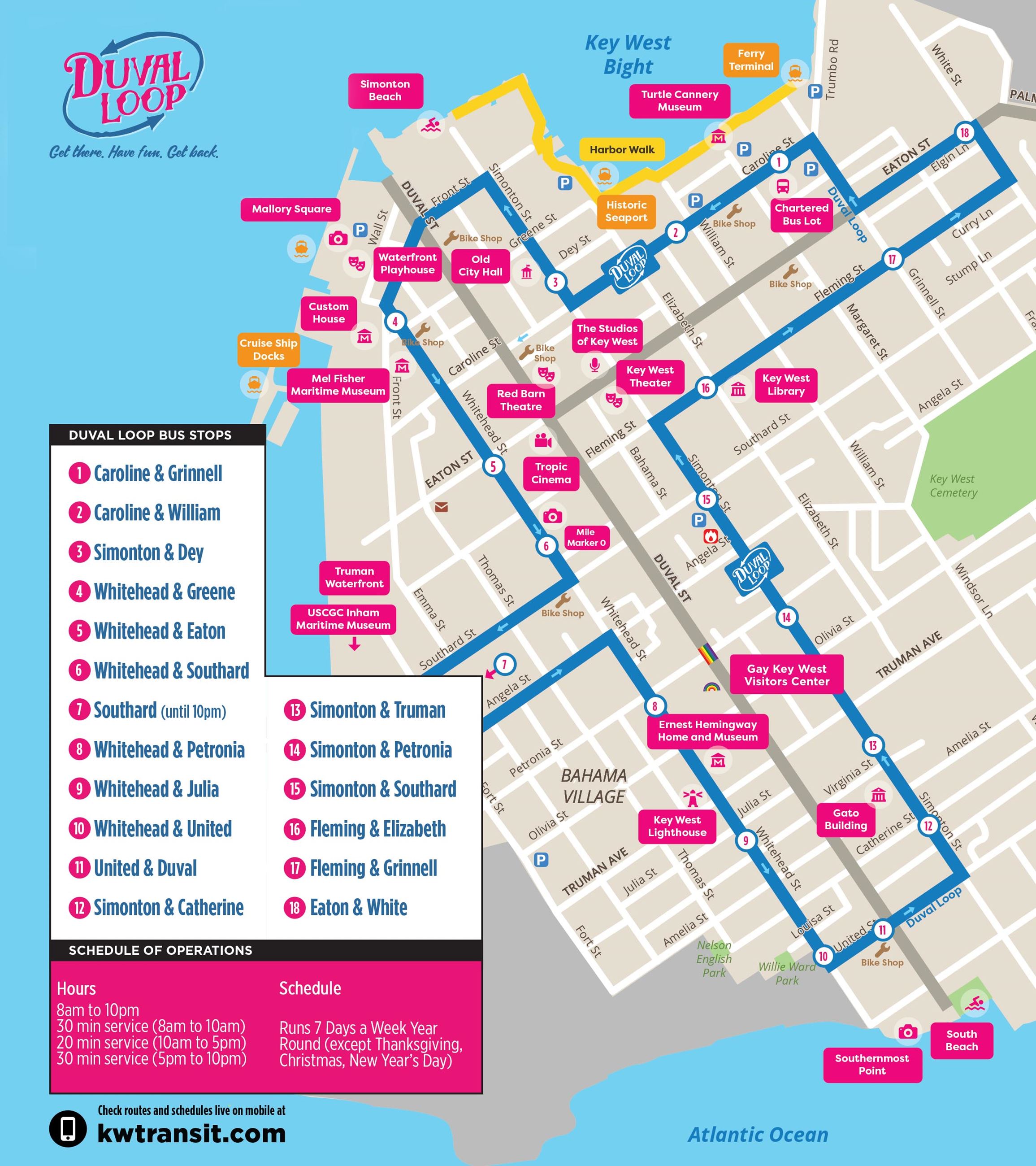
Although FY2026 began on October 1, the Duval Loop is still running—despite lacking dedicated funding to sustain it all year. That’s a hopeful sign.
Transit Director Rogelio Hernandez told us his team “has a date in mind” for shutting down the service and will “share that information with everyone soon.” He emphasized that the Loop isn’t being eliminated but “suspended,” adding:
“It’s not a goodbye, just a ‘see ya later.’ The Duval Loop will be back, and it’ll be even better.”
He also noted:
“There are some other improvements in the pipeline, and we will be happy to share more information as we get closer to implementation.”
Mr. Hernandez, who’s been director since spring, seems more determined than past leadership to find sustainable local funding to enable him to build the program. Maybe they’ll figure something out and keep the Loop running. We’ll find out when the public does—and we’re hoping for the best.
Ridership Reality Check
Transit systems live or die by their numbers. In Key West, those numbers don’t just reflect how many people ride—they help determine how much funding the system receives from state and federal sources. Ridership is up overall, about 2% vs last year, but only because of one route. Without the Duval Loop, the picture looks worse than it is.
Here’s the updated annual ridership for FY2025 (October 1, 2024, through September 30, 2025):
- Duval Loop: Up 15%, from 125,655 to 144,385. But after the $1 fare was introduced, ridership dropped 45% in the final 3 months vs the first 9 months and dropped 8% vs the same three months the year before.
- Lower Keys Shuttle: Ridership is 3% down—97,522 vs 100,533 last year.
- Key West Rides: Down 15%, with 70,458 rides this year vs 82,699 last year.
- Workforce Express: Up 11%—18,399 vs 16,581 last year but still not a lot of rides.
Worth noting: despite initial reports that Key West Rides was overwhelmed after Conch Connect shut down on August 15 (which had 65,000 rides last year), August and September ridership for Key West Rides (5,425 + 5,674) was actually 11 percent lower than the same two months the previous year (6,345 + 6,056). So, the impact has yet to show up in the data. And where did Conch Connect’s rides go?

Share of total ridership this fiscal year:
- Duval Loop: 44%
- Lower Keys Shuttle: 29%
- Key West Rides: 21%
- Workforce Express: 6%
Looking at the bigger picture: Annual total ridership in Key West has fluctuated significantly over the past decade:

Since the pandemic, ridership has increased each year—a positive trend. But 44% of that total now comes from the Duval Loop. In FY2016 and FY2017, before the Loop existed, the system still carried 250,000 to 300,000. And in FY2018 and FY2019 the City Routes were carrying double the current City Routes (KWR + WFE). It begs the question, what was working then?
The Backbone, The Gamble, and The Question Mark
We’ve discussed the Duval Loop a lot this summer (here, here and here). Three services remain. Each plays a different role—and each faces different challenges.

Lower Keys Shuttle (The Backbone)
With 10 trips a day in each direction, every 90–120 minutes from Marathon to downtown Key West, the Lower Keys Shuttle is the backbone of the remaining system. It’s hasn’t changed in a decade, and last year the City completed a $1.4 million mostly grant funded “final mile” upgrade to all 62 stops: new bike racks, fix-it stations, trash and recycling bins, solar flagging, and posted maps and schedules—a rarity on other routes.
Strong ridership and regional importance make it the strongest candidate for future investment. Riders we talked to on Facebook agree: “If the schedules were more frequent… more people would travel.” Another added, “With 90–120 minute waits… it’s hard to rely on it as regular transportation.”

Key West Rides (The Gamble)
Launched in November 2022, Key West Rides replaced the fixed North and South routes with an Uber-like on-demand model. The City hoped to stretch limited drivers and funding by expanding coverage and restoring weekend service—without increasing costs.
But the service hasn’t lived up to its promise. Ridership dropped 15% this year, and pre-COVID fixed routes carried twice as many riders. The model offers flexibility—but lacks scale and reliability.
Riders have voiced frustration: “I’ve had to take Uber home because I couldn’t cancel in time,” said one museum worker. Another writes, “Just bring back regularly scheduled bus routes and run them till midnight.” Another customer chimes in, “I try to use KW rides. 2/3 of the time it is slick, and I’m impressed, but the other 1/3 it is unavailable. It seems the algorithm is set for high efficiency for a few users. Having a full sized bus as a personal ride seems wasteful. It is very frustrating to see almost empty buses going past my building while the app says there are no rides available.” And still another, “It’s a joke. KW Rides never has availability.”


Workforce Express (The Question Mark)
Born from Key West Rides data showing a pattern, the Workforce Express launched in June 2023 to serve commuters from Stock Island to downtown. It started strong: 8 trips a day, a direct 30-minute route from Wreckers Cay to Bahama Village.
Then the City mucked it up—cutting trips to 6 and stretching the ride to 45 minutes to serve more locations. Ridership rose 11%, perhaps that’s where some Conch Connect riders went, but the total still remains low.
One rider says: “I was very disappointed by this change. It’s wrong to claim this is an expansion of service when it’s actually 2 fewer buses a day and they are much less frequent. Changes like this should not be allowed without public meetings.” While another says, “Express…Does not mean all the stops all the time.” And, “What about people who work evenings? There is nothing available.”
Local business leader Paul Menta offered a clear critique: “We should be buying smaller buses and running them more frequently.” He added, “Routes need to drop off at more primary points,” and called for real-time tracking and shelter from the elements.
Taken together, Key West Rides and Workforce Express – the City Routes – now serve half the riders the City Routes (the fixed Orange, Red, Blue and Green) routes did in 2019 or 2018. It begs the question: why?

The Vision That Was: The Transit Development Plans
Plans Were Made. Promises Too.
Since 2020, we’ve chronicled Key West Transit’s evolution—from ambitious planning and public hearings to moments of silence and retrenchment. In 2019, the City adopted a bold 10-Year Plan, held hearings, and promised transformation. In 2024, after much community input and analysis, the City adopted another 10-Year Plan—less visionary, but still expansive.
But time and time again, the ball is placed for a kick—and just like with Charlie Brown and Lucy, it’s pulled away. Aaugh!!! Instead of moving forward, we’ve gone backwards. FY2026 cuts feel familiar—not just in their impact, but in their timing. The question now is whether this time, things really will be different. Lucy is holding the ball and Charlie Brown is lined up for the kick. Stay tuned…
From Vision to Revision
2019 TDP: A Map of Ambition
The original 2020-2029 TDP, adopted in 2019, envisioned a full island-wide network of circulators and connectors that built on the success of the new Duval Loop and existing fixed-routes:
- Duval Loop, Midtown Loop, New Town Loop, Old Town Loop, Stock Island Circulator
- Airport Connector (South), North Connector and KWIK (Stock Island Garage) Connector
- Lower Keys Shuttle
The goal was comprehensive coverage, frequent service, and neighborhood-level accessibility. Transit was imagined as a public good—ubiquitous, reliable, and free.


on the right. Click to enlarge each map.
2024 TDP: A More Measured Approach
The new 2025-2034 TDP, adopted in late 2024, still talks expansion, but it’s more cautious:
- North and South Connector fixed-routes make a return
- Lower Keys Shuttle gets a frequency boost (from 90-120 minutes now to 60 and eventually 30 minutes)
- Duval Loop sees extended hours (7am–12am)
- Workforce Express gets a major frequency upgrade (to every 15 minutes)
The 2024 plan proposes phased improvements, aiming to balance ridership gains with cost and efficiency. It’s less about blanketing the city and more about optimizing what’s already there.

What Was Working Then?
The 2019 map of existing services shows a more robust fixed-route system—Red, Orange, Blue, and Green routes, plus the Lower Keys Shuttle—serving key corridors and neighborhoods. These routes predated the Loop and formed the backbone of a more traditional transit network. Riders had predictable schedules, broader coverage, and fewer transfers. The system wasn’t perfect by any measure, but it was functional—and it carried over 300,000 riders without the benefit of a free circulator.
What’s on the Ground Now
- Duval Loop is still running—it’s no longer free—and is slated for suspension.
- Lower Keys Shuttle remains the backbone, with consistent ridership and regional importance.
- Key West Rides has replaced fixed routes with on-demand service, a sharp departure from the 2019 vision.
- Workforce Express has expanded to serve more places but remains underutilized due to limited trips.

The contrast is clear: before COVID, the City Routes—those intended to serve locals getting around the island—carried twice the number of riders they do today. The Duval Loop then doubled those already strong numbers, proving that demand exists when service is reliable and accessible. The 2019 Plan built on that momentum and envisioned even greater expansion. But after years of retrenchment, the 2024 plan, while scaled to reflect fiscal and political constraints, still added frequency and span to existing routes and even added two new fixed-routes. And now, FY2026 begins not with the renewed investment embodied in that plan—but with cuts.
Timeline: Evolution of City Services
| Date | Milestone | Notes |
| Aug 2017 | Duval Loop launches | Free circulator begins service; becomes most popular route. |
| Dec 2019 | 10-Year TDP adopted | Envisions island-wide network of loops and connectors. |
| May 2020 | North & South lines introduced | Replace pre-COVID Orange, Red, Blue, Green routes. |
| Nov 2022 | Key West Rides launches | On-demand replaces North/South; weekend service restored. |
| May 2023 | Workforce Express begins | Stock Island to Bahama Village commuter route. |
| Dec 2024 | New 10-Year TDP adopted | Adds frequency, span, and two new fixed routes. |
| Oct 2025 | FY2026 cuts begin | Duval Loop suspended; no new investment. |
Transit at a Crossroads: Without Funding a Plan Is Just a Placeholder
The FY2025–2034 TDP is technically still in effect. But are we following it—or drifting in yet another new direction? Previously the City quietly abandoned the 2019 plan saying “conditions have changed within the city” and that the 2019 TDP’s “expansion strategy is now outmoded fiscally and by workforce availability.” Translation: they didn’t have the funding. And now the new plan begins with cuts. It’s like déjà vu all over again.
Without new and increasing sources of real, sustained funding, we are just nibbling around the edges and treading water. So, the first order of business should be to commit to finding money. We’ve discussed the legal case for using Tourist Development Tax (TDT) or TDC funding. Commissioners Haskell and Kaufman have led the charge. The new Transit Director is looking at innovative sources. And at the September budgeting meeting, the City Manager and his finance team signaled a willingness to look at big ticket revenue: TDT funds, cruise ship disembarkation fees, expanded parking revenue and more.

So, what’s next for the City?
The Plan picks up on some things that were working pre-covid and that people asked for: more frequency on existing routes and new, simple direct, fixed-routes.
But we haven’t seen a roadmap from the City for the year ahead and implementing the Plan. And Monroe County? No plan at all.

What Needs to Happen Next
To move from retrenchment to renewal, Key West Transit needs more than promises—it needs action. Here’s what must happen:
- Keep the Duval Loop running while funding is secured
- Implement the 2024 TDP with clear timelines, public updates, and measurable goals
- Increase frequency on the Lower Keys Shuttle and Workforce Express
- Restore fixed-route service, as called for in the Plan, and when this happens simplify the meandering WFE
- Use Key West Rides to fill gaps—not replace the backbone of fixed routes
- Secure More Monroe County funding to add frequency on the Lower Keys Shuttle and Workforce Express to reflect the LKS’ regional role and WFE importance to Stock Island as a first step
- Monroe County needs to get back in the game as a second step and implement the wonderful plan they laid out for the future
- Both the City and County need to pursue new revenue sources—TDT funds, cruise ship fees, parking revenue, tolls, and grants
(County plan here)
These aren’t just technical fixes. They’re steps toward a system that serves workers, residents, and tourists—and builds a better life for everyone who calls the Keys home.

Closing: A Call to Action
We’ve laid out the facts. The ridership. The plans. The cuts. The history. And yes, the failures. But we’ve also seen glimmers—of leadership, of public pushback, of possibility. The Duval Loop isn’t gone. The Plan isn’t dead. And the people working on this—the under appreciated and under-staffed Transportation team, Commissioners, the City Manager—deserve support.
We’re not naïve. We’ve seen Lucy pull the football before. But we’re still here. Still watching. Still hoping. Because if Key West can build a transit system that works—for workers, for residents, for tourists—it won’t just move people. It’ll move us as a community forward.
# # #
Recent transit stories leading up to today’s:
- No Director, No Department, No Direction: Monroe County’s Transit Collapse September 21, 2025
- Duval Loop Eliminated: A Tragedy — and a Turning Point September 14, 2025
- Could Tourist Dollars Be The Answer to Our Transit Funding Problem? August 31, 2025
- Even If You’ll Never Ride the Bus, You’ll Feel It When It’s Gone August 24, 2025
- Transit Is Collapsing in the Keys. Will Business Leaders Let It? August 17, 2025
- Dumb and Dumber Transit Cuts: A Failure of Leadership in the Keys August 3, 2025

Chris Hamilton is the founder of Friends of Car-Free Key West & Duval Street/Historic Downtown, a local advocacy group championing sustainable mobility and vibrant public spaces. Subscribe to the blog and follow on Facebook, Twitter, and Substack for updates. All stories are cross posted at KONK Life News. Originally from Washington, D.C., Chris spent over two decades leading nationally acclaimed initiatives in transit, biking, walking, and smart growth for Arlington County, VA’s DOT. Since moving to Key West in 2015, he has embraced a car-free lifestyle downtown, dedicating his time to non-profits and community projects. Explore all Streets for People column articles here.
A bus service that shuts down at 8pm is useless in a tourist community with an active nightlife. There are hundreds of businesses still operating when the buses stop. Either we need more cars and parking downtown or a bus system that is running when people get off work.