
Don’t Let the TDC Stonewall Using Tourist Monies for Tourist-Serving Transit
Posted on January 11, 2026 1 Comment

Why the City Must Push Monroe County and the TDC to Act Now on Using Tourist Tax Dollars for Tourist-Serving Transit While Also Planning for the Future
At Tuesday’s January 6 Commission meeting, hope was in the air that a little funding for our beleaguered public transit system could be found. It came in the form of a discussion item brought forth by Commissioner Monica Haskell that asked the question: “Should the City seek tourist tax funds to support tourist-serving transit like the Duval Loop?”
Nearly all of the Commissioners said some form of yes, let’s pursue it. The City Manager said he was already on the case too. And a letter of apparent support arrived just before the meeting from Kara Franker, the President and CEO of the County’s Tourist Development Council (TDC). Everything seemed to be aligning nicely for a helpful solution to a funding problem that has bedeviled both the City and County transit programs.
Except upon reading the fine print of Ms. Franker’s letter, which wasn’t available until after the meeting, perhaps it wasn’t as supportive as some thought and cheered. Her phrase “I’m not opposed, in principle” gave us immediate pause. And it seems like she’s sowing the seeds for kicking the can down the road by offering that the “appropriate next step is a deliberate, countywide evaluation of tourist-oriented transportation needs” and that it’s “a topic worth studying thoughtfully.” One can imagine that by the time this is thoughtfully studied and deliberately planned to death over the next few years, the Duval Loop will be a distant memory and more frequent transit on other routes will be too.
No. Absolutely not. We can walk and chew gum at the same time. Yes, Ms. Franker’s correct, we should indeed be planning for the future. But the next budget year that begins October 1, 2026, for which there will be discussions this summer, should include fully funding a free Duval Loop out of Tourist Tax Dollars. And they should add some funding for the Lower Keys “Tourist” Shuttle too. The TDC marketing juggernaut can spare a few million next fiscal year, while they, the County and the City plan for the big stuff. Let’s break it down in our story below.
Recap: Why Tourist Tax Funds for Transit?
Key West’s transit system has faced severe challenges in recent years. The Duval Loop has been suspended, and other transit services have struggled due to unreliable federal and state funding. The County’s Conch Connect and transit department were eliminated for similar reasons, leaving a gap in reliable transportation for workers, residents and visitors.
As we explored in last week’s story, Funding Transit Without Raising Local Taxes: A Win for Tourists and Residents,Tourist Development Tax (TDT) funds, collected from visitors, offer a stable, local source to support transit primarily serving tourists. This approach enhances the visitor experience, reduces congestion, and supports the hospitality industry—all without raising local taxes or burdening residents.

What Happened at the January 6 Meeting?
The City Commission discussed the idea but did not make any immediate decisions. Key points included:
- Haskell and Kaufman Lead: Commissioner Haskell emphasized she wasn’t asking for a reallocation of existing funds but looking at future budgets, reminding everyone that tourists pay these taxes, not residents. Commissioner Sam Kaufman expressed strong support and stressed the need for clear documentation of tourist benefit and coordination with the County.
- Calls for Support and Caution: Commissioner Aaron Castillo supported exploring reserve funds and TDC funds as options. Commissioner Veliz said, “Anything we can look at to get more money into transit—I’m for that.” Commissioner Lee urged caution, noting the concept has a long way to go and there are competing interests for TDC money.
- TDC’s Position: Kara Franker, President & CEO of the Tourist Development Council (TDC), sent a letter that morning emphasizing that while she is not opposed in principle, any use of TDT funds must comply with Florida law, be fiscally responsible, and equitable across Monroe County. She called for a countywide, long-term transportation strategy rather than piecemeal action.
- Budget and Funding Discussions: The Commission discussed potential funding sources, including reallocating funds from reserves or future budgets, but no commitments were made.
- Mayor Directs Next Steps: The Mayor directed the City Manager to work with the County and report back, signaling ongoing collaboration.
This discussion reflects cautious optimism but also highlights the need for clear plans and cooperation across jurisdictions to move forward effectively.

Our Take: The Ball Is in Their Court, But It Should Move Faster
The “Their” in this subtitle primarily refers to Monroe County and the Tourist Development Council (TDC), who control the allocation of Tourist Development Tax funds. However, the City of Key West also has a critical role to play. The City must actively insist and collaborate with the County and TDC to ensure timely and decisive action on funding tourist-serving transit. While the responsibility is shared, the urgency demands faster movement from all parties involved.
Kara Franker’s call for a thoughtful, countywide strategy is reasonable and necessary, but it risks delaying much-needed improvements. The transit crisis is immediate, and the Duval Loop is already designed to serve tourists. There is no need to reinvent the wheel or wait years for a comprehensive plan before allocating some funds. Here are two key actions that should happen now:
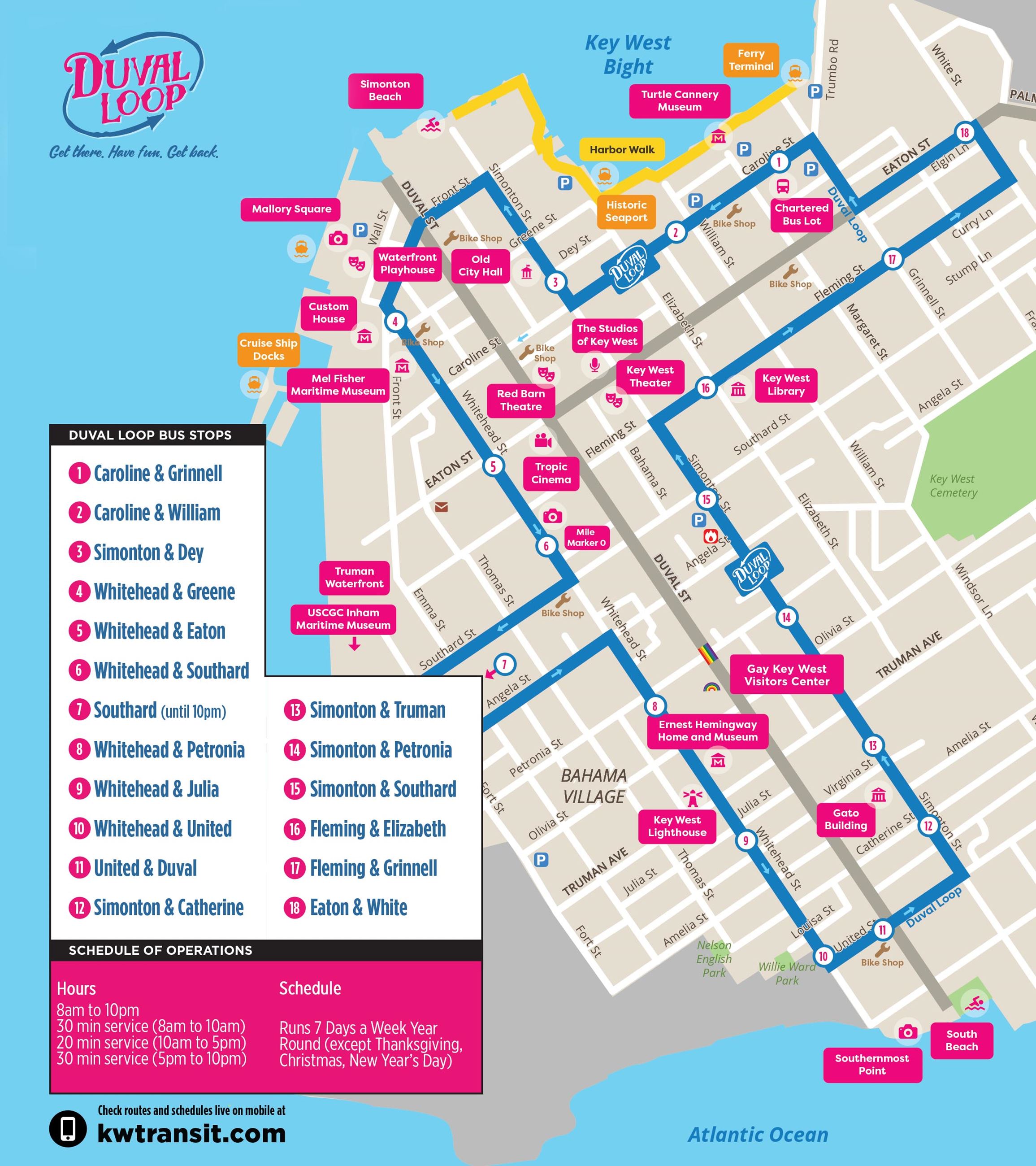
1. Fund the Loop and Enhance the LKS in the 2027 TDC Budget
We believe the County and TDC could easily allocate a few million dollars from next year’s TDC budget to restart and expand a free Duval Loop by October 1, 2026, and enhance the Lower Keys “Tourist” Shuttle, which naturally serves tourist lodging and destinations along US Route 1 between Marathon and downtown Key West. The Loop needs less than $1.5M annually to run a “free and frequent” circulator. And with another $1.5M added to the Lower Keys “Tourist” Shuttle, one could increase the moribund 90-120 minute current frequencies down to 60 minutes or less. That’s less than 10% of the current TDC marketing program.

This approach would:
- Provide immediate relief to visitors and reduce congestion.
- Demonstrate commitment to sustainable tourism and transit.
- Leave other funding sources available to support resident-serving transit.
And for goodness sake if there’s any leftover money from some source of unused funds, start sooner than October 1.
2. Plan for Transit and Its Funding for the Future
The City of Key West has an adopted 10-Year Plan that is just a little more than one year old. While not as formalized, the County had a long-term transit plan that included 30-minute trunk service along the Overseas Highway from Key Largo to downtown Key West, supplemented by a series of circulator and on-demand services in the villages up and down the Keys. Start with these, figure out how much money they need and what portions can be realistically funded by TDT funds as “tourist-serving” transit. And then figure out how we come up with the balance of funds needed.
The City and County Should Take Action NOW While Planning for the Future

Tourist Development Tax funds are allocated at the County level, so the City of Key West must actively engage Monroe County and the Tourist Development Council (TDC) to take decisive action. These funds represent a vital resource that can be reinvested in visitor-serving transit to boost the tourism economy and improve quality of life for all.
To avoid being caught flat-footed during the summer’s budget session, the County and TDC need to begin their due diligence immediately. This means lining up all necessary legal, fiscal, and procedural steps to allocate approximately $3 million for tourist-serving transit without delay.
At the same time, the City and County must initiate a long-term transit planning process that includes securing more stable funding. While reorganizing existing revenues in the next fiscal year is part of the solution, there may also be opportunities to increase the Tourist Development Tax within the limits allowed by state law. Exploring these options now will ensure a sustainable transit future for the Florida Keys.
Delaying action risks losing momentum and prolonging transit challenges that hurt workers, residents, and businesses alike. Your voice matters—urge local leaders to prioritize immediate funding for visitor-serving transit and to plan strategically for the years ahead.
Together, we can build a more accessible, less congested, and visitor-friendly Keys for everyone. Waiting too long risks procedural delays that could push funding decisions well beyond the next fiscal year.
# # #
Contact your Monroe County Commissioners, TDC Board Members, and contact Key West Mayor and Commissioners

Chris Hamilton is the founder of Friends of Car-Free Key West & Duval Street/Historic Downtown, a local advocacy group championing sustainable mobility and vibrant public spaces. Subscribe to the blog and follow on Facebook, Twitter, and Substack for updates. All stories are cross posted at KONK Life News. Originally from Washington, D.C., Chris spent over two decades leading nationally acclaimed initiatives in transit, biking, walking, and smart growth for Arlington County, VA’s DOT. Since moving to Key West in 2015, he has embraced a car-free lifestyle downtown, dedicating his time to non-profits and community projects. Explore all Streets for People column articles here.
Funding Transit Without Raising Local Taxes: A Win for Tourists and Residents
Posted on January 4, 2026 2 Comments

How Commissioner Haskell’s January 6 Discussion Could Change the Game
By now, most know that 2025 was a challenging year for public transit in the Keys and Key West. Monroe County dismantled its fledgling transit department and Conch Connect service, while the City of Key West suspended its popular downtown circulator, the Duval Loop. Both governments blamed cuts to Federal and State transit funds, but the responsibility lies with them to plan better and not rely on these volatile sources.
The impact? Workers and residents are left stranded without reliable transit options, and tourists—77% of whom arrive by car—are forced back onto those vehicles to get around, causing congestion and parking problems. But as we enter 2026, hope rises with the upcoming City Commission meeting on January 6, offering a chance to begin addressing this crisis.

Commissioner Monica Haskell, who has persistently championed this issue since early summer has placed a Discussion Item (#34) before the City Commission. She asks, “Do we support seeking tourist tax funds to fund tourist-serving transit like the Duval Loop?” The accompanying information she provides states this will “enhance the visitor experience, alleviate congestion, and bolster the hospitality industry.”
These are compelling reasons for all Commissioners to support and vote yes.
In the story below, we explore why tourist funds are essential, how this approach could work and the legal basis for using this source of monies. We also examine how it benefits not only tourists but also workers, residents, and the hospitality industry we all rely on. We hear from business leader Paul Menta and Commissioner Sam Kaufman and explain how you can urge the Mayor and Commissioners to back this crucial initiative for our island’s future.
Why Tourist Tax Funds?
| Category | Amount | Source |
| Monroe County TDT Revenue (FY 2024) | $61.5 million | FY 2024 Annual Report (PDF) |
| Transit Funding from TDT | $0 | FY 2024 Annual Report (PDF) |
| Marketing Spend | Estimated $30–40 million | FY 2024 Annual Report (PDF) |
Most of the funding for Key West Transit has come from Federal and State transit sources and grants, with the remainder from parking fees, fares, and advertising revenue. No General Fund or local tax dollars have ever been used. While staff have begun exploring other smaller innovative funding sources, these efforts will make only tiny dents in the funding gap. Relying on unstable State and Federal transit dollars has created a boom-and-bust cycle, preventing the realization of ambitious 10-Year plans. This underscores the need for a reliable, stable local funding source like tourist taxes.
Tourist Development Tax (TDT) funds come from taxes paid by visitors, not residents. Using these funds to support transit services primarily serving tourists does not increase general taxes or burden local taxpayers. Instead, it leverages the money tourists already contribute to enhance their experience and reduce congestion. This is why we also advocate exploring cruise ship disembarkation fees and more dedicated parking fees—costs largely borne by tourists.
What the Law Allows Regarding TDT Funds
In our August 31 story, Could Tourist Dollars Be the Answer to Our Transit Funding Problem?, we explored the specific legal framework governing the Tourist Development Tax (TDT) and what it permits. Florida Statute §125.0104(5)(a)(6) clearly allows TDT funds to be used for transportation systems designed to increase tourist-related business activity. This includes capital projects and services that primarily serve tourists.
Transit services such as the Duval Loop and Lower Keys Shuttle, which connect hotels, attractions, and beaches, fit squarely within this statute—especially when ridership data demonstrates their role in serving visitors. Commissioner Haskell’s information item also affirms this interpretation.
Further backing this, a Florida Attorney General Opinion AG 217-06 confirms that transportation services must be designed and promoted as part of the tourism experience to qualify for TDT funding.
This legal clarity strengthens the case for using tourist tax funds to support transit services that enhance the visitor experience while benefiting the local economy.
Some have questioned whether Tourist Development Tax funds can legally support transit like the Duval Loop and Lower Keys Shuttle. The key is that these services are designed primarily for tourists. The Duval Loop is explicitly designed to serve visitors, connecting hotels, attractions, and key destinations. In fact, City surveys have said that upwards of 80% of riders are tourists. The Lower Keys Shuttle, by running along US Route 1—the only road in the Keys—naturally serves all hotels and tourist spots. While the route itself may not change, branding and marketing can emphasize its role as a tourist-serving transit system.
Florida’s Attorney General Opinion AG 217-06 confirms that if a transit service primarily serves tourists and is promoted as part of the tourism experience, it qualifies for TDT funding. This aligns with Commissioner Haskell’s information item and the legal framework outlined in Florida Statute §125.0104(5)(a)(6).
This approach ensures that tourist tax dollars are reinvested to enhance the visitor experience, reduce congestion, and support the hospitality industry—benefiting both tourists and the local economy.
Future Use of TDT Funds?

Our August 31 story suggested that perhaps some of the $60M-plus TDT revenue collected in 2024 could be redirected. Specifically, we highlighted a portion of the $30-$40 million currently spent on marketing as a potential source. Commissioner Haskell’s information item notes that Florida Statute §125.0104 allows counties to add an additional 1% to 2% tourist tax, which would require a local referendum and approval by the county commission.
It’s not yet clear whether Commissioner Haskell is proposing to reallocate a portion of existing funds or to pursue an increase in the tax to support transit. This will likely be a key point of discussion at the January 6 meeting. Regardless, her direction signals a positive step toward securing sustainable funding for visitor-serving transit.
Benefits of Tourist-Serving Transit
Transit is a strategic investment in tourism that amplifies the island chain’s appeal and markets the free-and-easy spirit that makes the Keys unique.
- Enhances Visitor Experience: Reliable transit connecting key tourist destinations makes exploring the city and islands easier and more enjoyable.
- Alleviates Congestion: Reducing car traffic in popular areas helps preserve the charm and accessibility of Key West and neighborhoods throughout the Keys.
- Supports the Hospitality Industry: Easier movement for visitors means more business for hotels, restaurants, and attractions, and helps residents reliably get to work without the expense of owning a car.
In addition, transit can reinforce TDC messaging and branding by using participating vehicles as rolling billboards and placing TDC information on the outside and inside of buses and at stops. Real solutions paired with smart marketing amplify the island’s appeal.

Business Leader Paul Menta and Commissioner Kaufman Support Use of TDT Funds for Tourist Serving Transit
“I urge both the City and County to move quickly to make it happen.”
Sam Kaufman has long been a vocal proponent of public transit and bicycles. This past summer was no exception as he led the charge to try and save the Duval Loop. In the end it wasn’t enough, but he held City management to the task by saying he excepted them to come back in a few months with plans for new funding from TDT, cruise ship, parking and other sources to not only save the Duval Loop but to implement the long term plans that call for more and better service on all the routes. Here’s what he said when we asked him about Item #34 on the January 6 docket:
“Transportation services like the Duval Loop and the Lower Keys Shuttle are essential infrastructure for Key West. They reduce congestion, support our workforce, enhance the visitor experience, and help residents and tourists move safely and efficiently through our city. I strongly support using Tourist Development Council funding for these services, and the City should do everything it can, and as quickly as possible, to restore the Duval Loop now that service has been suspended. These transit investments also support climate resilience by reducing vehicle miles traveled, promote reduced traffic congestion in our historic downtown, and make it more realistic for working families to live and work here without relying on multiple vehicles. This is exactly the kind of smart, forward-thinking public policy that benefits residents, visitors, and our local economy, and I urge both the City and County to move quickly to make it happen.”

“Tourism Dollars Need to Support Tourism Transportation.”
We’ve been quoting Paul Menta, leader of the Shop Mom and Pop Key West business group and owner of the Key West First Legal Rum distillery for years as a proponent for better public transit, safer bike routes and affordable housing. Here’s what he had to say when we asked him about Commissioner Haskell’s initiative:
“As we step in the 2026 and we see what is hoping to be a busier tourist season, it brings a smile to my face to see more bicycles than ever all over town as people get around. The Duval Loop, which is a nice perk for tourists, cannot take money from our public transportation for the elderly and our workers. Tourism dollars need to support tourism transportation. The city could not afford to do this, and I think with the new transportation coordinator creating new routes for workers making it easier for them to get to their workplaces is just as important as workforce housing. Also, our senior citizens need places to sit and shade, and you have to have a budget for this. I believe that the Loop and the rest of the City’s transit routes should be separate entities. I travel a lot in this world and generally transportation is not free for tourism. Got to put the oxygen mask on ourselves first, keep riding those bikes!”
Paul has a point. By spending tourism dollars on tourist serving transit, it should free up money to improve the City’s other transit services. Paul has been advocating for more frequent and better spans of service, and he says the City should make this as much a priority as workforce housing. Amen!
Let’s Support Commissioner Haskell’s Initiative
Depending upon federal and state grants to fund public transit has proven foolhardy over the years. Using TDT funds is just one of a number of potential new local non-property tax or general fund sources that should be looked into. But for today, using TDT funds for tourist-serving transit and thus supporting this initiative on January 6 is a win-win, no brainer.
While the initiative requires approval by the County Commission and possibly a local referendum, it is important to emphasize that this funding approach does not divert general tax revenues. It is a strategic reinvestment of tourist dollars into infrastructure that benefits tourism and the local economy.
The City Commission should endorse seeking tourist tax funds to stabilize and expand visitor-serving transit. This is an investment in Key West’s future as a premier tourist destination and a more accessible, less congested city.
Commissioner Haskell’s question is direct: “Do we support using tourist tax funds for transit like the Duval Loop?”
The answer is a clear and resounding YES.
# # #
Contact Your Key West Mayor and Commissioners:
- Key West Commissioner Directory
- Mayor Danise “DeeDee” Henriquez: mayor@cityofkeywest-fl.gov
- Monica Haskell (District 1): DistrictI@cityofkeywest-fl.gov
- Samuel Kaufman (District II): DistrictII@cityofkeywest-fl.gov
- Donald “Donnie” Lee (District III): DistrictIII@cityofkeywest-fl.gov
- Lissette Carey (District IV): DistrictIV@cityofkeywest-fl.gov
- Greg Veliz (District V): DistrictV@cityofkeywest-fl.gov
- Aaron Castillo (District VI): DistrictVI@cityofkeywest-fl.gov
Submit an eComment: Visit the City legislative website here, look for the date of the meeting and at the far right you’ll see a button for eComment. Here’s a direct link to Item 34.
Chris Hamilton is the founder of Friends of Car-Free Key West & Duval Street/Historic Downtown, a local advocacy group championing sustainable mobility and vibrant public spaces. Subscribe to the blog and follow on Facebook, Twitter, and Substack for updates. All stories are cross posted at KONK Life News. Originally from Washington, D.C., Chris spent over two decades leading nationally acclaimed initiatives in transit, biking, walking, and smart growth for Arlington County, VA’s DOT. Since moving to Key West in 2015, he has embraced a car-free lifestyle downtown, dedicating his time to non-profits and community projects. Explore all Streets for People column articles here.
Bikes Gain Ground, Transit Faces Crisis: Key West’s 2025 Transportation Story
Posted on December 21, 2025 Leave a Comment

As 2025 draws to a close, it’s clear that this year has been a defining one for transportation and urban mobility in the Keys and Key West. Our 24 stories this year reveal a tale of two contrasting trends: meaningful progress in bicycle infrastructure and advocacy, alongside significant setbacks in public transit.
The year saw our community make strides toward safer, more accessible cycling options including new bike lanes, kickoff of a new Safety Action Plan and a brand new bike bridge, among other projects, that promise a more bike-friendly future. Meanwhile, transit services faced severe challenges, with the County ending its transit program entirely and the City suspending its flagship Duval Loop service. These changes have left many workers, residents, and visitors grappling with fewer reliable options to get around without the expense of owning a car.
In our story below we’ll briefly review the island’s advances on the bicycle front and examine what’s gone wrong with transit. We’ll also touch on how the resignation of the Planning Director fits into the larger theme of transit’s collapse. As well as look at how the erasing of our rainbow crosswalks sparked local engagement and hope amid these shifts.


Progress on Bicycle Infrastructure
The year began with a spark of controversy when Commissioner Donnie Lee raised concerns about e-bike safety, igniting a community-wide conversation that ultimately left more questions than answers (Commissioner Lee Is Right. It’s Time To Get Fast Moving E-Bikes Off of Our Promenades, January 10)). Today, the most promising path on a solution on e-bikes lies with the Safety Action Plan committee (Zero Fatalities by 2035 – Key West Aims for Safer Street for All, July 27), which is actively identifying projects and policies aimed at making the island safer for cyclists, pedestrians and drivers. This plan represents a significant step, and we eagerly anticipate its completion in 2026.
Infrastructure improvements marked the year, with the completion of new bike lanes on South and United Streets downtown (Rebuild of South Street Is Complete and Includes New Bike Lane, January 27) standing out as a major milestone. The opening of the upgraded Staples Avenue Bike and Pedestrian Bridge (The Crosstown Green – The Locals Not So Secret Bikeway, November 7) further enhanced connectivity, alongside a bunch of ongoing efforts, including roundabouts, signage, data collection and upcoming initiatives at many of the intersections along the almost 4 mile long Crosstown Greenway route.
Looking ahead, the question posed in our story Could Key West Become the Paris of Small Cities? July 1 captures the optimism of the moment. With our compact size, favorable weather, and walkable urban grid, Key West has the potential to become a model city for biking with continued commitment and effort.
Transit in Crisis

Early Promise and Optimism
The year began with hope as the County’s Conch Connect micro-transit service showed promising signs of success, earning praise for its innovative approach to local transit (Just Six Months Old, Conch Connect Micro-Transit Is Already Beating Expectations, January 24). This service offered a glimpse of what a responsive, flexible and well-branded transit system could look like for the Keys. And just months before that at the end of 2024 the City adopted an ambitious 10-year Transit Development Plan that promised expanded service and new routes.
Beyond Conch Connect, the County had ambitious plans to expand transit service across the island chain. The vision included a 30-minute trunk line running the length of the Keys, providing frequent, reliable service along the main corridor. This would be complemented by neighborhood circulators and on-demand transit options designed to serve local areas and provide first-and last-mile connections. These plans represented a forward-thinking approach to transit, aiming to create a network that was both comprehensive and adaptable to community needs. Unfortunately, these promising plans were never fully realized, as the County’s transit program was abruptly dismantled early in the summer (Conch Disconnect: County Scraps Transit Service for Local Workers, July 20 and Conch Disconnect: Repeal Without Replace Is Just Regression, July 24) and the City’s plans came undone slowly over the the same time period.
The Summer Collapse
In what proved to be a foreboding of bad things to come, in June, the City announced that the Duval Loop would begin charging $1 per trip starting in July—a move we covered and criticized as penny wise and pound foolish (The $1 Mistake: How Key West Is Undermining the Duval Loop, Again, July 6 and Making the Duval Loop Free and Easy Helps Downtown Prosper, July 14).
It wasn’t until the end of July, during budget season, that the potential permanent cuts became clear. Both the County and City seemed to unravel as preliminary budgets were released, and Federal and State grants—funding sources they arguably should not have been relying on—began to dry up. The County abruptly ended Conch Connect and disbanded its entire transit department, while the City suspended the Duval Loop service amid financial pressures, while congratulating itself for not cutting other services. Neither entity appeared to have planned ahead or taken public transit seriously enough to ensure continuity. The result has been a severe reduction in transit options, leaving many workers, residents, and visitors with fewer reliable ways to get around without a car (Dumb and Dumber Transit Cuts: A Failure of Leadership In the Keys, August 3 and Transit Is Collapsing In the Keys. Will Business Leaders Let It? August 17).


Community Impact and Response
Our coverage throughout the summer and fall documented the fallout from these decisions that wouldn’t officially be codified until budgets were adopted in September. With no more Conch Connect, trip requests initially surged on the similar Key West Rides overwhelming the service, and community frustration grew palpable. Many stories highlighted how these cuts disproportionately affected workers and residents who depend on affordable, reliable transit daily. Business leaders (especially Paul Menta) and city officials (most notably Commissioners Sam Kaufman and Monica Haskell) have stepped into the conversation, exploring alternative solutions and advocating for restored and improved transit options (Even If You Never Ride the Bus, You’ll Feel It When It’s Gone, August 24 and Key West Rides Overwhelmed After Conch Connect Shutdown – City Pushes Alternative Buses Amid 36% Spike In Trip Requests, August 26).
Leadership and Funding Challenges
The transit crisis has exposed significant leadership voids and funding shortfalls. The County’s decision to end its transit department and the City’s budget-driven suspension of the Duval Loop reflect a lack of coordinated planning and investment. These challenges raise urgent questions about the future of transit in Monroe County and the City, underscoring the need for renewed commitment and innovative funding strategies (Duval Loop Eliminated: A Tragedy and a Turning Point, September 14 and No Director. No Department. No Direction: Monroe County’s Transit Collapse, September 21).

A vivid example of these leadership challenges came in September with the resignation of Katie Halloran, the City’s Director of Human Resources (Katie Halloran’s Quiet Revolution, September 7). In a public letter, Halloran detailed a hostile work environment, understaffing, and a lack of responsiveness to internal complaints. Her departure highlighted deeper organizational dysfunction within City government, which has compounded the difficulties in managing transit and other essential services. This story adds a human and institutional dimension to the transit crisis, illustrating how internal struggles at City Hall have further undermined efforts to maintain and improve public transportation in 2025.
Looking to the future, our article Could Tourist Dollars Be The Answer to Our Transit Funding Problem? August 31 offers a critical lens on potential solutions. As 2026 approaches, the community’s focus must turn to securing sustainable funding and leadership to rebuild and reimagine transit services that truly meet the needs of all who live, work, and visit the Keys.
Rainbow Crosswalks: A Symbol of Community and Hope
Among the challenges of 2025 we’d include the erasing of our rainbow crosswalks at Duval and Petronia by the State of Florida. But something remarkable happened as the community banded together first in protest and then for solutions that included installation of rainbow bike racks and a future rainbow welcome arch. These vibrant symbols celebrate diversity and foster local engagement and hope during a year marked by transit setbacks and infrastructure debates. Our stories (From Rainbow Crosswalks to Rainbow Museums, September 10 and This Is Just the Beginning Rainbows Return to Duval, October 7) highlight how such initiatives contribute to the city’s cultural fabric and community spirit, inspiring ongoing conversations about inclusion and public space.


Looking Ahead to 2026
As we move into 2026, the challenges facing transit demand renewed focus and innovative solutions, that we hope are captured in our recent article After the Loop’s Gone, What’s Next for Key West Transit, November 29. Meanwhile, the momentum behind cycling and safer streets offers hope for a more balanced, sustainable transportation future in the Keys.
Thank you for following along this year. We look forward to continuing this vital conversation and advocacy in the year ahead because an island that is bike, walk and transit friendly and remembers that our downtown streets are for people first, is a more prosperous, healthy, green, equitable and happy little island paradise.
# # #
Our Most Popular Stories Ranked By Views On WordPress (Doesn’t include KONK Life or Substack Views).

Chris Hamilton is the founder of Friends of Car-Free Key West & Duval Street/Historic Downtown, a local advocacy group championing sustainable mobility and vibrant public spaces. Subscribe to the blog and follow on Facebook, Twitter, and Substack for updates. All stories are cross posted at KONK Life News. Originally from Washington, D.C., Chris spent over two decades leading nationally acclaimed initiatives in transit, biking, walking, and smart growth for Arlington County, VA’s DOT. Since moving to Key West in 2015, he has embraced a car-free lifestyle downtown, dedicating his time to non-profits and community projects. Explore all Streets for People column articles here.
After the Loop’s Gone, What’s Next for Key West Transit?
Posted on November 29, 2025 1 Comment

Even with enhancements underway, reliable funding is key to making transit dependable for workers, residents, and visitors.
About six weeks after our October 12 story asked, “Can Key West Transit Rise Again?” where we detailed the impending cuts and analyzed existing services and plans, transit staff recently laid out a clearer, if still uncertain, path forward at a November 13 public meeting in Bahama Village.
The Duval Loop, a vital circulator route for visitors, workers and residents alike will be officially suspended on December 31, 2025. While the Loop continues to run for a few more weeks, this, we hope, temporary shutdown underscores the ongoing challenges facing City amid budget cuts and shifting funding landscapes.
We learned at the meeting that within the framework of this year’s budget, the Key West Transit (KWT) team is actively making numerous small but meaningful improvements across the system. These include upgrades to bike racks on the buses, backend software enhancements for the Key West Rides on-demand service, farebox modernization, and route fine-tuning on the Lower Keys Shuttle and Workforce Express. At the same time, staff are focused on securing funding to bring the Loop back and improve service frequencies and capacities on other routes. We learned the meeting is part of a broader dialogue KWT wants to have with the community, reflected in public meetings held in November—and with another meeting planned for December, though the date has yet to be announced.
In our story below we’ll go through what we’ve been hearing about these improvements, listen to what the public has to say, discuss why finding reliable funding is consequential to improved service and how we need to stay on top of officials to ensure this all happens.
What We Know So Far: Key Takeaways

Duval Loop
The suspension of the Duval Loop is now official, with the last day of service set for December 31, 2025. However, city staff emphasize that this is a temporary suspension rather than a permanent elimination. There is no set date for when the Loop will restart, but hopes are pinned on the next fiscal year, which begins October 1, 2026. To guide improvements, the city has engaged a consultant to review the Loop’s operations and recommend changes that better integrate potential future mobility hubs.
Working on Improvements This Year That Include:
At the November meeting, Transit Director Rogelio Hernandez shared some exciting updates on the many improvements underway across Key West Transit. These projects tackle rider concerns and operational challenges head-on, aiming to enhance the overall transit experience in tangible ways. Here’s a closer look at what’s happening:
- Bike Racks: Key West Transit is installing new bike racks on all buses, increasing capacity from two to three bikes. These upgraded racks are designed to accommodate larger, heavier bikes, including longer and thicker models, directly addressing frequent rider complaints. A cool new feature will provide real-time information on bike rack availability, helping riders know in advance if there is space for their bike. This enhancement encourages multimodal trips by making it easier for cyclists to combine biking with bus travel, a crucial step in expanding transit accessibility and convenience.
- On-Demand Software Upgrades: The Key West Rides on-demand service is undergoing backend software upgrades aimed at improving operational efficiency. A key focus is enforcing a no-show policy more effectively to reduce service disruptions caused by riders who book rides (taking up allocated seat space) but fail to show up. Additionally, workers will soon be able to pre-book rides up to a week in advance and specify arrival times, allowing the system to optimize pick-up schedules and improve reliability. By minimizing no-shows and enabling advance booking, the system can better allocate resources and ensure more reliable service for all users, especially workers.
- Farebox Modernization is underway, with plans to enable tap payments using credit cards and mobile wallets like Apple Pay. Expected to be operational by spring, this upgrade will streamline fare collection, reduce boarding times, and enhance convenience for riders who prefer cashless payment options.
- Route Fine-Tuning efforts include specific adjustments to the Lower Keys Shuttle to address delays caused by driver breaks and refueling stops. These changes aim to shorten trip durations and improve schedule reliability, directly responding to rider feedback about lengthy wait times and inefficiencies.
- Electric Bus: Key West Transit is preparing to introduce its first electric bus in January. While it won’t enter service until summer to allow for driver training, this vehicle represents a significant step toward a cleaner, more sustainable fleet.
- Marketing: Outreach efforts will be expanded through a partnership with South Florida Commuter Services, focusing on rebranding, marketing, and community engagement. This collaboration is designed to boost public awareness and ridership by improving communication channels and conducting targeted outreach to better connect with the community. These are the same folks who originally branded the Duval Loop and Car-Free Key West and we’re glad to see them back to help out.
- New Planning Software: The adoption of new transit planning software will support future service changes and public outreach initiatives. This advanced tool will enable data-driven decision-making and facilitate more effective engagement with the public as Key West Transit evolves its services. A key part is inputting data from Key West Rides to better pinpoint needs of the fixed route services.

Community Reaction
Since we began covering potential cuts to both County and City transit services on July 1, the community’s response has been vocal and heartfelt, reflecting the deep reliance many have on public transit for daily mobility. The Duval Loop, in particular, has become a symbol of effective transit that helped keep tourists out of their cars, eased parking and congestion, and connected people to shops, restaurants, and key destinations. This importance is underscored by the fact that five of our top 10 stories over the last six years were focused on transit cuts just this summer, with our social media pages also full of public angst.
At the November public meetings, workforce transit reliability and accessibility remained top concerns. Many emphasized that dependable service is critical for employees who rely on buses to get to work on time. Business leaders like Paul Menta, of Shop Mom and Pop Key West, highlighted the tangible impact of transit cuts on their employees, stressing that reduced service threatens workforce stability and local economic vitality. Menta noted that many of his employees depend on transit, and cuts could worsen staffing challenges already felt across the local economy.

Riders shared mixed feedback about the Duval Loop. While all appreciated its role in connecting key destinations, some pointed to frustrations with its route length and frequency. The announced suspension has raised worries about accessibility and convenience, especially for those who depended on the Loop for daily errands and commutes. Transit staff acknowledged these concerns and emphasized their commitment to bringing the Loop back in an improved form, alongside ongoing efforts to enhance amenities and service reliability across the system.
Additional feedback from the first public meeting in November included suggestions to explore late-night or 24-hour service options to better accommodate residents and workers with non-traditional schedules. Concerns were raised about the “Seat Unavailable” prompt on the Key West Rides app, which some found unclear or frustrating when booking rides. There were also worries about the ability of some riders, especially seniors, to use the on-demand Key West Rides app effectively. One rider expressed a preference for multiple small, fixed-route loops around the island instead of the current Uber-like on-demand buses.
Transit Director Rogelio Hernandez said outreach efforts would focus on seniors and underserved communities, aiming to ensure that transit remains equitable and responsive to all residents’ needs. Community feedback continues to shape planning and service adjustments.
One longtime resident reflected on the Duval Loop as “the best idea I’ve seen the City of Key West come up with,” expressing hope that with Rogelio Hernandez at the helm, funding will be found to rejuvenate this essential route. Paul Menta noted that workers use the Duval Loop to navigate downtown after being dropped off by the Lower Keys Shuttle and expressed concern that they might give up on transit once the Loop is gone. However, he told officials that if new funding is secured, the priority should be better service for workers, including increased frequency on the Lower Keys Shuttle and Workforce Express, noting how many downtown workers now live further up the Keys.
Feedback gathered over the summer also underscored the community’s reliance on transit and the importance of maintaining and improving service despite budget challenges. These voices continue to inform the ongoing dialogue between transit staff and the public.
Together, these perspectives paint a picture of a community deeply invested in the future of Key West Transit, eager for solutions that balance fiscal realities with the need for reliable, accessible transportation.

Funding: The Crux of the Matter
It was encouraging to hear about all the new projects and improvements staff are working on, but for transit to truly improve — with more services, higher frequencies, and longer, reliable hours that serve workers, residents, and visitors — the system needs more funding. As local business leader Paul Menta emphasized, the City must take transit as seriously as it does affordable housing, because transit is just as critical to the community’s well-being and economic vitality. We agree wholeheartedly with Paul!
Key West’s transit system has long relied heavily on grants, and they must have mentioned going after more grants half a dozen times at the meeting. While we applaud wanting not to tax locals, grants should be used to enhance service, not fund its base. It is the overreliance on this kind of funding that has contributed to the boom and bust cycle of cuts and uncertainty and never fulfilling the long-term plans. In fact, this year it led to the suspension of the island’s best-used service.
To break this pattern, city and county leaders need to get creative and explore new local revenue sources that can stabilize and expand transit services sustainably. Discussions are ongoing with County officials, and there is interest in tapping into cruise ship and Tourist Development Council (TDC) funds as potential revenue streams.
Monica Haskell, who attended the November meeting, mentioned she is still actively working with the Tourist Development Council, highlighting ongoing collaboration efforts to explore funding opportunities.
Many of the revenue-generating ideas and cost-saving strategies discussed by the internal staff Transportation Coordination Team (TCT) — including increased parking violation fines, improved Park N Ride signage, special event surge pricing, advertising opportunities, and the new tap-to-pay fare system — have been incorporated into this year’s budget or are actively being pursued. Transit staff is also exploring operational efficiencies through improved routing, vehicle types, fuel alternatives, and other strategies to reduce expenditures
While these efforts are promising and nibble around the edges, a reliable, steady local funding source is still needed as the base to truly improve and expand transit. Cruise ship and TDC funds could and should be part of that solution.
Over the summer, our coverage has highlighted the funding challenges and the urgent need for innovative solutions. Without a stable and dedicated funding source, restoring and enhancing transit services — including bringing back the Duval Loop and improving frequencies on key routes — will remain difficult.
Our leaders at the City and County face a critical moment to prioritize transit funding and ensure the system can meet the community’s needs now and into the future.
For more on the potential of tourist dollars to solve transit funding challenges, see our related story: Could Tourist Dollars Be the Answer to Our Transit Funding Problem?


What to Watch For and Looking Ahead
As we continue to follow Key West Transit’s evolving story, there are several key developments to watch closely. Ongoing public engagement will shape the future of transit services, with community feedback playing a critical role in guiding decisions. The new partnership with South Florida Commuter Services promises to enhance outreach, marketing, and rider engagement, helping to build stronger connections between transit and the community.
Funding strategies and partnerships remain central to the system’s sustainability, with updates expected as city and county leaders explore creative revenue sources. Progress on mobility innovations, including planning tools and service improvements, will also be important indicators of how transit adapts to changing needs.
Continued collaboration between the City and County will be essential to securing a stable future for Key West Transit.
Looking ahead, our coverage will remain committed to providing timely updates from meetings, developments, and community conversations, ensuring that residents, workers, and visitors stay informed about the transit system that serves them.
This ongoing dialogue underscores why transit matters so deeply to Key West — it is a lifeline for many, a key to economic vitality, and a cornerstone of the city’s vision for a sustainable, accessible future.
# # #
Recent transit stories leading up to today’s:
- After the Cuts Can Key West Transit Rise Again? October 12, 2025
- No Director, No Department, No Direction: Monroe County’s Transit Collapse September 21, 2025
- Duval Loop Eliminated: A Tragedy — and a Turning Point September 14, 2025
- Could Tourist Dollars Be The Answer to Our Transit Funding Problem? August 31, 2025
- Even If You’ll Never Ride the Bus, You’ll Feel It When It’s Gone August 24, 2025
- Transit Is Collapsing in the Keys. Will Business Leaders Let It? August 17, 2025
- Dumb and Dumber Transit Cuts: A Failure of Leadership in the Keys August 3, 2025
Chris Hamilton is the founder of Friends of Car-Free Key West & Duval Street/Historic Downtown, a local advocacy group championing sustainable mobility and vibrant public spaces. Subscribe to the blog and follow on Facebook, Twitter, and Substack for updates. All stories are cross posted at KONK Life News. Originally from Washington, D.C., Chris spent over two decades leading nationally acclaimed initiatives in transit, biking, walking, and smart growth for Arlington County, VA’s DOT. Since moving to Key West in 2015, he has embraced a car-free lifestyle downtown, dedicating his time to non-profits and community projects. Explore all Streets for People column articles here.
Why Key West Ruins Everything — And Why I’m Still Grateful to Call It Home
Posted on November 27, 2025 Leave a Comment

Every Thanksgiving, I find myself reflecting on how grateful I am for wonderful family and friends, but above all, how fortunate we are to call this place home.
This story originally took shape two Thanksgivings ago. I was musing that we’d left wonderful lives in the District to take a chance on Key West, and my love for this place has deepened since. So, this is an ode to how genuinely wonderful our little island paradise is, and how lucky and grateful I am to call it home.
Today, our car-free lives here are enriched by engaging in vibrant traditions and events that happen year-round or just enjoying the peace and tranquility of our always lush balcony. We’re blessed to work with the most wonderful, creative and wacky people at two venerable and always fun Duval Street mainstays: Mikey at La Te Da, where he’s been going strong for nearly 9 years, and me at the Red Barn Theatre, where I’m approaching 7 years.
Where else in the USA can one spend an afternoon or two a week, 12 months a year, at clothing optional pool bars? For us these jaunts remain a cherished ritual — a time to hang out with the local gang, unwind, connect, and soak in the island’s free-spirited vibe. For me, Sundays culminate in the glorious outdoors Tea Dance at La Te Da, a long-held 40+ year tradition hosted by DJ Rude Girl, where the music and dancing – I’m often the first and last person on the dance floor – carry on the island’s enduring culture and One Human Family community.

We’ve also just hosted our 4th Annual Fantasy Fest People’s Parade Balcony Party, a highlight of the year where friends bring and hand out thousands of beads and shots, as we party with neighbors, other locals and visitors together in celebration and joy. But this is just part of the tale of our love for Key West.
Join me below in reliving the story I shared on November 23, 2023, as we revisit the journey and celebrate what I believe is Key West’s greatest asset — its people.
Originally published on November 23, 2023:

Key West Ruins Everything Or Why I’m Grateful to Call Key West Home
December 1 marks Mikey and my 9th anniversary of arriving to live in Key West. And for that decision we are very thankful this holiday. We left a good life in the District. Jobs we loved, family and friends developed over decades, season tickets to the Nationals and Redskins, a cute condo in a hip and thriving neighborhood near the trendy U Street Corridor, favorite café’s, an unparalleled ethnic food scene that we readily took advantage of, and a cool bikeshare and pervasive transit system that made it easy and inexpensive to hop about town without a car. Life was good. But here we are getting ready to celebrate our 9th holiday season on the island. Key West has that kind of effect on people. It draws visitors in and makes them dream of, well, as the book says quitting your job and moving to Key West.
Which we did. And never for a moment have we regretted making the decision to uproot all we had going in D.C. and take a chance on life where we didn’t know a soul and had no work. Boy, do we love it here and consider ourselves fortunate to be residents and workers on this island.
Everyone who calls Key West home, and I’m including snowbirds, part-timers, and regular visitors because we love and need them all, have their own reasons to be thankful, but for us it starts with the fact that we’re urban rats and prefer a city-life where you can bike and walk to all of life’s needs. (Walkscore 94 and Bike Score 100) And living in Key West makes that easy. Being able to live car-free keeps life simple and more connected to our glorious surroundings. Oh, and it certainly helps us better afford the high cost of living in a sought after vacation destination.

We are grateful to live smack dab in the middle of North America’s largest historic district of wooden structures. Old Town is simply beautiful and reminds us of our old neighborhoods in D.C. and Old Town Alexandria – although those were brick. And our balcony overlooking Fleming Street provides us with ideal 12-months-a-year outdoor living while allowing us “front porch” viewing of a vibrant city life below.
Wearing shorts and t-shirts and being able to swim 12 months a year is an amazing plus. And saves money on wardrobe. It keeps us healthy too as we’re more apt to get out and about for exercise. And for my friends and family up north, yes, we have changing seasons, they’re just a lot more subtle.
It’s an easy, breezy, simple, and relaxed life because well, we’re all on Key West time. And everywhere we turn there’s the ocean, the gulf, or the seaport. Oh, and unlike in D.C., where we were often the oldest people wherever we went, now we seem to be the median age. It’s nice to live in a place that accepts us as we are. Which leads me to the main reason we are so gratified to live here. THE PEOPLE!
Maybe it’s because we’re such a small town so you get to know everyone. Wherever you go there’s a hello or a hug. Or maybe it’s because Key West attracts the best of humanity. We’re an island of misfits, and people on their second and third lives. We’re known to attract artists and creative types. And dreamers. And dropouts. And people who love to party and cut loose. And people who like to quietly paint, write or curl up with a good book. There’s always something to do and there’s always the option just to waste away.
We live and let live and are willing to give anyone the benefit of the doubt. We’re generous to a fault – witness there’s a fundraiser every single week of the year, and resilient in the face of obstacles. We’re just too small a town not to include everyone and that spirit is embodied in our One Human Family slogan. It’s uplifting and hopeful and fun to live in a place with this kind of spirit and love. As a result, we’re blessed with amazing co-workers and lovely friends. I’ve never witnessed and felt this kind of close-knit and connected community.
So, you can have your mainland and your mainland ways of life. As Mikey said to me a few years ago, “Key West ruins everything!” And it does. Because living anywhere else just pales in comparison and so ruins it for us. I’m just so very thankful and grateful to live here.
# # #
Chris Hamilton is the founder of Friends of Car-Free Key West & Duval Street/Historic Downtown, a local advocacy group championing sustainable mobility and vibrant public spaces. Subscribe to the blog and follow on Facebook, Twitter, and Substack for updates. All stories are cross posted at KONK Life News. Originally from Washington, D.C., Chris spent over two decades leading nationally acclaimed initiatives in transit, biking, walking, and smart growth for Arlington County, VA’s DOT. Since moving to Key West in 2015, he has embraced a car-free lifestyle downtown, dedicating his time to non-profits and community projects. Explore all Streets for People column articles here.
The Crosstown Greenway — The Locals’ Not-So-Secret Bikeway
Posted on November 7, 2025 1 Comment

Key West’s Crosstown Greenway is a quiet triumph — a safe, slower bike route that threads through the quiet heart of the island, offering locals a way to avoid the chaos of N. Roosevelt Boulevard, the heavy traffic on Flagler and the long loop around the promenade on S. Roosevelt. Starting at Duck Avenue and S. Roosevelt, the Greenway weaves through a couple of improvised cut-throughs before winding along Staples Avenue, Von Phister, Reynolds, and finally connecting to South and United Streets downtown. It’s not just a path — it’s a story of community persistence, smart planning, and ongoing investment.
Recent data from a permanent counting dashboard installed on the Staples Avenue Bridge shows that roughly 1,100 people cross the bridge daily, with about 900 cyclists and 200 pedestrians. Since the bridge sits at the midpoint of the Greenway, this number offers a strong proxy for the volume of people traversing the route each day.
In our story below we examine how the path was born, some of the recent improvements including a roundabout, a new bike/ped bridge and new bike lanes to connect to the heart of downtown and plans for future improvements. With the City in the middle of developing a Safety Action Plan, the Crosstown Greenway takes on greater importance as the safe route of choice to cross east to west across the island. Let’s take a look more closely…

🚲 How the Greenway Was Born
The Crosstown Greenway didn’t start with a master plan — it started with locals who saw a better way. Tom “The Bike Man” Theisen and then–Bike Coordinator Jim Malcom were early champions, piecing together a safe route through the middle of the island in the very late 1990s to early 2000s.
One of their first victories was securing a right-of-way across Housing Authority property between 12th Street and Kennedy Street. At the time, the Housing Authority had fenced off access, forcing bikes to either use a dumpster ramp on the tall Housing Authority building or detour a couple of blocks to Flagler Avenue and “salmon” — that is, ride against the flow of traffic on a narrow sidewalk. This affected everyone — workers, tourists, and kids heading to school.
After Hurricane Georges, Tom launched a guerrilla campaign. He cut plywood into square signs, stenciled “Henry’s Blockade” (a jab at Housing Authority director Henry Haskins), and screwed them to the fence. The signs were removed as fast as he put them up. He also organized a letter-writing blitz to the Citizen, enlisting friends to sign each one to bypass the paper’s submission limits. Eventually, Jim Malcom stopped by Tom’s house with good news: the Housing Authority would grant the right-of-way.


Funding stalled the project until Jim found leftover concrete from another job. Just like that, the path went in — a mix of old sidewalk and fresh concrete. It’s still in use today.
Another key link was the path through the Wickers Sports Complex parking lots — a quiet connector that helped form the original “Locals’ Bikeway.” Combined with the Staples Avenue Bridge, these segments gave residents a car-free alternative to Flagler Avenue and N. Roosevelt Boulevard.
Jim Malcom, who passed away in 2008, was instrumental in these early efforts. Known for his tenacity and commitment to accessibility, he pushed for ADA-compliant ramps and curb cuts across the city, often ruffling feathers but making lasting change.
The City formally embraced the route in March 2019, when it was designated the “Crosstown Connector” in the Key West Bicycle and Pedestrian Master Plan. The idea was and is, to use low density neighborhood streets with low volumes of traffic (Seidenberg, Staples, Von Phister) and further enhance their safety with traffic calming measures as an alternative to heavier trafficked, but sometimes more direct streets (N. Roosevelt or Flagler). The slow, leafy residential nature of the route is why it is today referred to as a Greenway.

From Recommendations to Real Change
As improvements began — from green paint to new bike lanes — the name quietly shifted to the “Crosstown Greenway,” reflecting its growing role as a safe, people-first corridor. What started as a locals’ workaround is now a centerpiece of Key West’s mobility future.

This is where the City began to seriously pick up on the recommendations from the Bicycle and Pedestrian Master Plan and start turning ideas into action. Volunteers and advocates showed how small, targeted improvements — like green paint and quick-build projects — could make streets safer and more welcoming for people on bikes and on foot.
This momentum led to tangible improvements: wayfinding signage on poles and painted directly on the street, the Staples Avenue Bridge replacement, the installation of the new mini roundabout, and the permanent bike counter on the bridge. These projects mark a turning point, demonstrating the City’s commitment to safer, more accessible streets and the ongoing evolution of the Crosstown Greenway.
🚧 A Bridge Worth Celebrating
The Staples Avenue Bike/Ped Bridge is more than just a crossing — it’s a cornerstone of the Crosstown Greenway. Originally installed about 25 years ago after contentious community meetings pitting neighbors afraid of gas-powered scooters against bicycle advocates wanting a simple, straightforward path. A trans quadriplegic in a motorized wheelchair regularly attended meetings and was a powerful advocate for inclusive, straightforward design.
As Tom Theisen recalls, “The biking community (also) wanted a straight approach but was tired of fighting the neighbors at that point.” So, eventually the bridge was shaped by compromise: bikers had to get off the street and use the sidewalks to access the bridge. Bollards were added down the middle of the bridge to calm traffic. The sidewalks and bollards, meant to scare away the scooters, also made it very difficult for bike riders, many of whom had to dismount to traverse the bridge as a result, especially for tricycles. But it was still way better than the alternative routes and so was heavily used.
We’re told the original bridge was championed by passionate commissioners, including Merili McCoy and Jeremy Anthony, who faced fierce opposition from neighbors. With the rise of e-bikes, some of those concerns have resurfaced, and Tom concedes the neighborhood is now “tormented” by them.

Plans for a new and better bridge started about five years ago in 2020 when we reported on issues of rusting and corrosion reported by kayakers under the bridge. The City Engineering Department immediately responded and said although the bridge was safe, it was nearing the end of its useful life and made plans to replace it. After a couple years of funding delays the City announced in 2023 that a new bridge would be built. Work started in 2024 and was completed earlier this year.
Bikes now approach the new bridge straight on from the middle of the street. At 15 feet wide, the replacement structure is much wider, allowing for two-way bicycle traffic and a separated pedestrian walkway. No more navigating onto the sidewalk and curving around onto the bridge. No more pesky bollards in the middle to crash into. No more bike vs. pedestrian incidents. Easier to cross. Safer for everyone. A huge improvement.
Despite its importance, the bridge never got a grand opening ceremony when it was rebuilt and finished earlier this year. But its impact is undeniable. It connects key segments of the Greenway and offers a safe, car-free route through the center of the island.

The Importance of Data: Counting on the Bridge
A permanent counting dashboard was installed on the Staples Avenue Bridge a few months ago, providing valuable data on usage patterns. This data is crucial for informed planning and ensuring the Greenway continues to meet the needs of its users and neighbors.
The dashboard shows that roughly 1,100 people cross the bridge daily, with about 900 cyclists and 200 pedestrians — a testament to the bridge’s vital role as a key artery for safe, car-free travel across the island.
The Roundabout That Got People Talking
The paint is still drying on the recent reconstruction of the intersection of 4th Street and Staples Avenue that included replacing the existing two-way stop controls with a neighborhood traffic circle, as recommended in the Key West Bicycle and Pedestrian Master Plan. This change was designed to accommodate larger turning radius vehicles while improving traffic control in all directions to minimize collisions, reduce vehicle emissions, decrease traffic control disregard, and enhance pedestrian crosswalks as part of the Crosstown Connector.
The project had long been in the works, approved by the City Commission and supported by the Sustainability Advisory Board. While some residents were surprised by the new mini roundabout, it reflects the City’s commitment to safer, more efficient streets.
“Modern Mini Roundabouts can certainly be part of the plan… but we should ensure that we don’t create problems for people with low or no vision.” — Ryan Stachurski
Though the final design lacks a landscaped island, it includes pavement markings and raised markers to guide traffic. It’s a modest but meaningful step toward safer streets. And our friend Tom Thiesen says:
”The roundabout at 4th is a great improvement and should be implemented on the whole bike route.”
We agree with Tom that there are plenty of opportunities for more of these along the route. Especially as he points out there’s about three dozen stops along the entire route. Either that or perhaps implement the Idaho Stop, that allows for cyclists to treat stop signs as yield signs, for bikes along the Greenway.

The Proposed Wickers Path: Progress and Challenges
The Wickers Path is a key segment of the Crosstown Greenway, winding through the area once home to the Wickers Stadium, a minor league baseball park from 1969 to 1975 — we wrote about the history here: In Quest to Improve Crosstown Greenway, City Prepares to Construct New Bike Trail Segment. Today, the site is known as the Wickers Sports Complex, bounded by 14th Street, Kennedy Drive, Flagler Avenue, and Poinciana Elementary School.
This short but crucial trail segment connects the concrete cut-through path from Seidenberg Avenue between 12th and Kennedy through two parking lots serving the sports complex before reaching Duck Avenue at 14th Street. Currently, this area is an unsafe mess, with bikes and cars sharing tight spaces.
In May of 2021, we reported that Commissioner Sam Kaufman and then-Commissioner Greg Davila championed efforts to separate bike traffic from the parking lots to improve safety for all users. At the time, Multi-Modal Coordinator Ryan Stachurski told us that Calvin, Giordano and Associates completed their report on the project, and design alternatives were expected shortly, with construction initially slated for summer 2021.
However, the project has faced delays and challenges, including drainage issues that proved the allocated funding inadequate to overcome those problems. Initial funding remains allocated, but construction was pushed back from 2027 to 2029, with a likely need for value engineering due to budget constraints. Additionally, the presence of the new Flagler pump station and fire station on the Wickers property requires redesign efforts.
This project has seen fits and starts, but the commitment to improving this critical connection remains strong among advocates and city officials alike as Wickers Path remains a vital piece of the Crosstown Greenway.

Downtown Extension: South & United Streets
The City of Key West has recently completed major rebuild projects on United Street and South Street, bringing brand new, wider bike lanes and improved pedestrian safety to these critical downtown corridors.
The United Street rebuild, finished in 2024, included a $4.8 million investment in new curb and gutter, narrower and safer pedestrian crossings, fresh asphalt, abundant new trees, and a wider bike lane where none had existed before. This new bike lane heads out of downtown and connects seamlessly with the Crosstown Greenway and other bike facilities, helping create a safer, more connected network.
Following closely, the South Street rebuild wrapped up in early 2025 with a $3.5 million investment. It features new paving, ADA-compliant sidewalks and curb ramps, improved drainage, landscaping, and a new inbound bike lane designed to be 4 feet wide with a 2-foot buffer, totaling 6 feet. While slightly narrower than state minimum standards for door-zone bike lanes, it is wider than many existing lanes in Key West and represents a significant safety upgrade.
Together, these two projects act like a bike lane pair similar to the Fleming and Southard Streets lanes, providing safer, easier routes for cyclists traveling into and out of downtown. They also connect to the Reynolds Street bike lanes, which lead to Higgs Beach and beyond, enhancing the overall bike network on the island.
Then Mayor Teri Johnston had been a vocal supporter of these improvements, as has Commissioner Sam Kaufman, emphasizing the importance of dedicated bike lanes to keep bikes and e-bikes off sidewalks and improve traffic flow while maintaining parking.
Ryan Stachurski, Multi-Modal Transportation Coordinator, highlighted the complete streets elements incorporated in these projects, including bicycle wayfinding signs, street trees for shade, and design features reinforcing the 20 MPH speed limit to promote safety and support the City’s Vision Zero goal.
These new bike lanes and pedestrian improvements mark a major step forward in Key West’s commitment to safer, more accessible streets for all users.

What’s Next for the Greenway
The Crosstown Greenway is a sprawling, evolving project with many moving parts. According to Ryan Stachurski’s April report, several key initiatives are on the horizon:
- Completing wayfinding confirmation signage across the entire route to help users navigate more easily.
- Installing complete street features, some embedded or funded within the Von Phister Street resurfacing project, though not all details have been finalized.
- Continuing progress on the roundabout at 4th Street and Staples Avenue and the Wickers Path, both covered earlier in this page.
Where Duck Avenue Meets S. Roosevelt
Additionally, the City is actively pursuing grant funding to study improvements at the Duck Avenue and S. Roosevelt intersection, a critical entry point to the Greenway. Advocates have long called for enhanced safety measures here, including a traffic light or pushbutton flashing beacons, as detailed in our previous coverage here: “Do We Need a Traffic Light at Duck Avenue and S. Roosevelt?“. The Sustainability Advisory Board supports this grant effort, and the City is open to community input. While construction may be years away, securing early design funding could accelerate the timeline.
We’ll point out that Tom Thiesen suggests that Eagle Avenue is a safer alternative than busier and more congested Duck Avenue. We agree and often use Eagle ourselves when getting to S. Roosevelt from the Greenway. But the problem of safely crossing the four lanes of traffic on S. Roosevelt would still need to be overcome. So we applaud studying options.
Other Intersections That Need Safety Features
From a safety perspective, there are other busy crossings along the Greenway that need attention, including White Street, First Street, 5th Street and Kennedy Street. In addition to the crossing why oh why does Kennedy Street need four lanes of vehicle traffic?
Both the Bike/Pedestrian Master Plan and Ryan’s recent updates highlight White Street as a priority for improvements. For example, bulb-outs could shorten crossing distances and enhance pedestrian safety where sidewalk expansion is limited. And green paint could be applied across the street to alert cars to the presence of the Greenway.
Von Phister Targeted Next
The Von Phister Street resurfacing project is backed by $500,000 in grant funding. It primarily involves mill and pave work and shoulder restoration but aims to lock in some of the temporary improvements from the original pilot project, such as sharrows and wayfinding signage. Sidewalk improvements may be limited due to space constraints, but safety enhancements like bulb-outs at White Street are under consideration. The project design is expected to be done mostly in-house, with construction planned for this year. Official project documents are available here.

The Crosstown Greenway: A Path Worth Investing In
The Crosstown Greenway isn’t just a shortcut — it’s a statement. It shows what happens when a city listens to its residents, prioritizes safety, and builds for the future. With continued investment, clearer markings, and community support, this not-so-secret bikeway can become a signature feature of Key West’s mobility landscape.
Encouraging more people to get on bikes not only reduces congestion and emissions but also makes life on our island healthier, safer, and more enjoyable for everyone. The Greenway’s evolution is a testament to what’s possible when community advocacy meets smart planning and sustained commitment.
Ryan Stachurski sums it up well:
“The Crosstown Greenway is an important facility for residents and visitors as not only does it provide a comfortable bicycle route for students to get to school and families to get to the game – but it means fewer cars on the road and less parking congestion at the destination. Workers who take the route don’t displace car-parking spaces that might otherwise be used by customers. Slower-speed roads with safe crossings correlate with fewer injuries that can be catastrophic for vulnerable road users and their families.”
Stay tuned for ridership data and more updates as the story unfolds.
Together, we can keep moving Key West forward — one pedal stroke at a time.
# # #
Chris Hamilton is the founder of Friends of Car-Free Key West & Duval Street/Historic Downtown, a local advocacy group championing sustainable mobility and vibrant public spaces. Subscribe to the blog and follow on Facebook, Twitter, and Substack for updates. All stories are cross posted at KONK Life News. Originally from Washington, D.C., Chris spent over two decades leading nationally acclaimed initiatives in transit, biking, walking, and smart growth for Arlington County, VA’s DOT. Since moving to Key West in 2015, he has embraced a car-free lifestyle downtown, dedicating his time to non-profits and community projects. Explore all Streets for People column articles here.
After the Cuts: Can Key West Transit Rise Again?
Posted on October 12, 2025 1 Comment

Perhaps, if the plan is followed—and funded—there’s still a way forward.
Note on October 14, 2025, two days after we posted the story below, the Key West Transit Director, provided this memo to the City Commissioners via the City Manager that Duval Loop service would be suspended on December 31. He also provided this summary of the Loop changes and some minor changes to the Lower Keys Shuttle as well as a communications and public meeting schedule. Neither the memo nor summary indicates when the Loop may return.
FY2026 Begins with Uncertainty and a Promise
FY2026 begins not just with budget cuts—but with a question: can public transit in the Keys survive this moment, and maybe even emerge stronger? Monroe County’s system has collapsed. Key West Transit is shrinking. And yet, the Duval Loop still runs. Promises are being made. Plans are on the books. The question isn’t just what’s happening—but what could happen next.
The City has cut $1.3 million from its transit budget and is slated to “suspend” the Duval Loop sometime soon. We think. Meanwhile, Monroe County’s Conch Connect was canceled, and its transit department and director eliminated. It’s a moment of reckoning for public transportation in the Keys.
So, we’re taking stock. What services remain? What do the numbers say? And what does the future look like under the City’s 10-Year Transit Plans—adopted last winter and previously in 2019? And we’ll discuss what needs to happen next. Let’s dive in…
Duval Loop: Still Running, Still Uncertain
Although FY2026 began on October 1, the Duval Loop is still running—despite lacking dedicated funding to sustain it all year. That’s a hopeful sign.
Transit Director Rogelio Hernandez told us his team “has a date in mind” for shutting down the service and will “share that information with everyone soon.” He emphasized that the Loop isn’t being eliminated but “suspended,” adding:
“It’s not a goodbye, just a ‘see ya later.’ The Duval Loop will be back, and it’ll be even better.”
He also noted:
“There are some other improvements in the pipeline, and we will be happy to share more information as we get closer to implementation.”
Mr. Hernandez, who’s been director since spring, seems more determined than past leadership to find sustainable local funding to enable him to build the program. Maybe they’ll figure something out and keep the Loop running. We’ll find out when the public does—and we’re hoping for the best.
Ridership Reality Check
Transit systems live or die by their numbers. In Key West, those numbers don’t just reflect how many people ride—they help determine how much funding the system receives from state and federal sources. Ridership is up overall, about 2% vs last year, but only because of one route. Without the Duval Loop, the picture looks worse than it is.
Here’s the updated annual ridership for FY2025 (October 1, 2024, through September 30, 2025):
- Duval Loop: Up 15%, from 125,655 to 144,385. But after the $1 fare was introduced, ridership dropped 45% in the final 3 months vs the first 9 months and dropped 8% vs the same three months the year before.
- Lower Keys Shuttle: Ridership is 3% down—97,522 vs 100,533 last year.
- Key West Rides: Down 15%, with 70,458 rides this year vs 82,699 last year.
- Workforce Express: Up 11%—18,399 vs 16,581 last year but still not a lot of rides.
Worth noting: despite initial reports that Key West Rides was overwhelmed after Conch Connect shut down on August 15 (which had 65,000 rides last year), August and September ridership for Key West Rides (5,425 + 5,674) was actually 11 percent lower than the same two months the previous year (6,345 + 6,056). So, the impact has yet to show up in the data. And where did Conch Connect’s rides go?

Share of total ridership this fiscal year:
- Duval Loop: 44%
- Lower Keys Shuttle: 29%
- Key West Rides: 21%
- Workforce Express: 6%
Looking at the bigger picture: Annual total ridership in Key West has fluctuated significantly over the past decade:

Since the pandemic, ridership has increased each year—a positive trend. But 44% of that total now comes from the Duval Loop. In FY2016 and FY2017, before the Loop existed, the system still carried 250,000 to 300,000. And in FY2018 and FY2019 the City Routes were carrying double the current City Routes (KWR + WFE). It begs the question, what was working then?
The Backbone, The Gamble, and The Question Mark
We’ve discussed the Duval Loop a lot this summer (here, here and here). Three services remain. Each plays a different role—and each faces different challenges.

Lower Keys Shuttle (The Backbone)
With 10 trips a day in each direction, every 90–120 minutes from Marathon to downtown Key West, the Lower Keys Shuttle is the backbone of the remaining system. It’s hasn’t changed in a decade, and last year the City completed a $1.4 million mostly grant funded “final mile” upgrade to all 62 stops: new bike racks, fix-it stations, trash and recycling bins, solar flagging, and posted maps and schedules—a rarity on other routes.
Strong ridership and regional importance make it the strongest candidate for future investment. Riders we talked to on Facebook agree: “If the schedules were more frequent… more people would travel.” Another added, “With 90–120 minute waits… it’s hard to rely on it as regular transportation.”

Key West Rides (The Gamble)
Launched in November 2022, Key West Rides replaced the fixed North and South routes with an Uber-like on-demand model. The City hoped to stretch limited drivers and funding by expanding coverage and restoring weekend service—without increasing costs.
But the service hasn’t lived up to its promise. Ridership dropped 15% this year, and pre-COVID fixed routes carried twice as many riders. The model offers flexibility—but lacks scale and reliability.
Riders have voiced frustration: “I’ve had to take Uber home because I couldn’t cancel in time,” said one museum worker. Another writes, “Just bring back regularly scheduled bus routes and run them till midnight.” Another customer chimes in, “I try to use KW rides. 2/3 of the time it is slick, and I’m impressed, but the other 1/3 it is unavailable. It seems the algorithm is set for high efficiency for a few users. Having a full sized bus as a personal ride seems wasteful. It is very frustrating to see almost empty buses going past my building while the app says there are no rides available.” And still another, “It’s a joke. KW Rides never has availability.”


Workforce Express (The Question Mark)
Born from Key West Rides data showing a pattern, the Workforce Express launched in June 2023 to serve commuters from Stock Island to downtown. It started strong: 8 trips a day, a direct 30-minute route from Wreckers Cay to Bahama Village.
Then the City mucked it up—cutting trips to 6 and stretching the ride to 45 minutes to serve more locations. Ridership rose 11%, perhaps that’s where some Conch Connect riders went, but the total still remains low.
One rider says: “I was very disappointed by this change. It’s wrong to claim this is an expansion of service when it’s actually 2 fewer buses a day and they are much less frequent. Changes like this should not be allowed without public meetings.” While another says, “Express…Does not mean all the stops all the time.” And, “What about people who work evenings? There is nothing available.”
Local business leader Paul Menta offered a clear critique: “We should be buying smaller buses and running them more frequently.” He added, “Routes need to drop off at more primary points,” and called for real-time tracking and shelter from the elements.
Taken together, Key West Rides and Workforce Express – the City Routes – now serve half the riders the City Routes (the fixed Orange, Red, Blue and Green) routes did in 2019 or 2018. It begs the question: why?

The Vision That Was: The Transit Development Plans
Plans Were Made. Promises Too.
Since 2020, we’ve chronicled Key West Transit’s evolution—from ambitious planning and public hearings to moments of silence and retrenchment. In 2019, the City adopted a bold 10-Year Plan, held hearings, and promised transformation. In 2024, after much community input and analysis, the City adopted another 10-Year Plan—less visionary, but still expansive.
But time and time again, the ball is placed for a kick—and just like with Charlie Brown and Lucy, it’s pulled away. Aaugh!!! Instead of moving forward, we’ve gone backwards. FY2026 cuts feel familiar—not just in their impact, but in their timing. The question now is whether this time, things really will be different. Lucy is holding the ball and Charlie Brown is lined up for the kick. Stay tuned…
From Vision to Revision
2019 TDP: A Map of Ambition
The original 2020-2029 TDP, adopted in 2019, envisioned a full island-wide network of circulators and connectors that built on the success of the new Duval Loop and existing fixed-routes:
- Duval Loop, Midtown Loop, New Town Loop, Old Town Loop, Stock Island Circulator
- Airport Connector (South), North Connector and KWIK (Stock Island Garage) Connector
- Lower Keys Shuttle
The goal was comprehensive coverage, frequent service, and neighborhood-level accessibility. Transit was imagined as a public good—ubiquitous, reliable, and free.


on the right. Click to enlarge each map.
2024 TDP: A More Measured Approach
The new 2025-2034 TDP, adopted in late 2024, still talks expansion, but it’s more cautious:
- North and South Connector fixed-routes make a return
- Lower Keys Shuttle gets a frequency boost (from 90-120 minutes now to 60 and eventually 30 minutes)
- Duval Loop sees extended hours (7am–12am)
- Workforce Express gets a major frequency upgrade (to every 15 minutes)
The 2024 plan proposes phased improvements, aiming to balance ridership gains with cost and efficiency. It’s less about blanketing the city and more about optimizing what’s already there.

What Was Working Then?
The 2019 map of existing services shows a more robust fixed-route system—Red, Orange, Blue, and Green routes, plus the Lower Keys Shuttle—serving key corridors and neighborhoods. These routes predated the Loop and formed the backbone of a more traditional transit network. Riders had predictable schedules, broader coverage, and fewer transfers. The system wasn’t perfect by any measure, but it was functional—and it carried over 300,000 riders without the benefit of a free circulator.
What’s on the Ground Now
- Duval Loop is still running—it’s no longer free—and is slated for suspension.
- Lower Keys Shuttle remains the backbone, with consistent ridership and regional importance.
- Key West Rides has replaced fixed routes with on-demand service, a sharp departure from the 2019 vision.
- Workforce Express has expanded to serve more places but remains underutilized due to limited trips.

The contrast is clear: before COVID, the City Routes—those intended to serve locals getting around the island—carried twice the number of riders they do today. The Duval Loop then doubled those already strong numbers, proving that demand exists when service is reliable and accessible. The 2019 Plan built on that momentum and envisioned even greater expansion. But after years of retrenchment, the 2024 plan, while scaled to reflect fiscal and political constraints, still added frequency and span to existing routes and even added two new fixed-routes. And now, FY2026 begins not with the renewed investment embodied in that plan—but with cuts.
Timeline: Evolution of City Services
| Date | Milestone | Notes |
| Aug 2017 | Duval Loop launches | Free circulator begins service; becomes most popular route. |
| Dec 2019 | 10-Year TDP adopted | Envisions island-wide network of loops and connectors. |
| May 2020 | North & South lines introduced | Replace pre-COVID Orange, Red, Blue, Green routes. |
| Nov 2022 | Key West Rides launches | On-demand replaces North/South; weekend service restored. |
| May 2023 | Workforce Express begins | Stock Island to Bahama Village commuter route. |
| Dec 2024 | New 10-Year TDP adopted | Adds frequency, span, and two new fixed routes. |
| Oct 2025 | FY2026 cuts begin | Duval Loop suspended; no new investment. |
Transit at a Crossroads: Without Funding a Plan Is Just a Placeholder
The FY2025–2034 TDP is technically still in effect. But are we following it—or drifting in yet another new direction? Previously the City quietly abandoned the 2019 plan saying “conditions have changed within the city” and that the 2019 TDP’s “expansion strategy is now outmoded fiscally and by workforce availability.” Translation: they didn’t have the funding. And now the new plan begins with cuts. It’s like déjà vu all over again.
Without new and increasing sources of real, sustained funding, we are just nibbling around the edges and treading water. So, the first order of business should be to commit to finding money. We’ve discussed the legal case for using Tourist Development Tax (TDT) or TDC funding. Commissioners Haskell and Kaufman have led the charge. The new Transit Director is looking at innovative sources. And at the September budgeting meeting, the City Manager and his finance team signaled a willingness to look at big ticket revenue: TDT funds, cruise ship disembarkation fees, expanded parking revenue and more.

So, what’s next for the City?
The Plan picks up on some things that were working pre-covid and that people asked for: more frequency on existing routes and new, simple direct, fixed-routes.
But we haven’t seen a roadmap from the City for the year ahead and implementing the Plan. And Monroe County? No plan at all.
What Needs to Happen Next
To move from retrenchment to renewal, Key West Transit needs more than promises—it needs action. Here’s what must happen:
- Keep the Duval Loop running while funding is secured
- Implement the 2024 TDP with clear timelines, public updates, and measurable goals
- Increase frequency on the Lower Keys Shuttle and Workforce Express
- Restore fixed-route service, as called for in the Plan, and when this happens simplify the meandering WFE
- Use Key West Rides to fill gaps—not replace the backbone of fixed routes
- Secure More Monroe County funding to add frequency on the Lower Keys Shuttle and Workforce Express to reflect the LKS’ regional role and WFE importance to Stock Island as a first step
- Monroe County needs to get back in the game as a second step and implement the wonderful plan they laid out for the future
- Both the City and County need to pursue new revenue sources—TDT funds, cruise ship fees, parking revenue, tolls, and grants
(County plan here)
These aren’t just technical fixes. They’re steps toward a system that serves workers, residents, and tourists—and builds a better life for everyone who calls the Keys home.

Closing: A Call to Action
We’ve laid out the facts. The ridership. The plans. The cuts. The history. And yes, the failures. But we’ve also seen glimmers—of leadership, of public pushback, of possibility. The Duval Loop isn’t gone. The Plan isn’t dead. And the people working on this—the under appreciated and under-staffed Transportation team, Commissioners, the City Manager—deserve support.
We’re not naïve. We’ve seen Lucy pull the football before. But we’re still here. Still watching. Still hoping. Because if Key West can build a transit system that works—for workers, for residents, for tourists—it won’t just move people. It’ll move us as a community forward.
# # #
Recent transit stories leading up to today’s:
- No Director, No Department, No Direction: Monroe County’s Transit Collapse September 21, 2025
- Duval Loop Eliminated: A Tragedy — and a Turning Point September 14, 2025
- Could Tourist Dollars Be The Answer to Our Transit Funding Problem? August 31, 2025
- Even If You’ll Never Ride the Bus, You’ll Feel It When It’s Gone August 24, 2025
- Transit Is Collapsing in the Keys. Will Business Leaders Let It? August 17, 2025
- Dumb and Dumber Transit Cuts: A Failure of Leadership in the Keys August 3, 2025
Chris Hamilton is the founder of Friends of Car-Free Key West & Duval Street/Historic Downtown, a local advocacy group championing sustainable mobility and vibrant public spaces. Subscribe to the blog and follow on Facebook, Twitter, and Substack for updates. All stories are cross posted at KONK Life News. Originally from Washington, D.C., Chris spent over two decades leading nationally acclaimed initiatives in transit, biking, walking, and smart growth for Arlington County, VA’s DOT. Since moving to Key West in 2015, he has embraced a car-free lifestyle downtown, dedicating his time to non-profits and community projects. Explore all Streets for People column articles here.
🌈 This Is Just the Beginning: Rainbows Return to Duval
Posted on October 7, 2025 Leave a Comment

When the State of Florida removed Key West’s rainbow crosswalks in the dead of night on September 9, many feared it marked a retreat from visibility, history, and pride. But the response from our community has been anything but quiet.
In the weeks since, two powerful developments have emerged—proof that resilience, creativity, and collaboration are alive and well in Key West.

🏳️🌈 A Welcoming Arch, Approved
The City of Key West and the Key West Business Guild have announced that FDOT has officially approved the construction of an “All Are Welcome Here” arch honoring the LGBTQ+ community and our allies. This vibrant symbol will stand at the entrance to the newly designated LGBTQ+ Historic District, celebrating our past, present, and future.
“We want to thank Key West Mayor Danise ‘Dee Dee’ Henriquez, City Manager Brian Barroso, and so many others in city government, for working so closely with this group to help make sure this happens,” said the Key West Business Guild.
The arch will span Petronia Street at Duval, mirroring the Bahama Village arch on the opposite side of Petronia. The current design features translucent tubes to allow light to pass through, and the committee is exploring a plaque on one of the posts to explain the arch’s origin. The project is now in the hands of City Director of Engineering Doug Bradshaw, who is working with artists and architects to refine the design. It still needs to go before HARC, Planning, and the City Commission before final approval.
Rob Dougherty, Executive Director of the Business Guild, emphasized that this is just the beginning. The committee is also exploring signage and other ways to mark the LGBTQ+ Historic District (Simonton Street to Duval Street, Olivia Street to Angela Street), ensuring visitors know when they’ve entered this vibrant neighborhood. Dougherty expressed hope that the City will establish a standing LGBTQ+ advisory committee, modeled after similar efforts in other cities.
He praised the City’s genuine collaboration: “At no point was it lip service. People were very honest and easy to work with.” And he echoed the Mayor’s sentiment that “things have to be Tallahassee-proof” — a nod to the importance of creating lasting, resilient symbols of inclusion.


🚲 Rainbow Bike Racks Hit the Street
Meanwhile, the first phase of the City’s new Rainbow Racks initiative is underway. Brightly painted bike racks now line the 700 and 800 blocks of Duval Street, offering a joyful burst of color and a visible reminder of our LGBTQ+ legacy.
The idea came from Ryan Stachurski, the City’s Multi-Modal Coordinator, who wanted a quick, visible way to show support while the arch project moved through approvals. Ryan brought the idea to Dorian Patton, the City’s Mayor and Commission Liaison, who then enthusiastically took it to Mayor Danise “Dee Dee” Henriquez. The Mayor loved it and brought it to City Manager Brian Barroso, who responded, “This is wonderful.” Dorian tells us the City Manager also took the initiative to contact FDOT and secure approval.
The City asked the Key West Business Guild to select the correct rainbow colors, and then City crews painted and installed the racks. So far, three groups of six rainbow racks (red, orange, yellow, green, blue, and violet), have been installed. In two locations, existing black racks were relocated elsewhere on Duval Street and replaced with six rainbow racks—adding four new racks in each spot. In the third location, six rainbow racks were installed where none existed before. That’s a net gain of 14 new racks across those blocks, and a total of 18 rainbow racks now brightening Duval Street.
Commissioner Sam Kaufman shared this reflection:
“While it’s disappointing that FDOT chose to remove the crosswalks, I’m proud to see our City staff and the Key West Business Guild working together to keep that message alive through the new rainbow-colored bicycle racks. These beautiful displays continue to reflect our City’s official philosophy of ‘One Human Family.’ I’ll always support seeing more rainbows across our community as a reminder that everyone belongs here.”
✊ A Community That Refuses to Be Erased
These projects are more than decoration. They’re declarations. They show what happens when a community refuses to be erased—and instead responds with creativity, unity, and pride.
As Rob Dougherty put it: “This is just the beginning.”
We couldn’t agree more.
# # #
Read our September 10, 2025 story: From Rainbow Crosswalks to Rainbow Museums.
Feature Photo: Key West Business Guild Executive Director Rob Dougherty, Community Services’ Ralph Major, 801 business owner Jim Gilleran, and Community Services’ Richard Sarver.
Chris Hamilton is the founder of Friends of Car-Free Key West & Duval Street/Historic Downtown, a local advocacy group championing sustainable mobility and vibrant public spaces. Subscribe to the blog and follow on Facebook, Twitter, and Substack for updates. All stories are cross posted at KONK Life News. Originally from Washington, D.C., Chris spent over two decades leading nationally acclaimed initiatives in transit, biking, walking, and smart growth for Arlington County, VA’s DOT. Since moving to Key West in 2015, he has embraced a car-free lifestyle downtown, dedicating his time to non-profits and community projects. Explore all Streets for People column articles here.
No Director, No Department, No Direction: Monroe County’s Transit Collapse
Posted on September 21, 2025 2 Comments

Transit Decapitated in the New Budget
Monroe County’s new budget year begins October 1, and with it comes a stunning decision: the complete elimination of the county’s transit department and the departure of its director, Richard Clark. This isn’t just a bureaucratic reshuffle—it’s a declaration that transit is no longer a priority in the Keys. Clark’s exit, along with the decision to end Conch Connect—the County’s short-lived micro-transit pilot—in August, marks the end of a brief but ambitious era of trying to build real mobility options for residents, workers, and visitors alike.
Clark was hired in September 2022 to help Monroe County “solve one of our largest challenges with transportation,” according to then–County Administrator Roman Gastesi. At the time Commissioner Cates called the new transit director position an “investment” in public transportation and Commissioner Lincoln said the county needs a person whose “sole job is transportation.” With a background in economic development and public transit leadership, Clark was brought in to develop cost-effective, high-quality, innovative public transportation options. The County recognized the problem and invested in leadership. Now, they’ve abandoned the effort—even though the underlying problems haven’t improved.

County Administrator Christine Hurley confirmed the cuts in a recent email: “We did not fund the Transit Director position, nor Conch Connect.”
This decision doesn’t just eliminate a department—it erases a vision. It signals a retreat from solving the very problems Monroe County once committed to tackling: congestion, worker mobility, tourism, affordability, and environmental sustainability.
The City of Key West recently eliminated its Duval Loop service—a painful cut, but one that sparked public outcry and perhaps a willingness to finally address funding, leaving room for future reconsideration. Monroe County’s decision is different. It doesn’t just reduce service—it erases the department, the director, and the vision. There’s no flicker of hope here. Not yet. Only a void where leadership should be.
The sections that follow will show how transit in Monroe County was beginning to show signs of promise on an ambitious plan, why transit and that plan remains essential, and what’s at stake when leadership fails to act. From the collapse of Conch Connect to the worsening conditions on U.S. 1, the story is one of regression, not reform.

Conch Connect and the Vision It Served
Conch Connect, the county’s micro-transit service, was launched last summer to help workers—especially those on Stock Island—access jobs and services more reliably. It was just a start, an early piece of a broader plan: a quick-launch pilot using outside contractors, designed to address unmet demand where Key West Transit was struggling (and still is). While the County later claimed it wasn’t meeting expectations, the service had gained a small but loyal ridership (65,000 annual rides—far more than the City’s Workforce Express at 12,000) and was showing signs of promise. Feedback was positive, and demand was beginning to outpace supply.
Our May 2024 article laid out Richard Clark’s vision in detail—a layered, scalable system tailored to the Keys. It called for frequent 30-minute coach bus service from Key Largo to Key West along the Overseas Highway, supported by fixed-route circulators in 14-passenger vans and on-demand micro-transit to fill gaps in the many villages up and down the island chain. With up to 30 coaches serving long haul travel on U.S. 1 and the vans and micro-transit serving as first/last mile connectors to that service AND helping people in the Lower Keys, Marathon, Islamorada, Key Colony and Key Largo to get around those villages without a car. The goal: connect workers to jobs, reduce congestion, and give visitors seamless access to destinations. As Clark put it, the plan was for “a system that’s frequent, easy-to-use, and connects the entire island chain—from Homestead to Key West.”
The vision was articulated in part because there is currently no viable regional transit service, and less than half of one percent of Monroe County workers use the bus to get to work. Even the City’s Lower Keys Shuttle between Marathon and downtown Key West offers just 10 trips in and 10 trips out per day—not much help. Growing that number through a layered, responsive system would directly address congestion and worker mobility.
This vision was repeated in County communications and featured in a promotional video produced by the County:
The “Looking Ahead to the Future” section of our January article on the success of Conch Connect painted a hopeful picture—one now rendered moot. Monroe County is dismantling a system before it could even get off the ground.
Why Transit Is Still Essential
The need for transit in the Keys hasn’t gone away—if anything, it’s grown more urgent. As outlined in the County’s own vision, transit is the only scalable solution to a host of interlocking challenges:
- No Room to Widen: Monroe County recently rejected FDOT’s request to reserve the ability to widen the Overseas Highway in the future. That decision effectively locks in the current footprint, making transit the only scalable alternative – because you can’t add more cars.
- Congestion on U.S. 1: The Overseas Highway is over capacity. Level of Service studies show the road is failing. Daily backups, long travel times, and resident frustration are now routine. In surveys over the years, congestion ranks just behind housing as the top concern for Keys residents.
- Worker Mobility: Thousands of workers commute from the Lower Keys to Key West daily. Others travel from Marathon, Islamorada, and even Homestead. Without transit, they face long, costly, and unreliable commutes.
- Visitor Experience: Tourism is the lifeblood of the Keys, but gridlock and parking scarcity degrade the experience—especially in the evening when workers are heading home and visitors are trying to get from resorts to dinner.
- Affordability and Fairness: Many families are forced to own a car for every adult just to survive here. Transit reduces the high cost of car ownership and expands access to jobs, services, and opportunity.
- Environmental Impact: More cars mean more emissions, more noise, and more wear on fragile infrastructure. Transit is a cleaner, smarter alternative.

With the Highway Failing, Transit Is the Only Fix
U.S. Route 1, operates at or exceeds its capacity. The most recent Level of Service study (LOS), the 2023 U.S. 1 Arterial Travel Time and Delay study downgraded the overall LOS for the highway from C to D – a failing grade by Monroe County standards. The study concluded there is “no reserve capacity for additional trips.”
FDOT’s proposal to widen the highway was recently rejected by the county, leaving transit as the only scalable solution. Without it, families are forced into car dependency, workers face impossible commutes, and the visitor experience continues to degrade.
Richard Clark’s vision, as laid out in the County’s own communications, was to build a system that addressed these issues head-on. The May 2024 article described a future with “frequent, easy-to-use transit up and down US1 and within each of the villages”—a future that’s now been shelved, even though the problems remain.
If the highway is failing and transit is the only fix, how did it come to this? If the County was serious about solving the problem—even if they didn’t yet have the money to launch service—why did they let go of the only person working on the plan?

Leadership Without a Plan
There is no replacement plan. No continuity. No vision. This isn’t just a budget cut—it’s a retreat from responsibility. County Administrator Christine Hurley stated that the County is “monitoring ridership with the City of Key West to determine whether need exceeds available seats”—a reactive posture that waits for failure rather than planning for success.
Hurley’s full email response to our request for information reveals a deeper problem: the County seems to have given up. She wrote, “I know you were focused on possible funding solutions; but most of the funding ideas were not something we can easily utilize.” She cited the failed charter county referendum and the State’s resistance to transit authorities, concluding, “Without the tax in place we could not venture into a new transit system.”
She added, “The thing about these funding ideas, is many of them have state or federal laws that don’t allow us to use them for transit.” Parking fees, TDC funds, and tolls were all dismissed as legally or politically unworkable. But as we explored in our August 31 article Could Tourist Dollars Be the Answer to Our Transit Funding Problem?, there are alternative legal interpretations and untapped possibilities. The County’s posture feels prematurely defeatist.
Hurley also wrote, “We believe having two separate government agencies providing transit doesn’t make sense—as you end up paying for two directors and support staff.” What, NOW this is a concern? If that’s the case, why did the County pursue a new transit system before resolving this question? And now that Clark is gone, who from the County will work with the City to figure it out?
If the County truly believed in the need for transit—regardless of which agency runs it—they would have kept someone in place to pursue alternatives, build partnerships, and fight for funding. Instead, they let go of the one person with the knowledge to do it.
Commissioner Michelle Lincoln has expressed openness to further discussion and acknowledged the need for more reliable transit routes. Her willingness to meet and explore ideas offers a glimmer of hope—but no clear commitments have been made. And where are her colleagues? Missing in action.
Two years ago, the County saw the need and invested in leadership. Now, they’ve retreated, offering reasons why things can’t be done instead of a vision for what should be.
The Road Ahead Seems Empty
Monroe County has walked away from transit—not just from a department, but from a responsibility. The Overseas Highway is our only road, and it’s failing. The County knew this. They hired a director, built a plan, and acknowledged the urgency. Then they retreated.
There is no interim strategy, no transition, no leadership. The County’s own statements show a pattern of excuse-making and legal deflection, not problem-solving. They shelved a solution that was already underway, leaving workers, visitors, and residents to fend for themselves.
This isn’t just a missed opportunity—it’s a dereliction of duty. The need for transit remains. The problems are worsening. And the only entity with the power to act has chosen not to.
Unlike the City’s recent transit cuts, there is no flicker of hope here. Not yet. Only a void where leadership should be.
# # #
Chris Hamilton is the founder of Friends of Car-Free Key West & Duval Street/Historic Downtown, a local advocacy group championing sustainable mobility and vibrant public spaces. Subscribe to the blog and follow on Facebook, Twitter, and Substack for updates. All stories are cross posted at KONK Life News. Originally from Washington, D.C., Chris spent over two decades leading nationally acclaimed initiatives in transit, biking, walking, and smart growth for Arlington County, VA’s DOT. Since moving to Key West in 2015, he has embraced a car-free lifestyle downtown, dedicating his time to non-profits and community projects. Explore all Streets for People column articles here.
Duval Loop Eliminated: A Tragedy — and a Turning Point
Posted on September 14, 2025 Leave a Comment

The Loop is gone. But the conversation has shifted — and that may be the first step toward a smarter future.
Key West is about to make a decision that defies logic, economic sense, and basic urban planning. The elimination of the Duval Loop — the city’s best-performing transit route — is a textbook example of short-term thinking with long-term consequences.
But something changed at Thursday’s budget hearing, even as they decreased this year’s transit budget by $1.3M versus last year’s. For the first time, city staff and commissioners seemed to begin talking seriously about long-term funding solutions — cruise ship disembarkation fees, Tourist Development Tax allocations, expanded Park-n-Ride revenue. These ideas should have been explored months ago, even years ago. Their absence is what led us here.
Still, the shift matters. It’s like turning a cruise ship — slow, deliberate, and overdue. But it’s movement. And that movement deserves recognition.
We mourn the loss of the Duval Loop. It didn’t have to be this way. But if the city follows through on the ideas now being discussed, this moment could mark the beginning of a smarter, more resilient transit future.
In the sections that follow, we’ll break down why this decision is so damaging, how the Loop became Key West’s most vital transit service, and what — if anything — can still be done to reverse course.
The Duval Loop: A Route That Works
| Transit Service | % of Total Rides (FY2024–2025) |
| Duval Loop | 43% |
| Lower Keys Shuttle | 29% |
| Key West Rides | 23% |
| Workforce Express | 6% |
Since its launch in August 2017, the Duval Loop has quietly become the backbone of Key West’s transit system. Designed to serve visitors and locals alike, it offered a simple promise: a reliable, free way to explore downtown without the stress of parking or traffic. And it delivered.
Ridership has rebounded dramatically since the pandemic, climbing from 63,055 in FY2020–2021 to over 152,000 projected in FY2024–2025. That’s a 141% increase — and yet, this is the route they’re cutting. The Loop now accounts for 43% of all Key West Transit rides, outperforming every other service. It’s not just popular — it’s essential.
| Fiscal Year | Duval Loop Ridership |
| FY2018–2019 | 331,603 |
| FY2019–2020 | 201,077 |
| FY2020–2021 | 63,055 |
| FY2021–2022 | 71,981 |
| FY2022–2023 | 109,044 |
| FY2023–2024 | 125,655 |
| FY2024–2025* | 152,000+ |
Cutting the Loop doesn’t just hurt riders — it risks future funding. Federal and state transit formulas rely heavily on ridership data to determine allocations. Every ride counts. By eliminating 43% of the system’s total rides, Key West could jeopardize its eligibility for future funding, compounding the damage for years to come.

Research Tells Us Downtown Depends on the Loop
City management and transit leaders presented short-term fixes to preserve Key West Rides and Workforce Express. That’s encouraging. Someone is finally thinking about new sources of funding. But no money for the Loop, that since its launch has quietly become the backbone of the island’s transit system — serving visitors, workers, and locals alike with a reliable, free way to explore downtown.
In our March Madness and the Duval Loop, March 29, 2024 article, we showed how the Loop absorbs seasonal surges, keeping downtown accessible even during peak tourism. It’s not just a convenience — it’s a pressure valve. Without it, traffic clogs, parking overflows, and the visitor experience deteriorates.
During a recent conversation with USRadio 1’s Nick Wright, we talked about how the Loop fuels downtown vitality. “It’s the one thing that makes downtown feel like it works,”we said. “You take it away, and suddenly everything feels harder — for visitors, for workers, for businesses.”
Research tells us that 77% of overnight visitors drive to Key West. And if they have a car and don’t have an easy-to-use alternative, they’ll default to the car — because it’s there. Even those who do walk, often come from car-dependent places where walking isn’t second nature. Add in the heat, and many visitors won’t explore beyond a few blocks. The Loop opens up areas of downtown that might not otherwise get visited — and that’s good for our retailers, restaurants, and destinations.
Business owners have echoed this sentiment for years. From Duval Street retailers to waterfront restaurants, the Loop brings foot traffic that translates directly into revenue. It’s not just transit — it’s infrastructure for prosperity.
Cutting the Loop sends a troubling message: that downtown mobility is expendable. And if that’s the message, then Key West risks undermining the very infrastructure that makes its economy thrive.


The Loop: Not Just for Tourists
The Duval Loop isn’t just for visitors — it’s a lifeline for locals too. That fact is about to become even more obvious as 126 units of workforce housing begin opening at The Lofts, located right on the Loop’s route. The city was rightly praised for placing affordable housing downtown, with direct access to transit. Now, it’s preparing to cut that very connection.
Officials claim the Loop is “only for tourists,” estimating that 95% of its riders were visitors last year. But that figure is disputed — and it overlooks the lived experience of downtown workers who rely on the Loop to move between jobs, errands, and lunch breaks.
The Park and Ride Garage on Grinnell Street will also lose its downtown shuttle connection. Workers are encouraged to park there — so are tourists — but without the Loop, there’s no easy way to get from the garage to the heart of downtown. This isn’t just inconvenient. It’s a step backward for mobility, equity, and common sense.
Residents use the Loop. Workers use the Loop. And the city’s own planning decisions — like placing affordable housing downtown — were built around its presence. Eliminating it undermines years of smart, mobility-focused development. If the city is serious about restoring the Loop, it must start by recognizing its full value.

The Missed Opportunity That Brought Us Here
This isn’t the first time Key West has been caught flat-footed by transit funding shortfalls — and it won’t be the last if leadership continues to rely on unstable grants. As we laid out in our August 3 Dumb and Dumber Transit Cuts article, the city’s dependence on federal and state dollars has created a cycle of surprise and retreat. Each year, officials act shocked when the money doesn’t materialize, despite years of warning signs.
There’s been no sustained effort to build a reliable local funding source. No contingency planning. And now, the city is cutting its most successful route — not because it failed, but because the system wasn’t protected.
Transit has too often been treated as a secondary concern — something for those without cars, rather than a core part of the city’s infrastructure. That mindset has shaped decisions for years, and the consequences are now playing out in real time.
But it doesn’t have to be this way. As we explored in our August 31 article Could Tourist Dollars Be the Answer? the Tourist Development Tax (TDT) is a viable, logical source of funding for the Duval Loop. Commissioners Monica Haskell and Sam Kaufman have pushed for this — Haskell even met with the TDC Executive Director, who expressed support for using those funds. The door is open. City leadership now has a chance to walk through it.


Is the Cruise Ship Starting to Turn?
In the days leading up to Thursday’s budget hearing, Commissioner Sam Kaufman exchanged emails with the City Manager, pressing for answers about the Duval Loop and the city’s long-term transit strategy. These quotes come directly from that exchange — and they reflect a growing awareness that something needs to change. Some of these themes were echoed on the dais during the hearing itself, suggesting that the cruise ship may, at last, be starting to turn. Here’s Commissioner Kaufman’s question to the Manager:
“The City’s 10-year Transit Development Plan lays out a bold vision, but this budget drastically cuts transit. How do you reconcile those cuts with the commitments in the TDP? And specifically—why are we eliminating the Duval Loop, our fastest-growing route, up 21% this year while others are flat or down? Cutting the Loop not only hurts downtown and visitors but also weakens our state funding formula. What’s the plan to restore this service? I understand grants play a role, but the City has known for years that transit funding is unstable. Why hasn’t a sustainable local funding source been prioritized to protect essential services like the Duval Loop? Without a plan for dedicated funding, aren’t we setting ourselves up for the same crisis year after year?”
Kudo’s to Commissioner Kaufman. He gets it. Here’s how the City Manager responded:
“Yes, the Transit Development Plan was developed with a bold vision, but the pages also identified that there was a lack of funding overall. Identifying new, local revenue sources is something that we have actively been working on, however, many of the ideas do not have a short-term implementation. We have identified $3.4M in local funding for the operations of the Transit System, however, grant funding for the system has been decreased to $2.6M in FY2026. The City has identified increased advertising initiatives, dedicated parking fees, and a dedicated portion of citation fees as immediate local funding increases, however, longer term ideas such as TDC Funding, a possible increase to disembarkation fees, participation from the business community, and other options are not immediately available for implementation. The disruption of services is not desirable; however, the suspension of the Duval Loop will have a lesser impact on our local workforce. The suspension of the Duval Loop does not equate to the City surrendering its long-term vision which is in the pages of the TDP. The City is committed to continuing its efforts to enhance revenue opportunities, and in turn, its transit system.”
It’s a familiar pattern: acknowledge the vision, point to funding constraints, and promise future action. But once the Loop is gone, the urgency to restore it may fade — especially if the city adjusts to operating without its most successful route. That’s the danger of short-term cuts: they risk becoming permanent.
The city says it hasn’t surrendered its long-term vision. That’s encouraging. But vision without urgency is just paperwork. If leaders truly believe in restoring the Loop, they’ll need to act — not just plan.

A Day Late and a Dollar Short
At Thursday’s budget hearing, city staff laid out a few short-term fixes to preserve Key West Rides and Workforce Express — including a $10 cut of parking citation fees projected to raise $200K and new revenue from special event parking. These are welcome steps. City Hall is finally thinking creatively.
But for the Duval Loop, the timing may be off. The ideas now being explored — while promising — won’t arrive in time to prevent its suspension.
The city is now exploring longer-term ideas like cruise ship disembarkation fees, Tourist Development Tax allocations, and expanded Park-n-Ride revenue. When asked about when we’d see funding plans for these ideas by Commissioner Kaufman, the City Manager said recommendations could come “a couple of months into the new fiscal year.” That’s progress — but it won’t save the Loop.
Commissioner Sam Kaufman rightly asked for a legal memo on disembarkation fees, noting that Key West charges far less than other Florida ports. He also pushed back on raising worker parking permit fees, emphasizing the need for fairness to workers.
There’s movement. There’s momentum. But the Loop is still being cut. And unless the city commits to restoring it once new revenue is secured, this moment will be remembered not just as a tough pill to swallow, but as a turning point that came too late to save what mattered most.
A Window of Hope
Something seemed to shift at Thursday’s budget hearing. For the first time, city leaders began talking seriously about long-term transit funding — not just in vague terms, but with real ideas: cruise ship disembarkation fees, Tourist Development Tax allocations, expanded Park-n-Ride revenue. These conversations should have started years ago. Their absence is what led us here.
But they’ve started now. And that matters.
Commissioners Sam Kaufman and Monica Haskell have been consistent, vocal, and strategic — not just in this budget cycle, but across years of transit advocacy. Kaufman’s letter to the City Manager laid out the stakes with clarity and urgency. Haskell’s push for TDT funding and her reaching out to the TDC Executive Director, who expressed support for using those funds, is a good sign. They’re not just talking. They’re leading.
We see the flicker of effort at City Hall. We recognize the shift. And we encourage it.
But we also remember what’s being lost. The Duval Loop didn’t fail — it was failed. And unless the city reverses course with a Hail Mary pass by final budget adoption on September 25, this decision will be remembered as a missed opportunity to protect what worked.
So, we remain hopeful. But we also remain watchful.
Trust, but verify.
Because when we invest in good, frequent, easy-to-use transit, we build a better Key West – for workers, for residents, for visitors, for businesses and for our future.
# # #
Chris Hamilton is the founder of Friends of Car-Free Key West & Duval Street/Historic Downtown, a local advocacy group championing sustainable mobility and vibrant public spaces. Subscribe to the blog and follow on Facebook, Twitter, and Substack for updates. All stories are cross posted at KONK Life News. Originally from Washington, D.C., Chris spent over two decades leading nationally acclaimed initiatives in transit, biking, walking, and smart growth for Arlington County, VA’s DOT. Since moving to Key West in 2015, he has embraced a car-free lifestyle downtown, dedicating his time to non-profits and community projects. Explore all Streets for People column articles here.